What Is a Tokenomics Audit and Why It's So Essential
A tokenomics audit checks whether a token economy is sustainable and aligned with a project's goals — essential for UAE and Dubai Web3 teams preparing for a TGE, fundraising, or VARA/ADGM licensing. Learn what it covers, how it works, and when to get one.

A tokenomics audit is an evaluation of a project’s token economy, assessing whether it’s logically designed, sustainable, and aligned with the project’s goals. It evaluates how critical components like the supply model, distribution, incentives, utility, and governance tie together.
Many Web3 project developers think of a tokenomics audit when they find themselves in deep trouble. The complexity of the market is such that gaining an in-depth analysis is not a question of if – but how long it should be postponed for. By the time things start falling apart in a project, the train has already long left the station. If only they’d made the small initial investment to cover their basis, they wouldn’t be having to pay many times more for what should’ve been a relatively simple analysis.
Enter tokenomics audits, thorough reports of the health of a token economy, consisting of a scoring dashboard, documentation, and analytical summaries covering the most crucial considerations for a token’s performance.
As opposed to damage control situations, they best serve projects in the opposite scenarios:
- Kindling investor and stakeholder interest and confidence
- Preventing undesirable outcomes from materializing
They account, in particular, for weaknesses associated with:
- Supply
- Allocation
- Incentives
- Utility
- Governance
- Demand mechanisms
A tokenomics audit examines whether these elements work together effectively and whether the model can remain stable as the project grows. An economic review of the white paper is taken while modeling the finances in likely and hypothetical scenarios. Within it, stress-testing assesses the probable courses of development for incentives. Benchmarking is, meanwhile, also applied to see how strategies have played out in the past, since projects contain at least some similarities.
The analysis determines if the product’s design is strong enough to face the challenges of threats like excessive selling pressure and weak demand. It targets opportunities for creating and capturing value within the tokens, giving holders a reason to retain them long-term and thus support demand for the token.
Why it matters
The most important parts of a tokenomics audit are protecting tokens against market shocks, preserving liquidity, and properly aligning incentives across all the shareholders. This allows planning for endless negative outcomes and promising opportunities in advance. Rather than serving as a post-mortem, it’s a much handier alternative to have a report on how to get things on the right track for success.
Each step of the system must be validated under real-world conditions because markets are fragile and incentives motivate stakeholders to sell off the tokens right away or hold onto them thanks to staking, governance, usage discounts, and other rewards. Calculating contingencies and planning for them is as important, if not more important, than the product itself. The way tokens are created, distributed, and used early on directly impacts user behavior, investor confidence, and long-term sustainability. Everything is done with future conditions in mind.
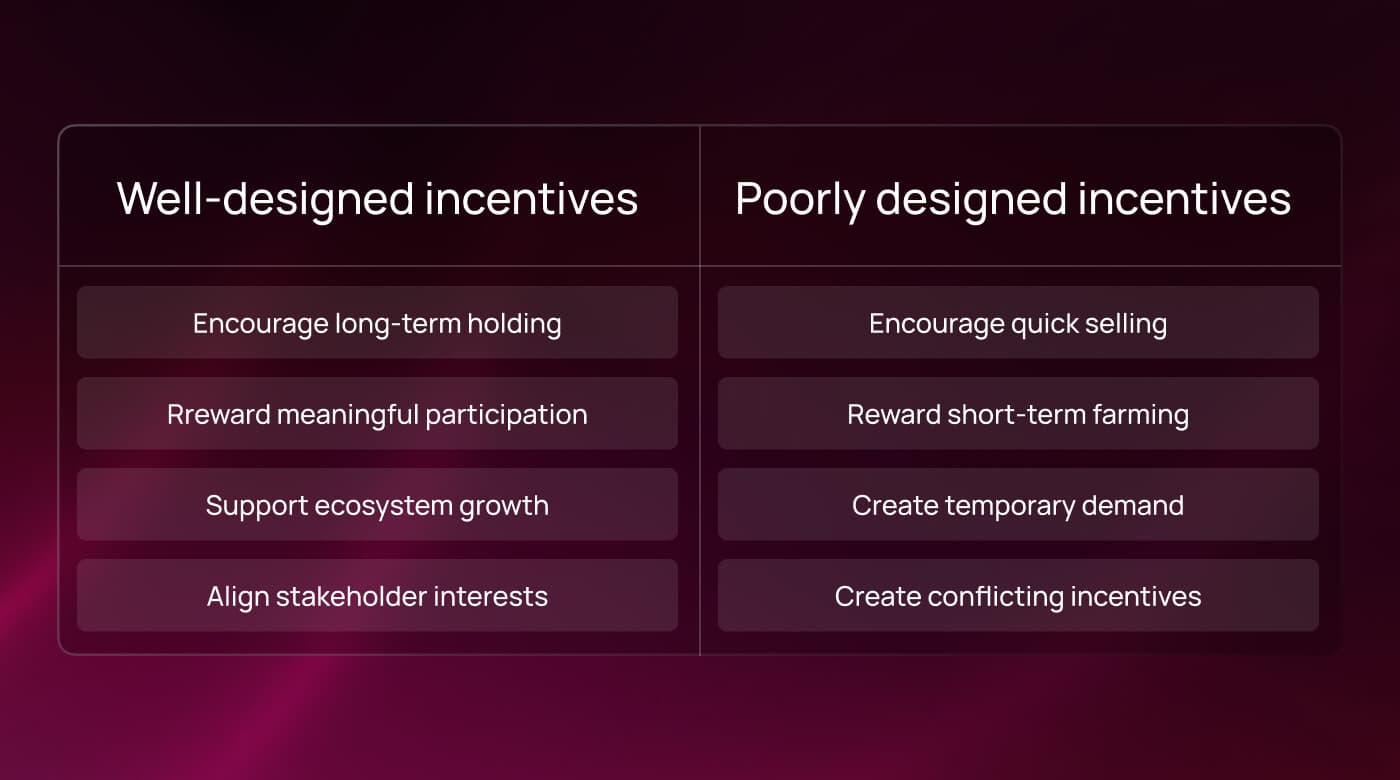
If your token economy is approaching a critical stage, a tokenomics audit can surface these issues while they're still cheap to fix.
When do vulnerabilities tend to surface?
A lot of vulnerabilities take a long time to start derailing a project. They may only come back to bite the project months or years later when supply grows, incentives shift, or user behavior changes. But by the time signs of instability start showing, many of the decisions causing those issues are already set in stone.
What supply mistakes do many projects make?
Too large a supply in excess of token demand inflates the price, while too little renders incentives difficult to offer. Though inflation is a necessary feature for users to be continuously incentivized, it must be smartly planned. A poor vesting and unlock structure can cause supply shocks. Governance decisions are huge, requiring truly adept experience. Releasing them willy-nilly poses the risk of inflation and, subsequently, a rapid sell-off.
How are stakeholder interests often misaligned?
Too much influence being exerted among a small group reduces interest among new investors and renders it vulnerable to quick profit-taking. Numerous stakeholder interests also inevitably act against each other, and these can’t be changed later on.
Are creating value and connecting a token to it enough?
Even if utility and profits are strong, a token must retain true utility, and that utility must be captured in the value of the token. Furthermore, incentives must not substitute for true value, so that people don’t sell the tokens en masse when rewards stop. It’s always possible for true value to be decreasing even while user activity is high.
What a tokenomics audit covers
A tokenomics audit examines the pillars of a token economy, how it is expected to function over time, and how its components interact. This ranges from supply management to stakeholder relations to incentives to governance to treasury.
How do tokenomics audits manage supply, distribution, and emission?
This defines how many tokens are going to exist and the way supply changes over time. This covers:
- Total token supply
- Circulating supply
- Inflation mechanisms
- Emission schedules
- Token creation rules
Along with that comes ownership and resource division among the ecosystem’s participants:
- Founders and team members
- Investors
- Community participants
- Ecosystem development
- Treasury reserves
- Strategic partners
Vesting and unlock schedule
The frequency and intervals at which tokens are released are pivotal. It will vary across different stages of growth, combined with varying incentives.
How do tokenomics audits inform incentive balance?
The token economy is set up to encourage specific behaviors, rewarding users and contributors and strategizing to keep the ecosystem growing. A token has to be necessary for a large number of users, not merely a means of pure speculation. Even if it does provide a substantial benefit, there can’t be an alternative that allows not holding the token at all, and users need to feel a need for the token specifically.
This sense of utility is bolstered through:
- Governance participation for holding a certain amount of the token
- Special access to products and services
- Payments or transactions
- Network participation
How is a tokenomics audit utilized in governance and treasury?
The way treasury is handled has a big-time impact on long-term development sustainability. This means funding strategies, treasury allocation, and resource management, which demand high-level expertise. Giving holders a role in governance and decision-making works well at making them want to hold onto the token. There are many different strategic ways to set this up, and it is quite a tricky endeavor.
All of these aspects cannot be assessed independently because changes in one area can affect the overall design. 8Blocks approaches tokenomics audits by evaluating the structure of a project’s token model and examining how its components interact over time. The focus is on whether the design supports the project’s economic goals and its long-term sustainability.
It provides a dashboard featuring charts, metrics, scores, and percentile ranks. Then follow the full audit checklist, existing risk factors, and actionable proposals.
How the tokenomics audit process works
The tokenomics audit process follows a structured sequence that evaluates how a token may perform under different conditions and what aspects of it could be shored up. A tokenomics audit is not based on a single calculation or metric. Rather, it analyzes how different assumptions within the token model may interact.
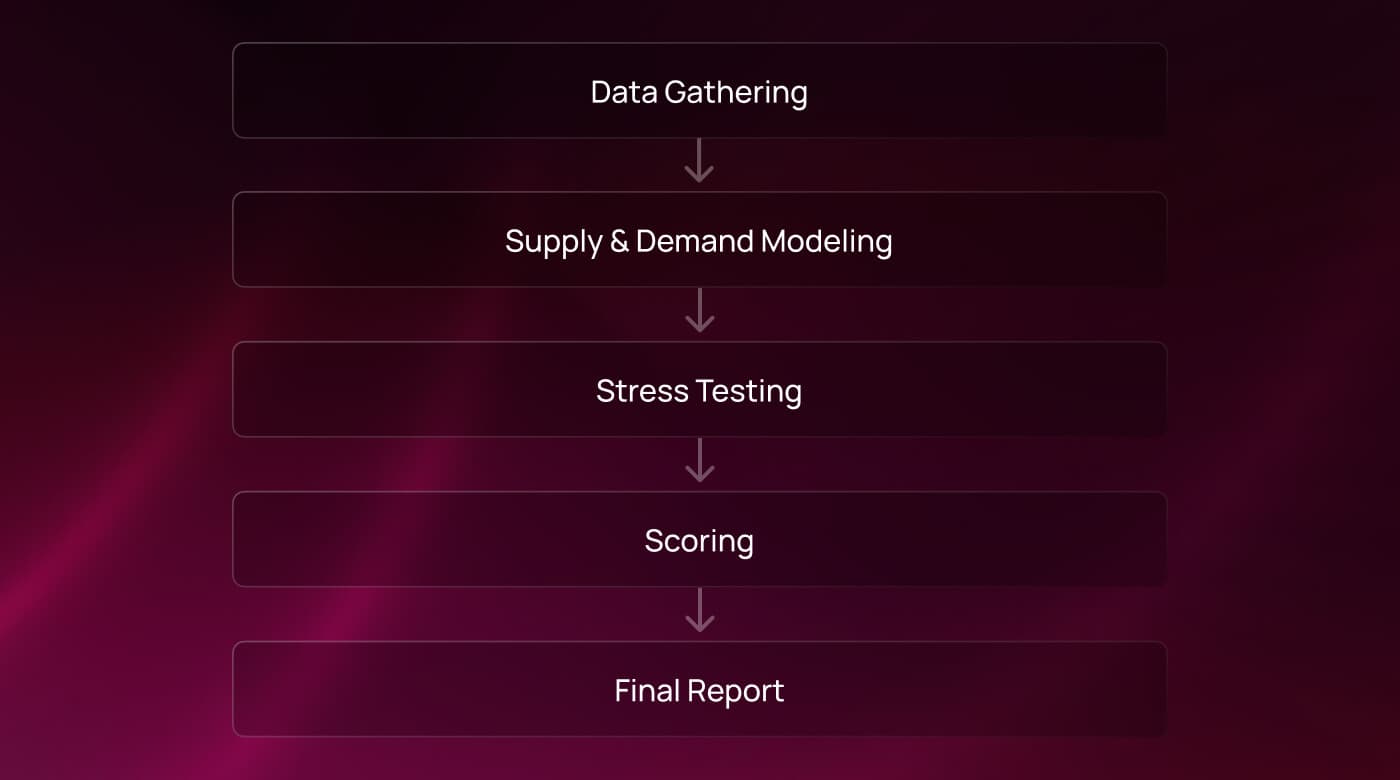
What are the steps in a tokenomics audit?
Step 1: Data gathering
First, the client submits materials describing how the token economy is intended to function. The purpose is to create an accurate starting point. This includes how emissions will take place and how participants will be incentivized.
Step 2: Supply and demand modeling
This entails a visualization of how matters will evolve in terms of tokens entering circulation and demand-influencing factors. This, importantly, involves who the primary buyers are expected to be and how to appeal to them and their needs.
Step 3: Stress testing
Projects start out with particular expectations, but sometimes the conditions take an unexpected turn. This is where those daunting scenarios get hypothetically played out, such as lower-than-expected user growth, high token circulation, dropping user activity for revenue, and different adoption timelines.
Step 4: Scoring
This provides a nice visual of what needs to be worked on and the order of priority. It answers questions like: “How balanced is the overall token structure? Where does the design show stronger or weaker alignment with project goals?”
Step 5: Finalizing the report
All the findings are unified in a clear overview featuring the key observations and recommendations.
For a complete breakdown of the components of a tokenomics audit, read the 8Blocks audit methodology.
Tokenomics audit vs smart contract audit
A tokenomics audit and smart contract audit focus on different parts of a Web3 project. The former evaluates the economic design of a token, including its supply structure, incentives, governance, treasury, and other related aspects. Smart contract audits, meanwhile, review security, the functionality of the code, and other such technical considerations.
They both address important but separate risk areas. For a deeper comparison, see our dedicated article on tokenomics audit vs smart contract audit.
When does a project need a tokenomics audit?
A tokenomics audit is most valuable before major decisions are made about a token economy, when changes can still be implemented without disrupting an active ecosystem. While some projects only seek an audit after issues have already surfaced, the strongest use cases are the stages before assets hit the open market, when the token's handling is about to change substantially, or when the project is seeking investment.
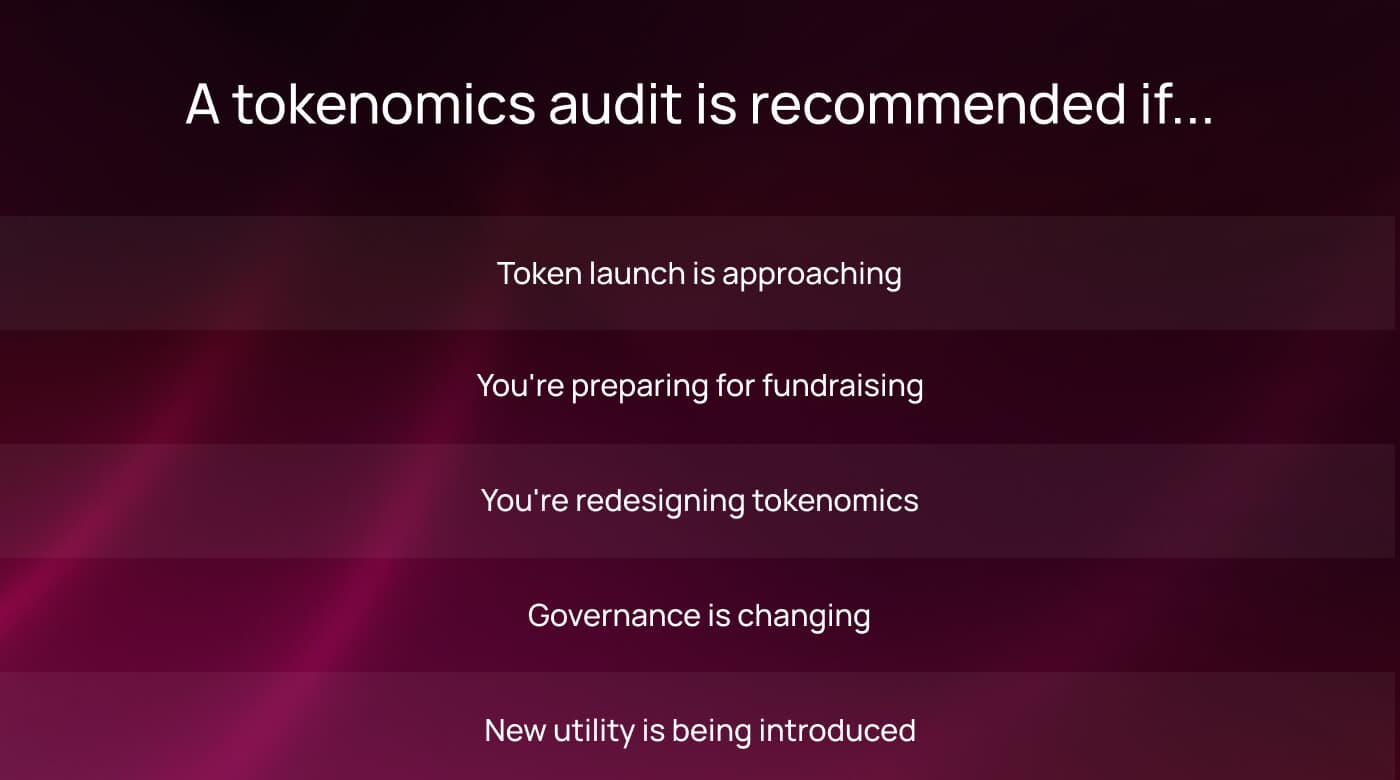
Before a token generation event (TGE)
At this time, the creators still have every opportunity to make whatever tweaks they want. The open market is unforgiving. Here, though, teams can review whether the planned supply model, distribution structure, incentives, and utility mechanisms are aligned first. An audit here will serve to confirm or contest whether the design is consistent and it’s prepared for future ecosystem growth.
Before raising capital
Investors tend to want to evaluate whether a particular token model is clearly structured and its economic design indeed supports the project’s long-term objectives. Reviewing those before a raise can help teams identify areas that require clarification and provide a stronger foundation for discussions with potential stakeholders.
On top of that, it inspires much more confidence in investors since they have a clearer understanding of how one expects the project to progress. As long as projects stick to their initial advertisements and white paper, they’ll retain stakeholders’ trust as well.
Before a token model redesign
Making a decision to overhaul the tokenomics is another time developers should have an audit done, since that is going to have a major ripple effect. It can affect numerous areas of the ecosystem. So that’ll help identify new pitfalls and properly protect the new ideas.
Some projects decide to take things as they come, but vulnerabilities only tend to surface further down the line as circumstances change and complexities grow. If one introduces new mechanisms on the go, that can introduce new economic relationships that weren’t part of the original design. That cannot be just done on the fly without a tokenomics audit.
Before launching or licensing a token in the UAE
The UAE has become one of the most active hubs for compliant Web3 businesses, and its regulators expect economic substance rather than technical promises alone. In Dubai, the Virtual Assets Regulatory Authority (VARA) oversees virtual asset issuance and services, while the Abu Dhabi Global Market (ADGM) and the DFSA in the DIFC operate their own frameworks. Across all of them, a token's supply, distribution, incentives, and governance are treated as material factors, not afterthoughts.
A tokenomics audit gives UAE-based founders documented evidence that their economic model is sustainable and internally consistent, which strengthens licensing applications, exchange listings, and conversations with regional investors and family offices. Reviewing the design before filing is far cheaper than reworking a live token to satisfy a regulator or a Dubai-based exchange after launch.
If your project is approaching a major milestone or reviewing its token design, request a tokenomics audit – or, for a full redesign, talk to a tokenomics consultant.
What audited projects walk away with
A tokenomics audit should provide more than a mere list of observations. The final deliverable typically consists of an audit report, scoring, and useful recommendations to bolster financial health and help stay true to its goals.
What does the audit report focus on?
This explains the system used for the audit, the findings for each area of the token model, and the reasoning behind every conclusion. Instead of just highlighting strengths and weaknesses in isolation, it ties everything together. This can be shown to investors and stakeholders and as a basis for adopted decisions.
How does the scoring system work?
Structured tokenomics scoring provides visible metrics highlighting what’s been done well, what needs tending to, and what areas are critically vulnerable, rather than just relying on subjective opinions. This allows project developers to prioritize improvements that’ll have the greatest impact on long-term sustainability.
What kind of recommendations are provided?
These are practical recommendations for areas to focus on, starting with the most pressing among them. That may be the emission schedules, allocation structures, vesting timelines, or a long list of other facets. Each is supported by analysis and reasoning.
Key takeaways
- A tokenomics audit evaluates whether a project’s token economy is sound, sustainable, and aligned with long-term objectives.
- Tokenomics audits deal with the economic side, while smart contract audits focus more on the technical aspect, like coding and security.
- The best time to conduct tokenomics audits is before a TGE, fundraising, or redesigning tokenomics, while changes are still easy to implement.
- A thorough tokenomics audit reviews the entire economic model from token supply to governance.
- A well-executed tokenomics audit evaluates critical phenomena across major model components, scores them, and provides actionable recommendations.
FAQ
How long does a tokenomics audit take?
This all depends on the complexity of the project and documentation. Projects with multiple token utilities, governance mechanisms, or intricate incentive systems generally require a much more extensive analysis. However, it typically ranges between one and two weeks.
Is a tokenomics audit the same as a smart contract audit?
No. A tokenomics audit evaluates the economic design of a token, such as its supply, allocation, incentives, governance, and long-term sustainability. A smart contract audit, by contrast, looks more into the security and code functionality aspects.
When should I get a tokenomics audit?
The best time is before a token generation event, raising capital, or introducing a major change into the existing tokenomics model. There is always an extensive list of potential scenarios. Weaknesses must be addressed while the developers still have the chance.
Does a tokenomics audit guarantee that my token will succeed?
No. A tokenomics audit cannot predict performance or guarantee adoption. Its purpose is to evaluate whether the economic model is logically structured, internally consistent, and aligned with the project’s long-term objectives.
About 8Blocks
8Blocks is a Dubai-based token economy design firm working with Web3-native teams and Web2 businesses entering Web3, including projects launching across the UAE and the wider MENA region. Since 2017, the company has designed tokenized economic systems where the token functions as part of the business model rather than a standalone asset. 8Blocks delivers tokenomics design, strategic consulting, tokenomics audits, and launch strategy, connecting business modeling, token mechanics, and investor materials into one coherent model.
Disclaimer
This content is provided for informational and educational purposes only. It does not constitute investment, financial, legal, or tax advice, and is not a recommendation to buy, sell, or hold any token or digital asset. Token design does not guarantee any financial return, token price performance, or regulatory outcome. Crypto assets carry a high risk of loss. In the UAE, the legal classification and permitted marketing of a token depend on its specific structure and the applicable framework, such as VARA in Dubai, the ADGM, or the DFSA in the DIFC. Readers should conduct independent research and consult qualified legal and financial advisors licensed in the relevant jurisdiction.

The 5 Most Common Tokenomics Mistakes and How to Avoid Them
Very few people understand tokenomics. Even in specialized crypto forums, most of the real discussions happen between funds, market makers, and teams that have already launched a token and learned the hard way. This article is for those who are about to launch and want to avoid the usual mistakes.
Why Tokens Drop After TGE Even When Everything Goes to Plan
In this article, we'll break down why a token can start dropping right after TGE, where that price pressure comes from, and how the way you structure rounds before listing can change the outcome entirely.
When the Product Grows but the Token Doesn't
The crypto market has changed fast over the past few years. Products are more complex, regulation is tighter, and users expect more. But one part of the industry is still stuck in the last cycle. It's tokenomics.