EarnPark: How Weekly Vesting Relieved $1.5M of Sell Pressure
Switching token unlocks from monthly to weekly cut EarnPark's peak sell pressure by more than fourfold — with the same allocations, same investors, and same total volume. The only change was unlock rhythm. This 8Blocks audit shows why unlock frequency, not just allocation percentages, decides how a token behaves after launch.

EarnPark: a UK Web3 company preparing for its TGE
EarnPark is a UK-registered digital asset management platform, operating since 2022, where users deposit crypto and earn yield through the platform's investment strategies. Ahead of its Token Generation Event (TGE), the team wanted independent validation of its token's economic model — specifically whether it would hold up under real market conditions without creating excess price pressure.
That instinct is the right one. The point of a pre-TGE audit is to test economics on paper before the market tests them with real money, when mistakes become public and expensive.
The question that mattered: monthly or weekly unlocks?
EarnPark's central question was narrow: what changes if tokens unlock once a week instead of once a month, under the same periods, volumes, and investor conditions? The change looked trivial — total unlock volume and investor terms stayed identical. The analysis showed the difference was critical for the market.
Why is monthly vesting dangerous for a young token?
Monthly vesting releases a large batch at once, which is simple for investors but creates a systemic problem after launch. If holders decide to take profit, a large slug of supply can hit the market on a single day and weigh on the price. Three factors make this dangerous for a young token:
- Low liquidity: the market cannot yet absorb large volumes without a price contraction.
- Unstable trading volumes: the order book is easy to push down.
- Market-maker strain: sudden supply jumps are hard to smooth out.
This matches the wider evidence on vesting design: guidance on vesting schedules consistently shows that cliff-like, infrequent unlocks concentrate sell pressure into single events, while more frequent linear releases distribute it and tend to support price stability.
Two scenarios, one conclusion
8Blocks audited EarnPark's tokenomics and modelled two scenarios. In the second, investor conditions did not change — same number of tokens, same wait, no lost benefit. The only variable was the rhythm at which tokens reached the market, and that was what relieved the pressure.
We first analysed the original tokenomics, then re-ran the audit on an updated model with weekly unlocks. The client ended with two comparable audits — a clear "before and after":
- Monthly vesting: peak potential sell pressure reached up to $1.5 million during certain periods.
- Weekly vesting: the pressure relaxed and spread smoothly over time.
Instead of one major event, the market received many small ones — the kind that liquidity, the market maker, and buyback mechanisms can digest without disruption. (Figures from the 8Blocks audit of EarnPark's tokenomics.)
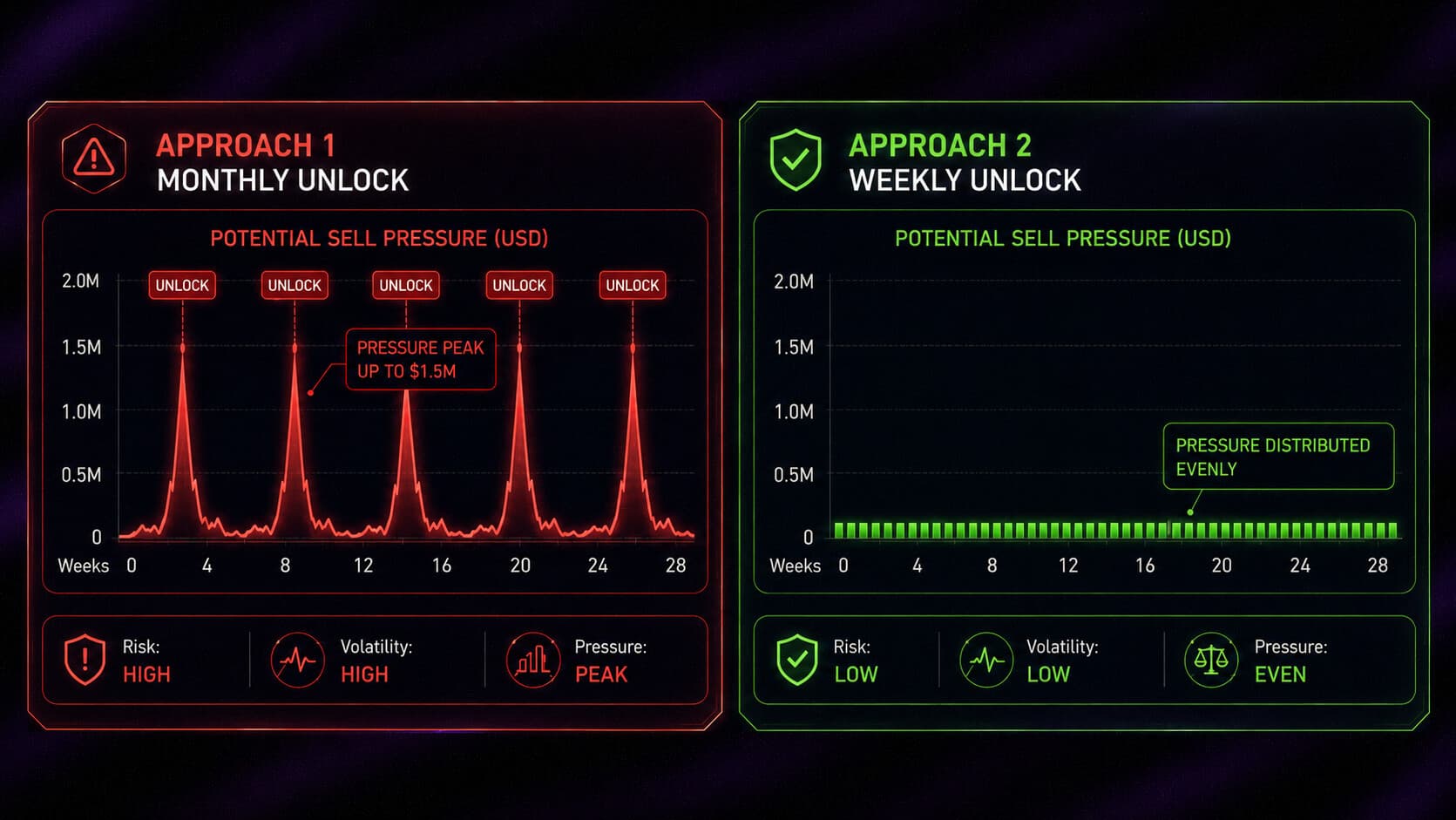
Same supply, different rhythm: monthly unlocks spike; weekly unlocks flatten the load.
A worked example: same volume, very different pressure
Model the same unlock volume two ways. Assume $6 million total unlocking over 12 months, identical allocations, time periods, and investor conditions — only the frequency changes.
Monthly: tokens hit the market once every 30 days, so each unlock is $6,000,000 ÷ 12 = $500,000. If investors sell 40% right after the unlock (a conservative pressure assumption), the one-time sell volume is 500,000 × 0.4 = $200,000. For a token with a $112,000 daily trading volume, that is a critical load — roughly 1.8x daily volume in a single day.
Weekly: the same $6 million spread across 52 weeks produces about $115,000 per week. Under the same 40% assumption, weekly pressure is 115,000 × 0.4 ≈ $46,000 — about 0.4x daily volume. Instead of $200,000 at once, roughly $46,000 reaches the market: a peak-load reduction of more than fourfold, again with no change to investor terms.
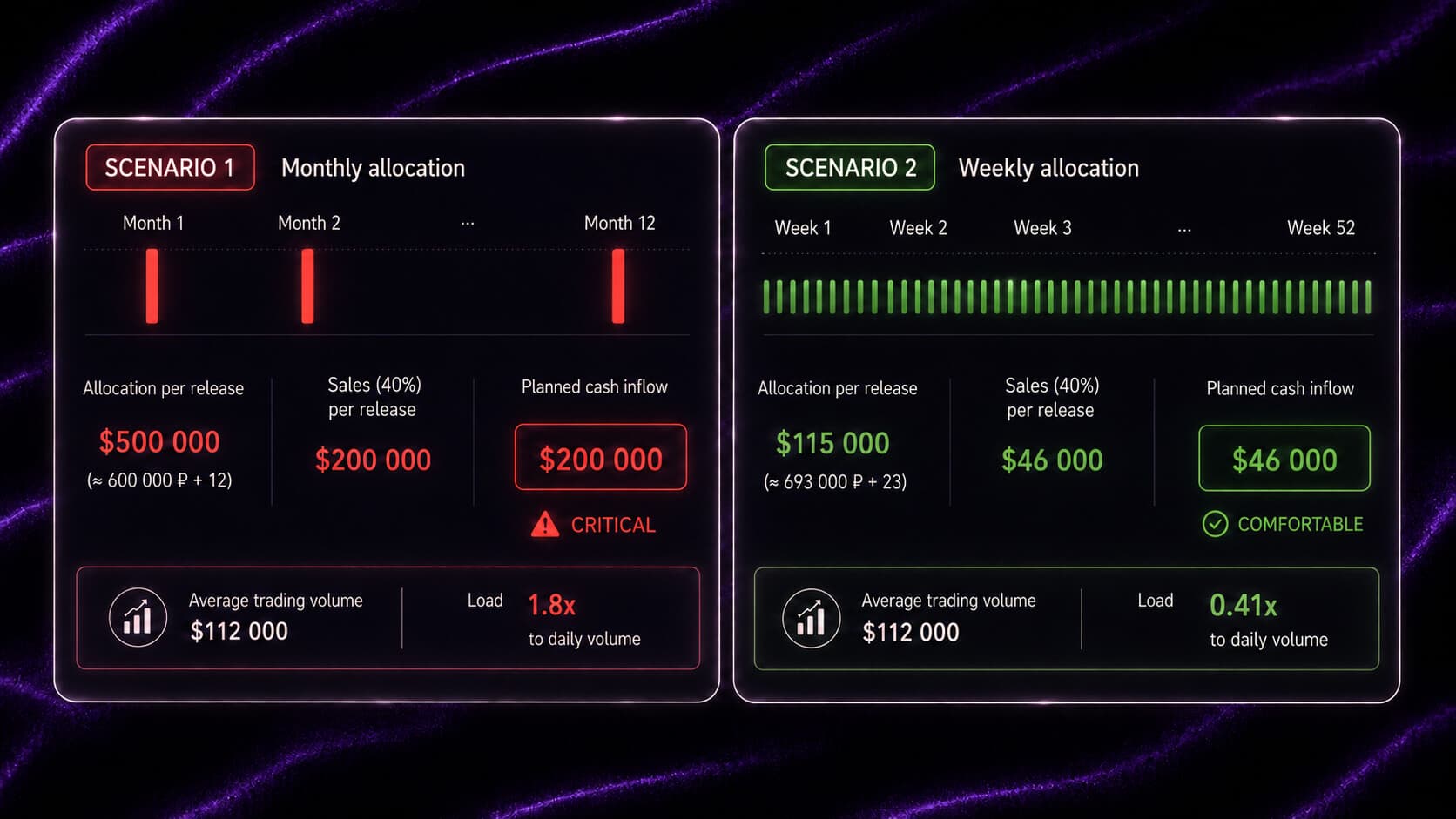
The monthly load runs at ~1.8x daily volume; the weekly load sits well below it.
Allocation percentages or unlock frequency — which matters more?
Teams habitually check allocation percentages and overlook the flow of tokens over time. The same volume behaves fundamentally differently depending on unlock frequency. Monthly unlocks create predictable pressure points — every unlock day provokes panic and throws off the market maker. Weekly unlocks spread the load until unlocking becomes routine and investors stop tracking the dates.
In practice this gives a project three things: the price avoids abrupt contractions, the community stops living unlock-to-unlock in fear, and the market maker handles supply without holding massive reserves.
The smooth effect: less uncertainty before launch
This matters most for projects that want the token to last, not just to pump around the TGE. Excess volatility in the first months damages both price and trust — how early investors perceive the token, how calmly new holders enter, and how fast a market reputation forms.
EarnPark tested how its economics would behave under real pressure before launching, avoiding lessons that are otherwise learned the hard way after listing. The team also gained stronger material for negotiating with market makers, funds, and listing platforms — not an abstract claim of "good tokenomics," but a model, a confirmed audit, and a comparative analysis.
Why this is especially relevant for UAE-based launches
For teams launching from Dubai under the Virtual Assets Regulatory Authority (VARA), disclosed and well-structured vesting is not optional polish — it is part of compliance. The VARA Issuance Rulebook sets disclosure and distribution standards for tokens issued in or from Dubai, and a vesting schedule that demonstrably limits sell-pressure spikes reads as credible to both regulators and the institutional capital active across the MENA region. A pre-TGE audit produces exactly the documentation that process requires.
Key takeaways
- Unlock frequency, not just allocation percentages, decides how a token behaves after launch.
- Switching EarnPark from monthly to weekly unlocks cut peak sell pressure by more than 4x — same investor terms (8Blocks audit).
- In the worked $6M model, monthly pressure ran ~1.8x daily volume; weekly pressure dropped to ~0.4x.
- Frequent linear unlocks distribute sell pressure; infrequent batch unlocks concentrate it (Tokenomics.com).
- For UAE launches under VARA, disclosed, spike-limiting vesting supports both compliance and investor trust.
FAQs
Why is monthly vesting risky for a new token?
Monthly vesting releases a large batch at once. For a young token with low liquidity and unstable volumes, that creates a predictable pressure point: holders can sell a big slug of supply on a single day, the market maker struggles to absorb it, and the price contracts even when the tokenomics is sound.
How does weekly vesting reduce sell pressure?
Weekly vesting releases the same total supply in smaller, more frequent portions. Instead of one large event, the market gets many small ones that liquidity, the market maker, and buyback mechanisms can absorb. In EarnPark's audit, this cut peak potential sell pressure by more than 4x without changing investor terms.
Does changing unlock frequency hurt investors?
No. In the EarnPark model, investors received the same number of tokens over the same total period under the same conditions. Only the unlock rhythm changed — from monthly to weekly — relieving market pressure without any loss of benefit.
What matters more in vesting — allocation percentages or unlock frequency?
Both matter, but teams routinely check allocation percentages and overlook unlock frequency. The same total volume behaves very differently depending on how often it is released. More frequent intervals smooth supply flow and reduce the panic that clusters around large unlock dates.
Sources
- EarnPark — official platform (UK-registered digital asset management, operating since 2022): earnpark.com
- Tokenomics.com — "Token Vesting: Complete Guide to Vesting Schedules, Cliffs, and Unlock Mechanisms" (cliff vs linear sell pressure): tokenomics.com
- VARA — Virtual Assets Regulatory Authority Rulebook (Issuance Rulebook, disclosure standards): rulebooks.vara.ae
- Sell-pressure figures ($1.5M peak; $6M / $500K / $200K / $115K / $46K worked example; $112K daily volume) are from the 8Blocks audit of EarnPark's tokenomics — an illustrative model, not market-traded data.
About 8Blocks
8Blocks is a strategic tokenomics consulting firm for Web3 teams. Founded in 2017 and headquartered in Dubai (8BLOCKS FZCO, DMCC), the company has delivered 30+ tokenomics models across DeFi, GameFi, and RWA projects. 8Blocks offers tokenomics design, tokenomics audits, and Token Lab — a free structural scoring tool available on Base App and Telegram.
The content of this article is provided for informational and educational purposes only. It does not constitute investment, financial, tax, or legal advice. Digital assets are volatile and carry a risk of total loss. Readers should conduct independent research and consult qualified advisors before making any financial decisions.

How we helped a fintech platform go decentralized and launch in five countries at once
Together with a Swiss fintech, we built a decentralized platform where investors and businesses from anywhere in the world connect directly.

When the Product Grows but the Token Doesn't
The crypto market has changed fast over the past few years. Products are more complex, regulation is tighter, and users expect more. But one part of the industry is still stuck in the last cycle. It's tokenomics.

The 5 Most Common Tokenomics Mistakes and How to Avoid Them
Very few people understand tokenomics. Even in specialized crypto forums, most of the real discussions happen between funds, market makers, and teams that have already launched a token and learned the hard way. This article is for those who are about to launch and want to avoid the usual mistakes.