The Downfall of the Personal Token: Why They Keep Failing Investors in 2026
Personal tokens fail because they have no utility. Launched by celebrities to monetise attention, they rise on coordinated hype and insider-controlled supply, then collapse once early holders exit and speculation fades. After the October–November 2025 crypto crash, investors — including UAE-based funds operating under VARA — now demand real products and demand, not famous names.
Why personal tokens enrich creators and bury investors
A personal token is a cryptocurrency tied to one individual's brand rather than to a product. In 2025, celebrities issued them alongside large marketing pushes, captured most of the supply, and sold into retail demand. The structure rewards the creator at launch and leaves later buyers holding an asset with no mechanism to sustain its price.
The pattern is consistent across the category. Data compiled by CryptoSlate across 30 celebrity tokens, one month after launch, put the average drawdown at roughly 94% from the all-time high; even the best four performers were still down more than 70%, and about half had fallen over 99%. These are not isolated failures — they are the default outcome of a design with no demand engine.
What are the most common personal-token red flags?
The clearest warning signs are insider-concentrated supply, launch timing built around a media moment, and "utility" that exists only in marketing copy. Each one separates attention extraction from genuine value creation.
- Timing. The $TRUMP token launched on January 17, 2025, days before the presidential inauguration, and peaked at an all-time high of $75.35; CoinGecko price data later shows it collapsing toward record lows near $1.83 — value extraction tied to a news cycle, not to a working product.
- Insider control. On-chain analytics from Bubblemaps, reported by The Block, found Kanye West's YZY token had roughly 94% of supply controlled by insiders, with about 87% sitting in a single multi-signature wallet before distribution — a setup that lets a handful of wallets dictate the market.
- Hollow utility. YZY promised "Ye Pay" payment processing and a crypto spending card, and hit a $3 billion market cap within 40 minutes before crashing the same day. As Cointelegraph documented, 51,862 of 70,201 wallets (73.8%) lost a combined $74.8 million. The promised products never materialised.
- Undelivered products. Logan Paul's CryptoZoo (2021) sold NFT "eggs" meant to hatch into reward-generating creatures. It raised millions and never shipped a functioning game; Paul later admitted it "will not be released" and, as TechCrunch reported, committed $2.3 million to refunds.
Other examples followed the same arc — launch, spike, insider exit, collapse. NewsBTC tracked MELANIA falling about 99% from its high and MOTHER (Iggy Azalea) dropping roughly 96%, alongside BODEN (Joe Biden) and WAP (Cardi B).
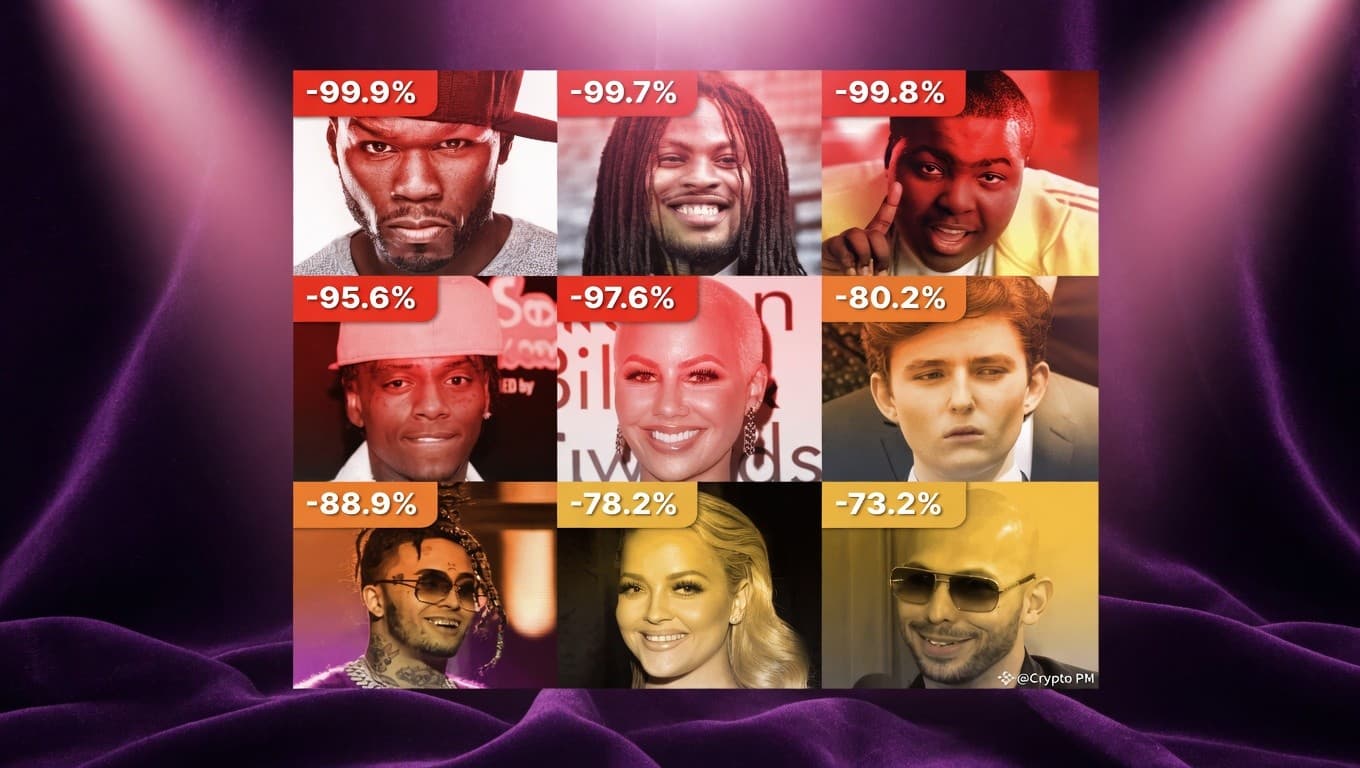
Nine celebrity tokens, measured from their all-time highs: losses run from -73.2% to -99.9%.
How the personal-token money grab works
Personal tokens follow a five-stage lifecycle that transfers value from retail buyers to insiders. The sequence is predictable enough to function as a checklist for what to avoid.
- Launch. Coordinated announcements and influencer leaks promise long-term utility.
- Insider accumulation. Connected wallets hold large allocations bought at or near zero cost.
- Retail entry. Public buyers chase the early price rise, reading momentum as proof.
- Early-holder exit. Insiders sell into that demand, creating sudden sell pressure.
- Collapse. With no product usage or burn to absorb supply, the price falls and does not recover.
Why are personal tokens destined to crash?
A token cannot hold value sustainably if it is not needed for anything. Once speculation fades, there is no underlying mechanism — no fees, no staking demand, no burn tied to usage — to replace the lost attention. That structural gap, not market timing, is why personal tokens crash.
Compare them with utility-driven tokens such as BNB, ONE, SC, HTR, and LSK, where the asset is required to pay transaction fees, secure the network, or buy storage. Demand there is mechanical: it comes from using the network, not from believing in a personality.
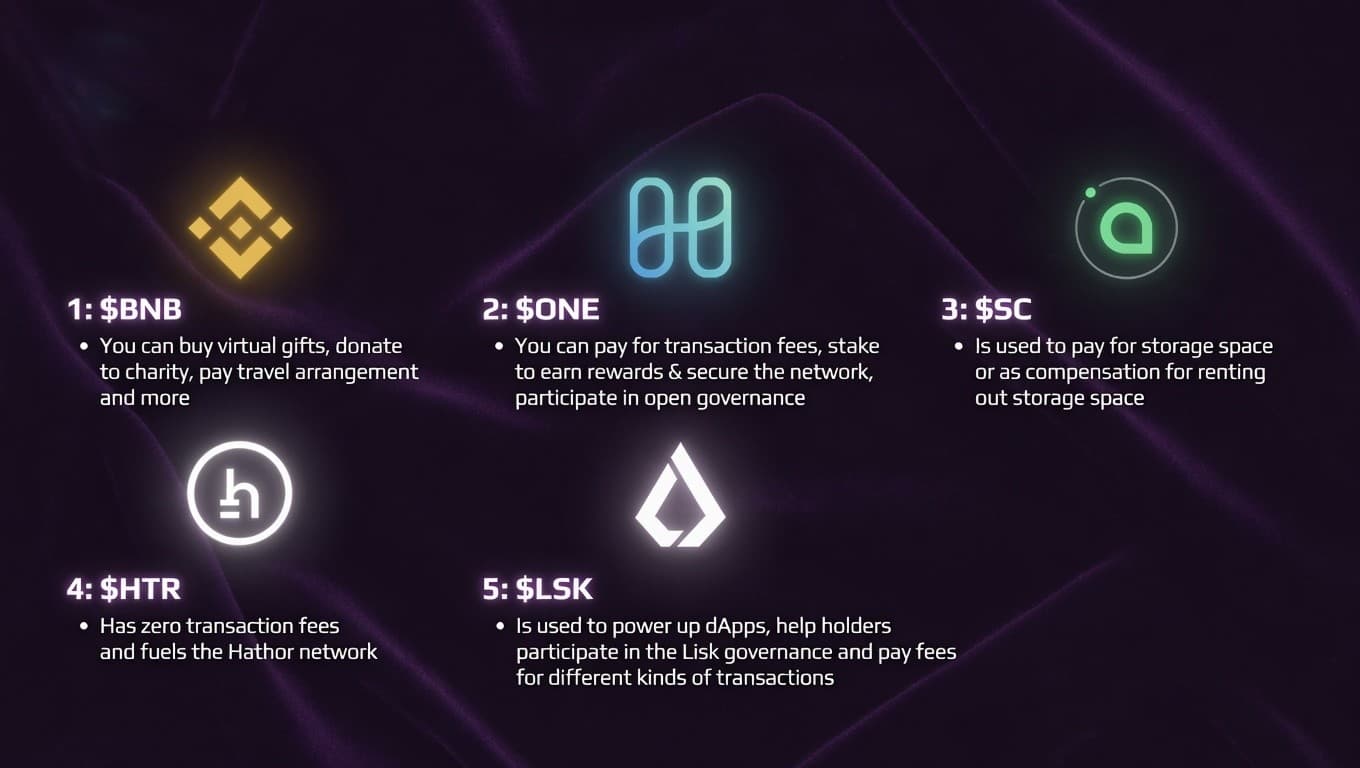
Utility tokens tie demand to a network function; personal tokens tie it to attention.
The 2025 turning point: how the market matured
The 2025 crypto crash drained the speculative liquidity that personal tokens depend on. Bitcoin peaked near $126,000 in early October 2025, as CoinDesk recorded, before the October 10 liquidation event wiped out about $19 billion in a single day and began a slide that carried Bitcoin into the low $80,000s by November. Assets with no real demand had nothing to fall back on. The downturn did not create the weakness — it exposed it.
Despite an estimated 15 million token launches across the cycle, the surviving question became consistent: what is this token actually for? Investors reset their priorities toward four things — real products with demonstrated usage, justified revenue models, experienced teams with execution histories, and consistent underlying demand.
How does the UAE's regulated market treat personal tokens?
In Dubai, where the Virtual Assets Regulatory Authority (VARA) governs token issuance and marketing, projects with insider-controlled supply and no demonstrable utility face direct compliance hurdles. The VARA Rulebook applies its Marketing Regulations to any business targeting UAE investors — licensed or not — with penalties up to AED 10 million, while its Issuance Rulebook sets disclosure and distribution standards for tokens issued in or from Dubai.
For founders building from the region, that environment is an advantage rather than a constraint. A token designed around genuine usage — the standard 8Blocks applies to every tokenomics model — clears regulatory review more easily and reads as credible to the MENA institutional capital now active in Web3.
Key takeaways
- Personal tokens fail by design: with no utility, nothing replaces demand once hype fades.
- Across 30 tracked celebrity tokens, the average drawdown was ~94% one month after launch; even the top four were down more than 70% (CryptoSlate, 2024).
- Insider-controlled supply — such as YZY's ~94% insider stake, 87% in one wallet — lets a few wallets dictate the market (The Block / Bubblemaps, 2025).
- The 2025 crash — BTC's ~$126,000 October peak into the low $80,000s by November — exposed tokens with no underlying demand (CoinDesk, 2025).
- Regulated markets like the UAE (VARA) reward tokens with real utility, disclosure, and credible teams.
FAQs
What is a personal token?
A personal token is a cryptocurrency launched by an individual — usually a celebrity or influencer — to monetise their brand or audience. It is marketed as exclusive access or future value, but typically has no product or on-chain function behind it.
Why did most personal tokens fail?
They had no utility. Demand came entirely from temporary attention, supply was concentrated among insiders, and once early holders sold there was no product usage or burn mechanism to support the price.
Are personal tokens scams?
Not all are outright scams, but many show exploitative patterns: insider-controlled supply, coordinated hype, and early-holder exits at retail expense. Long-term stability is rare.
How did the 2025 crypto crash affect personal tokens?
Bitcoin peaked near $126,000 in early October 2025, then the October 10 liquidation event (about $19 billion wiped out in a day) began a slide into the low $80,000s by November. That drained speculative liquidity, and tokens with no underlying demand had nothing to fall back on — so the downturn exposed and accelerated their collapse.
How do regulated markets like the UAE view personal tokens?
In Dubai, where VARA oversees token activity, projects with concentrated insider supply and no demonstrable utility face heavier scrutiny. VARA's Marketing Regulations apply to anyone targeting UAE investors, with fines up to AED 10 million, and its Issuance Rulebook sets disclosure standards before a token can be marketed or listed.
Sources
- CryptoSlate — "Celebrity tokens down 94% on average month after launch" (2024): cryptoslate.com
- CoinGecko — Official Trump (TRUMP) price and all-time high data: coingecko.com
- The Block — "Kanye West YZY: 11 wallets netted millions" (Bubblemaps/Nansen data, 2025): theblock.co
- TechCrunch — "Logan Paul promises CryptoZoo refunds" (2024): techcrunch.com
- NewsBTC — "Political meme coins implode: TRUMP down 92%, MELANIA nearly wiped out" (2025): newsbtc.com
- CoinGecko Learn — "October 10 crypto crash explained" (~$19B liquidations, 2025): coingecko.com
- CoinDesk — "Bitcoin's October peak was over $126K" (2025): coindesk.com
- VARA — Virtual Assets Regulatory Authority Rulebook (Marketing Regulations, Issuance Rulebook): rulebooks.vara.ae
About 8Blocks
8Blocks is a strategic tokenomics consulting firm for Web3 teams. Founded in 2017 and headquartered in Dubai (8BLOCKS FZCO, DMCC), the company has delivered 30+ tokenomics models across DeFi, GameFi, and RWA projects. 8Blocks offers tokenomics design, tokenomics audits, and Token Lab — a free structural scoring tool available on Base App and Telegram.
The content of this article is provided for informational and educational purposes only. It does not constitute investment, financial, tax, or legal advice. Digital assets are volatile and carry a risk of total loss. Readers should conduct independent research and consult qualified advisors before making any financial decisions.
The 5 Most Common Tokenomics Mistakes and How to Avoid Them
Very few people understand tokenomics. Even in specialized crypto forums, most of the real discussions happen between funds, market makers, and teams that have already launched a token and learned the hard way. This article is for those who are about to launch and want to avoid the usual mistakes.
What Drives DASH Coin Demand? A Look at Real Utility
Dash is a rare success story as it combines sustainable coin demand with real utility. It demonstrates how hype and incentives fall short. Dash has achieved this via collateral requirements, decentralized infrastructure, data services, and treasury independence.
Tokenomics Audit vs Smart Contract Audit
Two commonly confused types of audits required for crypto token projects are tokenomics audits and smart contract audits. They fulfill completely different purposes but are both completely necessary. Tokenomics audits are economically oriented, smart contracts — technically.