Tokenomics Audit vs Smart Contract Audit
Two commonly confused types of audits required for crypto token projects are tokenomics audits and smart contract audits. They fulfill completely different purposes but are both completely necessary. Tokenomics audits are economically oriented, smart contracts — technically.
Tokenomics audits and smart contract audits serve different but complementary purposes. Tokenomics audits evaluate economic model sustainability while smart contract audits assess code security and real functionality. Both are necessary for a Web3 project launching its own token. It's best to first perform tokenomics auditing, then the smart contracts.
Launching any kind of project requires substantial capital and is an incredibly complex undertaking. They're also important for getting investments and partners. You're going to be much better off if you're able to say you've been audited and you've covered your bases. If you decide to forgo either, bad consequences are bound to happen, and the sooner you become aware, the better. Two of the crucial audits you'll want to order if you're launching any kind of a token project are smart contract audits and tokenomics audits.
In a smart contract audit, what is being verified is how token-related operations technically execute. A smart contract is an automated digital agreement stored in a blockchain that triggers when specific predetermined conditions are met. They only do exactly as they are coded. This is crucial when it comes to them technically executing the functions the way they're supposed to, preventing openings for hackers, and properly authenticating parties to these agreements.
A tokenomics audit, meanwhile, handles the business and economic side of a token economy. This entails a thorough, multi-faceted business plan putting the founders in the best position possible to ensure that the economic purpose of the token will be met while avoiding the many pitfalls that may occur. First and foremost, this means adeptly balancing the interests of all the stakeholders, bolstering demand, creating true value for the token, and ensuring that that value finds its way to the token holders.
What a tokenomics audit covers
This entails an assessment of the health of a project's token economy in a variety of different areas. This covers whether the project is logically designed and structured in a way that the project fulfills its exact objectives.
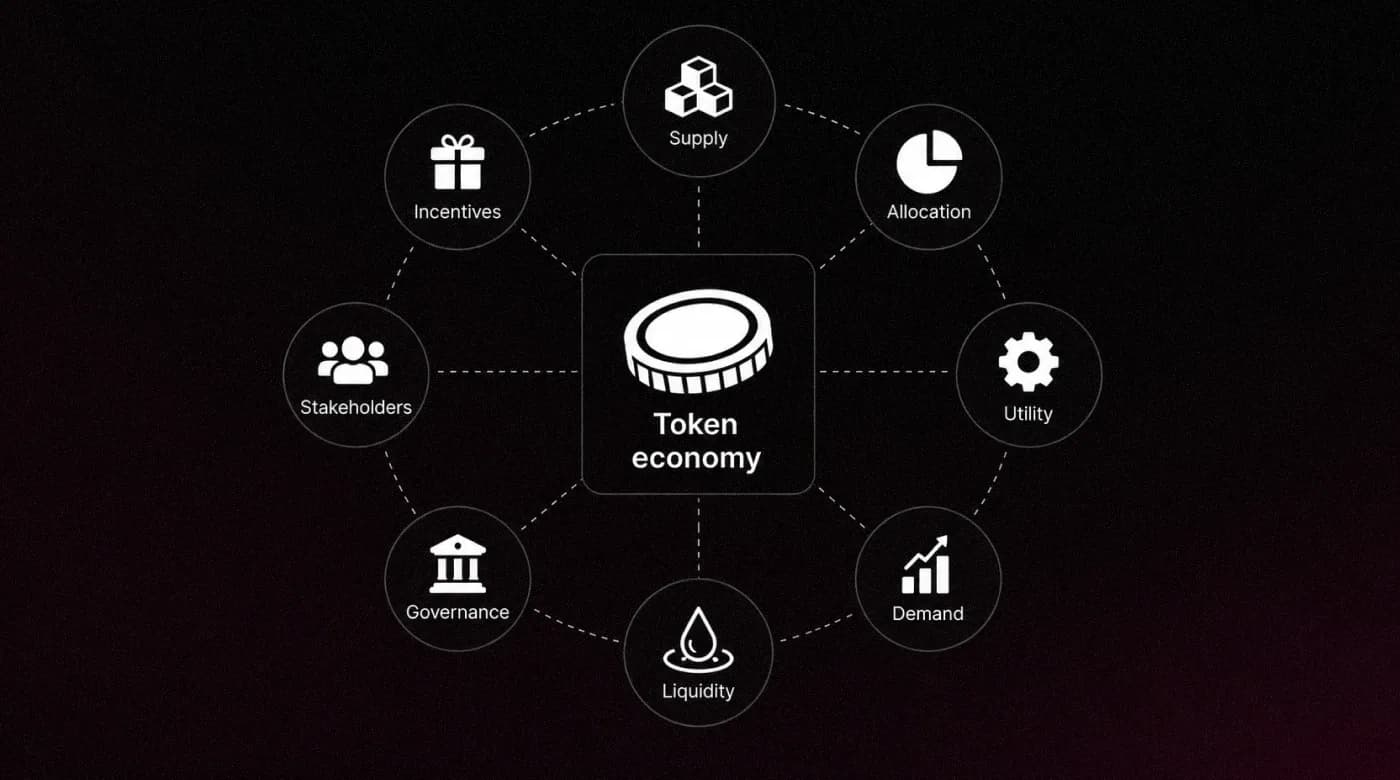
What are the main components of a tokenomics audit?
The main components it deals with include:
- Supply
- Allocation
- Utility
- Governance
- Stakeholder management
- Liquidity
- Demand
This includes releasing the supply into the ecosystem in a calculated way that avoids early privileged participants from offloading the tokens suddenly, creating a cascade of selling pressure. There has to be a balance in the overall proportions of circulating supply held in the treasury, within the community, as incentives given out to participants like miners, and either locked up or burned to avoid dips in the token price.
There are many more areas to be reviewed beyond these. For a complete list, take a look at the full audit checklist.
What's the goal of a tokenomics audit?
The open market is merciless, and there are many negative events that could occur that could completely sink the token economy. A project could also generate revenue and deliver lots of utility to many users, and that could fail to boost the market value of the token in any way. Thus, the most essential task of a tokenomics audit is to ensure the numerous elements in the token economy work together, and stability is maintained in the long-term.
The scope in reality is much broader than this. Our tokenomics audit piece goes into greater depth.
What a smart contract audit covers
This is one of the most essential steps in creating a trustworthy Web3 application. Creating one costs 10-25 thousand dollars on the smaller end and in the low hundreds of thousands for complex protocols. In this case, we are looking at the technical and software aspects of smart contracts' immutable code. They perform a detailed review of the project's smart contracts to check for flaws that could cause problems to be exploited.
What is the purpose of a smart contract audit?
Here, we have to make sure the code is indeed doing what we're telling it to do. There will inevitably be logical errors and vulnerabilities to clear out. Vulnerabilities exist because there are always hackers out there looking to pilfer the vast sea of cash being exchanged on blockchain.
What types of smart contract audits exist?
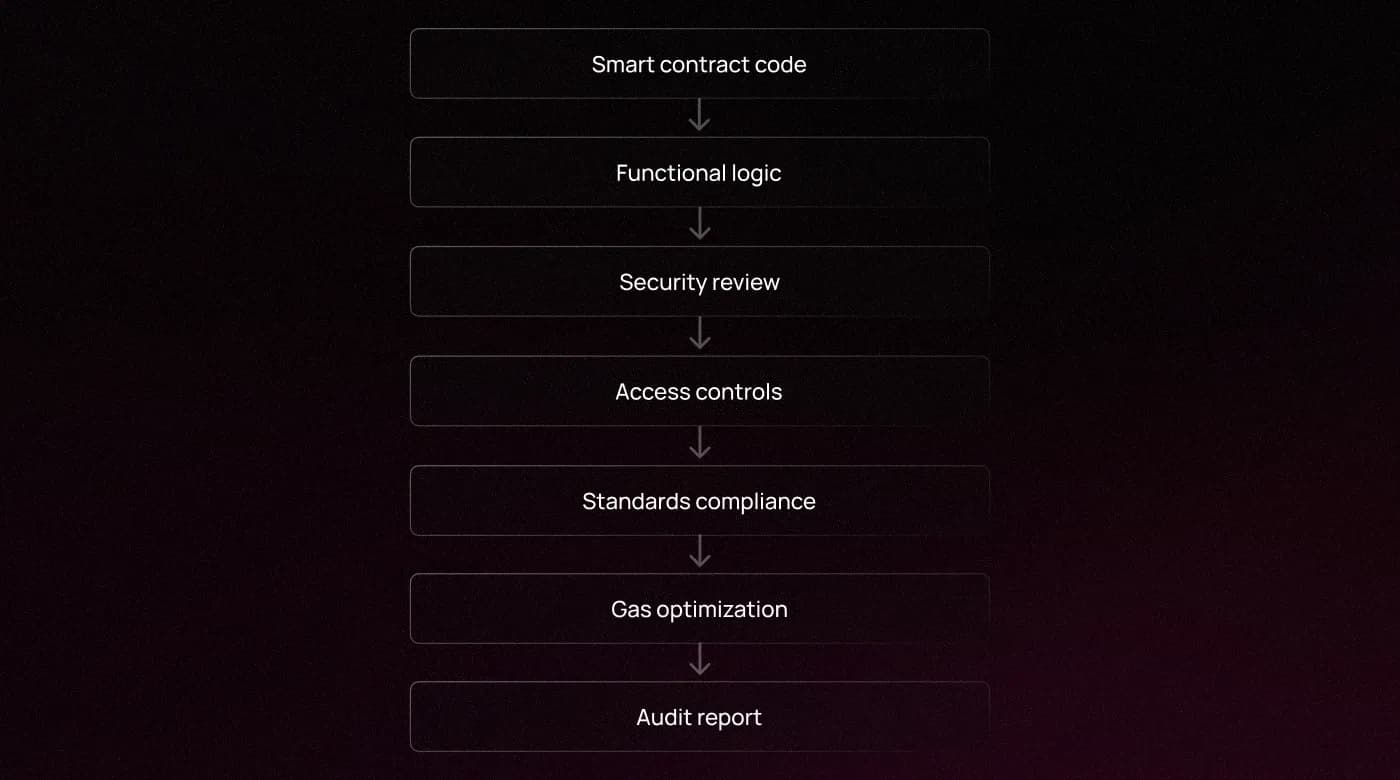
These are often conducted not as an overall assessment but to check for certain facets of the smart contract code:
- Functional: this is checking that the code fulfills in reality all the functions it's intended to. The auditor checks that the coding is compatible with the platform and bolsters the practices used in it. They also try to boost the operation speed, efficiency, and scalability.
- Code: the goal here is to look for errors, flaws, and bugs. These audits are often done using artificial intelligence.
- Security: checking for potential flaws that hackers could exploit. This has to do with databases, access, operation permissions, and encryption.
- Compliance: the smart contracts are looked at from the perspective of the law and meeting regulatory requirements. Big concerns here are observing the GDPR (and other data protection laws), KYC, and money laundering laws.
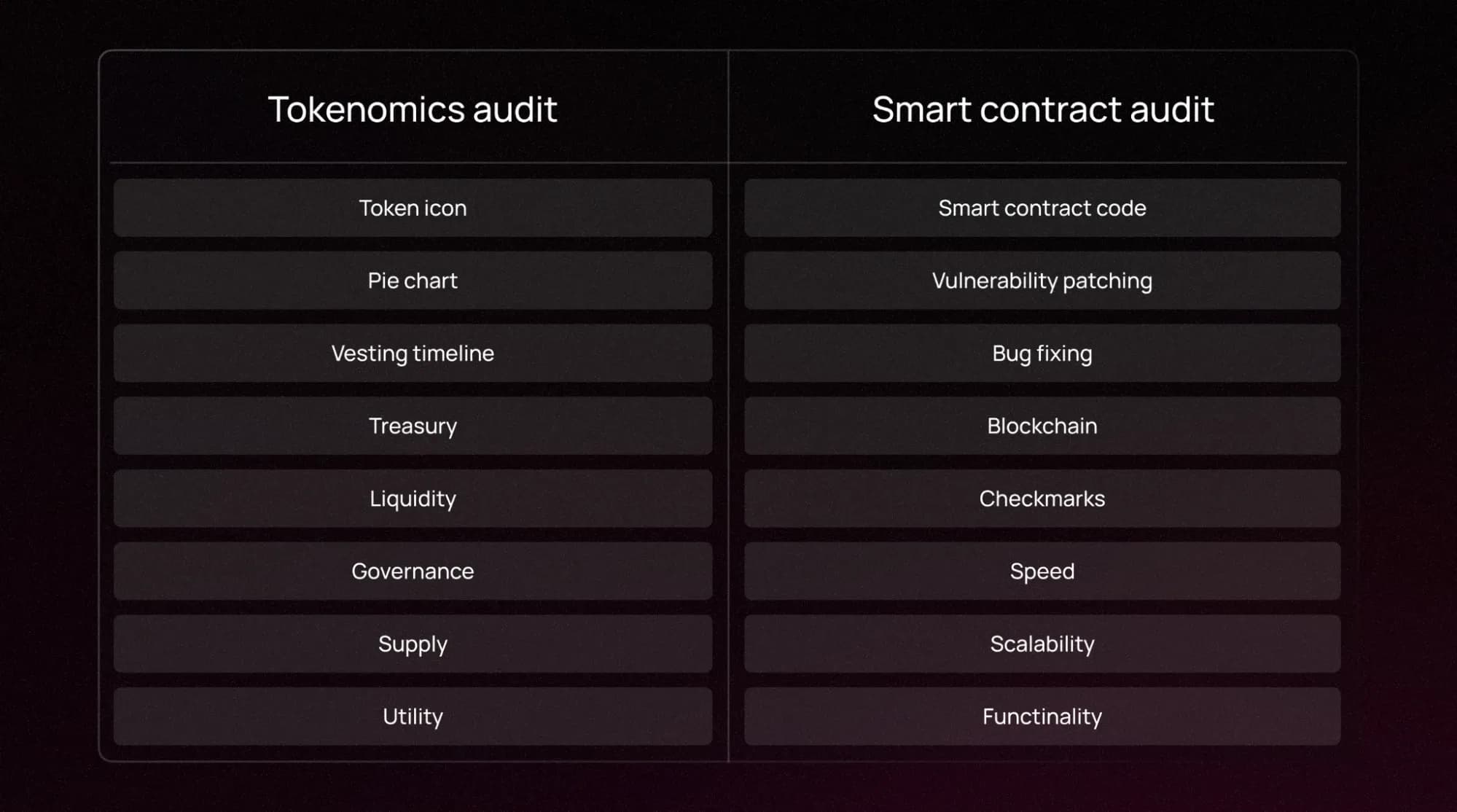
Tokenomics audit vs smart contract audit: key differences side by side
Thus, here is a visual comparison, as to how both types of audits differ from different perspectives:
Primary focus
- Tokenomics audit — economic design and sustainability of the token
- Smart contract audit — security, proper functioning, and code reliability
Main objective
- Tokenomics audit — determine whether the token has long-term economic viability
- Smart contract audit — verify that the code executes safely and as intended
What it analyzes
- Tokenomics audit — supply, allocation, utility, incentives, vesting, liquidity, governance, demand, and stakeholder alignment
- Smart contract audit — smart contract logic, vulnerabilities, permissions, business logic, code quality, and standards compliance
Primary risks assessed
- Tokenomics audit — weak demand, excessive selling pressure, poor incentives design, flawed token distribution, unsustainable economics
- Smart contract audit — exploitable bugs, coding errors, security vulnerabilities, unauthorized access, scalability issues, sluggishness, efficiency, and implementation flaws
Typical questions answered
- Tokenomics audit — will users have a reason to acquire, hold, and use the token? Is the economic model sustainable?
- Smart contract audit — can the contracts be exploited? Will they perform their intended functions properly?
Typical deliverables
- Tokenomics audit — economic analysis, tokenomics models, economic risk assessment & scoring, and strategic recommendations
- Smart contract audit — technical security report, vulnerabilities list, severity ratings, and remediation guidance
Performed by
- Tokenomics audit — tokenomics specialists, economists, and Web3 business strategists
- Smart contract audit — blockchain security firms and smart contract security engineers
When it's best performed
- Tokenomics audit — before token launch, fundraising, or major changes to the token economy
- Smart contract audit — before deploying smart contracts to the mainnet and after major code updates
Successful outcomes
- Tokenomics audit — a token economy that aligns incentives and supports sustainable participation
- Smart contract audit — smart contracts being secure, stable, and resistant to known attack vectors
What it does NOT guarantee
- Tokenomics audit — that the code is secure or free from vulnerabilities
- Smart contract audit — that the token will generate demand or have a sustainable economic model
What each one misses without the other
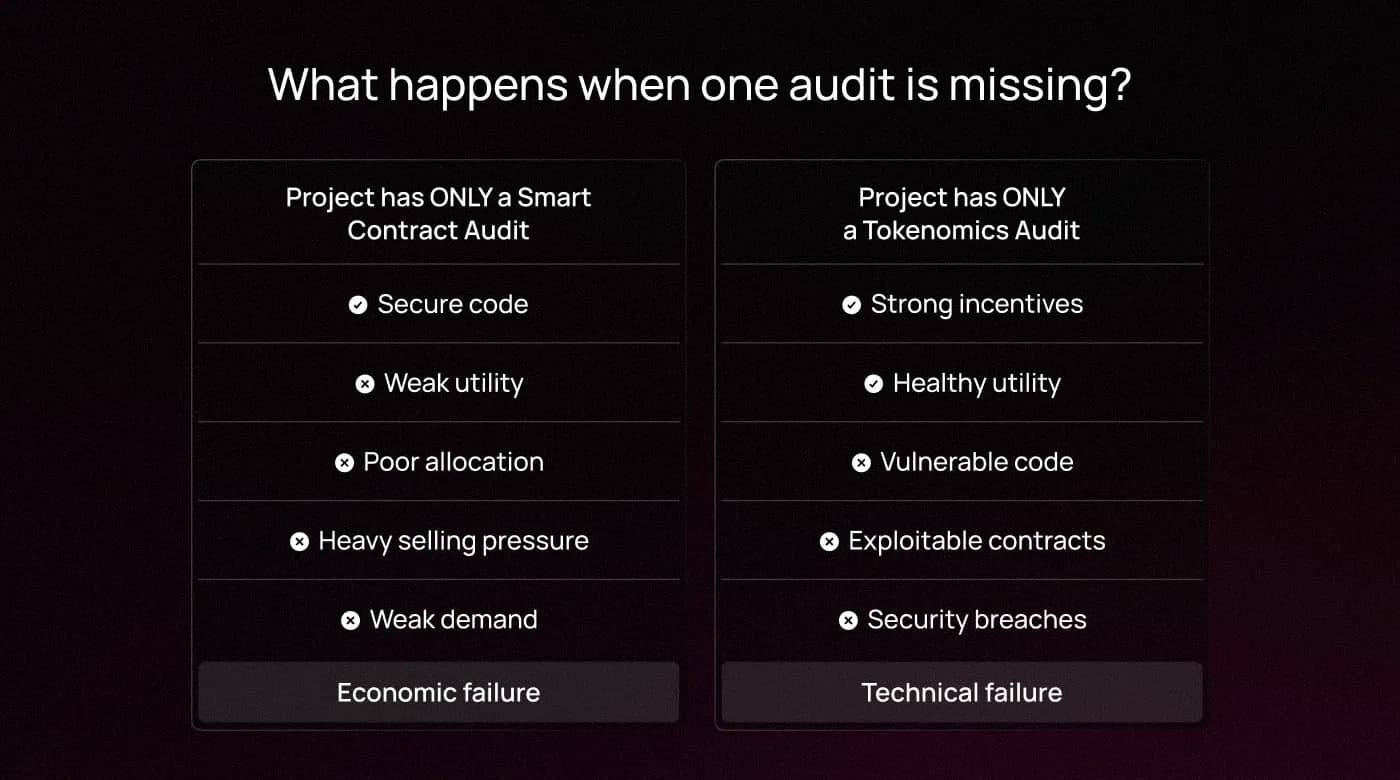
Neither of these is in any shape or form a substitute for the other because they answer fundamentally different questions. Ignoring either leaves a project exposed to risks that the other audit simply is not designed to identify.
Can a project have excellent code but poor tokenomics?
A proper project may absolutely receive a flawless smart contract audit and still struggle after launch because its token economics is fundamentally weak. There could be lots of great utility, but if the treasury floods the market too quickly or a whale that has too much of a token sells, and there is a lack of liquidity, those swings could crash the price instantly.
Can strong tokenomics compensate for insecure smart contracts?
Even the best-designed token economy cannot survive if the underlying infrastructure is vulnerable. A single breakthrough into the coding can mean drained protocol funds, unauthorized tokens being minted, bypassed authentication, and permanent damage caused to user confidence. Strong incentives and sustainable demand are meaningless if users cannot trust the security of the protocol itself.
Do you need both, and in what order?
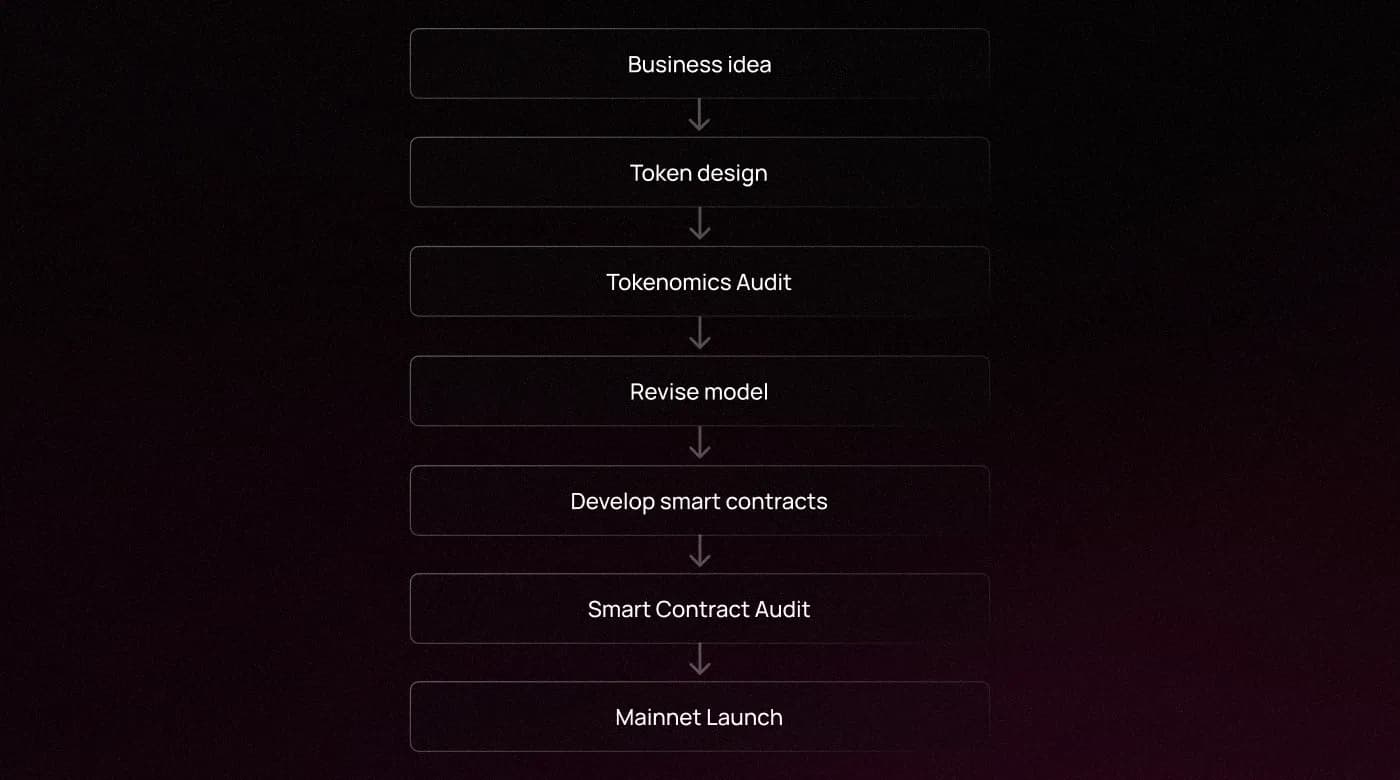
The answer is yes. A tokenomics audit and a smart contract audit address completely different categories of risk, and conducting both provides a far more comprehensive assessment before launch than relying on either one all on its own. A smart contract audit asks whether the protocol works safely, while a tokenomics audit asks whether the token economy itself works. Secure code cannot fix weak economics, and excellent tokenomics cannot compensate for vulnerable smart contracts.
Which should be performed first?
In most cases, the tokenomics audit should be conducted first. The token's economic design influences many of the features that will eventually have to be implemented in the form of smart contracts. If these change after the smart contracts have already been written and audited, the development team may have to rewrite the code anyway and then order yet another smart contract.
Too many projects focus too much on incentives and the short term when conducting tokenomics. The right thing to do is focus on legitimate value creation for the audience and sustainable demand that will outlive temporary hype and incentives. Book a tokenomics audit with 8Blocks today to help your token survive and flourish in the long term.
Which audit comes first for a VARA or ADGM licence?
In the UAE, the ordering question isn't just theoretical. Dubai's Virtual Assets Regulatory Authority (VARA) and Abu Dhabi's ADGM (through its FSRA) both expect applicants to submit a coherent economic rationale for the token alongside evidence that the underlying contracts are secure — and reviewers will flag a token model that keeps changing after the smart contracts were already signed off.
Locking the tokenomics first, then commissioning the smart contract audit against that finalized design, keeps a licensing file consistent and avoids paying for a second smart contract review after a late-stage economic redesign.
When should the smart contract audit take place?
Once the token model has been finalized and the smart contracts have been developed, the project should undergo a smart contract audit before deployment to the mainnet. This ensures the code faithfully implements the intended economic design while protecting users against vulnerabilities and exploits.
Key takeaways
- A tokenomics audit evaluates the designed economic strategy for a token, while a smart contract audit evaluates the security and correctness of the coding.
- Tokenomics audits focus on areas like supply, allocation, utility, incentives, stakeholders, liquidity, governance, sustainability, and long-term demand.
- Smart contract audits identify coding errors, security vulnerabilities, logical flaws, and implementation risks before deployment.
- A lucrative tokenomics design can fail if trust and security are breached, while secure, functional code may do no good if there is no demand for the token.
- These two types of audits are not interchangeable but complementary, one validating the economic model, the other — its technical implementation.
FAQ
What's the difference between a tokenomics audit and a smart contract audit?
The first ensures that the token's economic model is sustainable and the environment allows the economic goals to be achieved, while the latter handles security and functionality.
Can a project pass a smart contract audit and still fail?
Yes. Secure code does not mean a token will generate demand and income.
Does a tokenomics audit examine the project's code?
No. Tokenomics audits only align the token environment for business goals, from an economic standpoint.
Can either audit guarantee a project's success?
No, neither is enough on its own. Smart contract audits only handle security and functionality, while tokenomics audits handle the economic side.
When should a tokenomics audit be performed?
Ideally, before the token model, fundraising efforts, or major economic changes are finalized, as well as before smart contract development is complete.
Do VARA and ADGM require both a tokenomics audit and a smart contract audit?
Neither regulator names "tokenomics audit" as a mandatory line item, but VARA's rulebooks and ADGM's FSRA framework both expect issuers to evidence a sustainable economic model and independently reviewed, secure contract code before a token can be marketed or listed to UAE investors. In practice, projects submit both.
Where should a UAE-based project start?
With the tokenomics audit. It gives founders a defensible economic model to present in a VARA or ADGM licensing file, and it locks the token mechanics that the smart contracts will later need to implement exactly.
About 8Blocks
8Blocks is a Dubai-based token economy design firm working with Web3-native teams and Web2 businesses entering Web3, including projects launching across the UAE and the wider MENA region. Since 2017, the company has designed tokenized economic systems where the token functions as part of the business model rather than a standalone asset. 8Blocks delivers tokenomics design, strategic consulting, tokenomics audits, and launch strategy, connecting business modeling, token mechanics, and investor materials into one coherent model.
Disclaimer
This content is provided for informational and educational purposes only. It does not constitute investment, financial, legal, or tax advice, and is not a recommendation to buy, sell, or hold any token or digital asset. Token design does not guarantee any financial return, token price performance, or regulatory outcome. Crypto assets carry a high risk of loss. In the UAE, the legal classification and permitted marketing of a token depend on its specific structure and the applicable framework, such as VARA in Dubai, the ADGM, or the DFSA in the DIFC. Readers should conduct independent research and consult qualified legal and financial advisors licensed in the relevant jurisdiction.

What Is a Tokenomics Audit and Why It's So Essential
A tokenomics audit checks whether a token economy is sustainable and aligned with a project's goals — essential for UAE and Dubai Web3 teams preparing for a TGE, fundraising, or VARA/ADGM licensing. Learn what it covers, how it works, and when to get one.
Is Your Token Ready? The Complete Tokenomics Audit Checklist
Review every critical component of your token economy with this complete tokenomics checklist, from supply and incentives to governance and market readiness. Don’t launch a TGE, raise capital, or rework tokenomics until thoroughly covering your bases.
Inside the 8Blocks Audit Methodology: Our Approach to Evaluating Token Economies
Find out the working recipe behind the 8Blocks tokenomics audit, its central principles, process, components, and requirements to get started. Read about the benefits customers get and past cases where 8Blocks has saved tokenomics projects.