Inside the 8Blocks Audit Methodology: Our Approach to Evaluating Token Economies
Find out the working recipe behind the 8Blocks tokenomics audit, its central principles, process, components, and requirements to get started. Read about the benefits customers get and past cases where 8Blocks has saved tokenomics projects.

The 8Blocks tokenomics audit methodology evaluates whether a token economy is built on genuine market demand rather than temporary incentives. It analyzes utility, supply, allocations, vesting, incentives, treasury, liquidity, and market risks. Its economic modeling covers data review, stress testing, and detailed reporting, subsequently providing actionable recommendations to address risks and opportunities.
There are so many genius, Earth-shattering ideas people have come up with that never come to be. Numerous other stunning products and services do operate token economies and generate serious revenue. Even so, there’s a difference between creating value and capturing that value in a way that people truly want to buy and own the associated token. The road to translating value to a token is completely full of landmines at every single turn, as is a highly technical endeavor. Thus, projects that completely ignore it are doomed to failure. Much profound technical and economic research has been directed to fill the gap.
Yet, projects and auditors sorely miss the most important tokenomics principle of all:
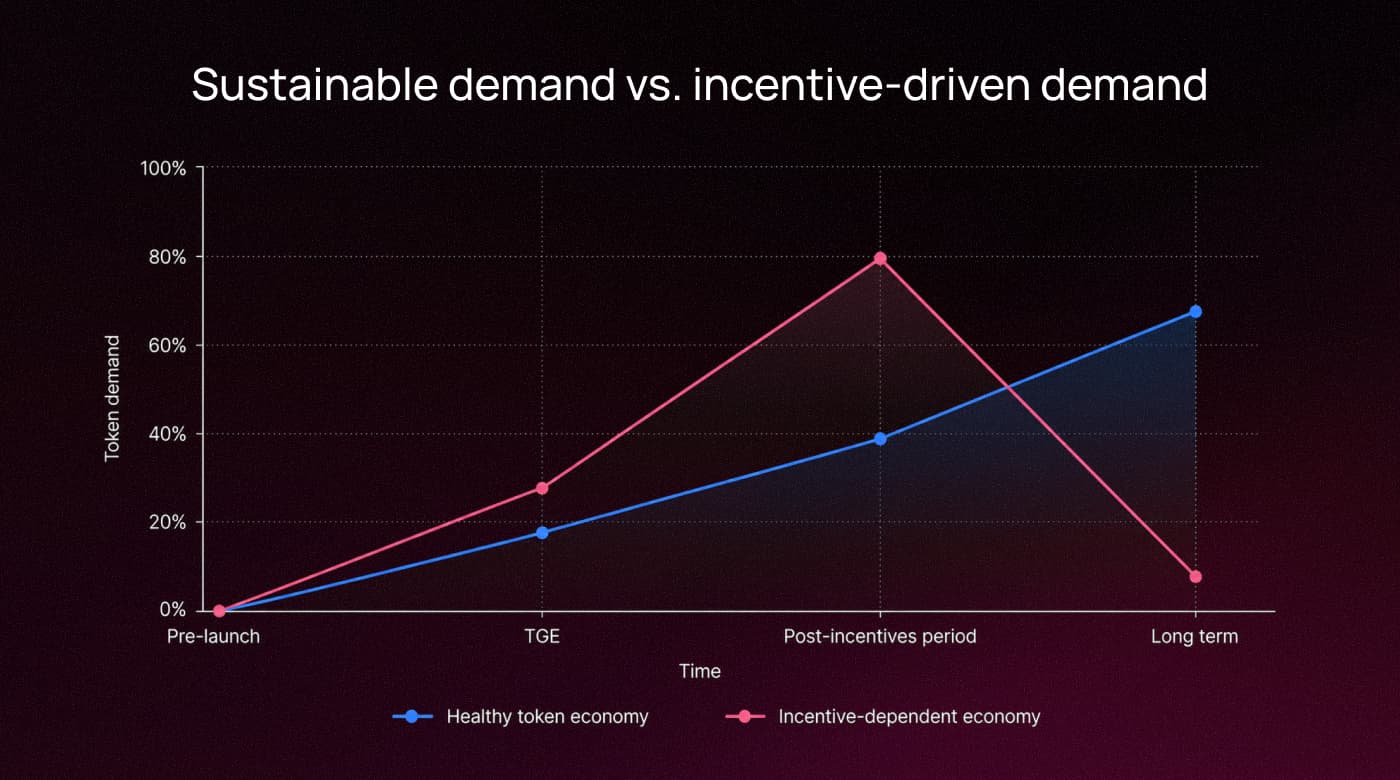
Demand for a token has to come from the market, not the marketing budget.
To some, just throwing more and more money at the token economy gives the appearance of breathing life into the system, but it only appears that way for so long. Soon enough, the cracks start to show, and founders find themselves in a big economic mess . If demand disappears the moment that incentives end, what that means is the economic model was never truly sustainable in the first place. At 8Blocks, our methodology focuses on telling genuine product-driven demand apart from demand that’s only being propped up by temporary subsidization.
Our approach: what we look at first
Many token models only look like everything is going nicely on the surface while rewards are being distributed, incentives are being funded, and hype campaigns are actively drawing new people in. The true litmus test, however, is the moment those resources are reduced or removed. If demand disappears at that point, the token itself never actually held any value on its own. Even beyond that, to trap the value within the token, there must be no alternative to using the product along with the token. It must be unique and irreplaceable.
What is the core principle behind our audit?
We believe that a token needs to have a clear economic purpose, significant beyond speculation. A healthy token creates a rational reason for users to acquire, hold, and use the token, seeing as doing so generates value. That value may come from:
- Access to products
- Participation in the ecosystem
- Cost savings
- Exclusive functionality
- Rendering essential tasks easier
It can serve users in numerous ways. The key, however, is that demand exists because users want what the token enables, not because they hope to turn around and sell it at a higher price. This distinction is critical because weaknesses go unnoticed until a lot of things become set in stone and can no longer be changed, in particular after the Token Generation Event (TGE) . Our methodology is designed to identify those weaknesses before they reach the market.
What are the first things we look for, and why?
We do not evaluate each tokenomics metric in a vacuum. What we do instead is examine a number of different interconnected components that determine whether the economic model can function sustainably over time.
Some crucial areas we analyze are:
- Token utilization: to understand who will use the token, why they will use it, and in what quantities. If demand projections are based primarily on assumptions rather than clear product utility, that likely won’t end well.
- Balance in discounted token sales before TGE versus the planned listing price: if too many early investors can buy tokens at prices at too much of a better deal than public participants, that creates an impetus to offload them after launch, unleashing a chain reaction of sales.
- Potential sales pressure: evaluating how many tokens could realistically enter the market during the first weeks and months, who controls those tokens, and at which price levels selling becomes economically attractive. Even a very strong project can struggle if too much supply reaches the market too quickly.
- Token circulation: we map how tokens reach users’ hands, how they are used inside the ecosystem, where they are held, how value returns to the project, and how tokens eventually find their way back to the market. This helps us determine whether value is continuously circulating within the ecosystem or simply leaking out through ongoing selling.
Since token economies rarely fail due to a single problem, these components are always viewed in context. It’s usually the interaction of several different weaknesses that causes crashes. In and of themselves, they may appear manageable, but collectively they wreak unsustainable conditions.
What do we consider the strongest sign of healthy tokenomics?
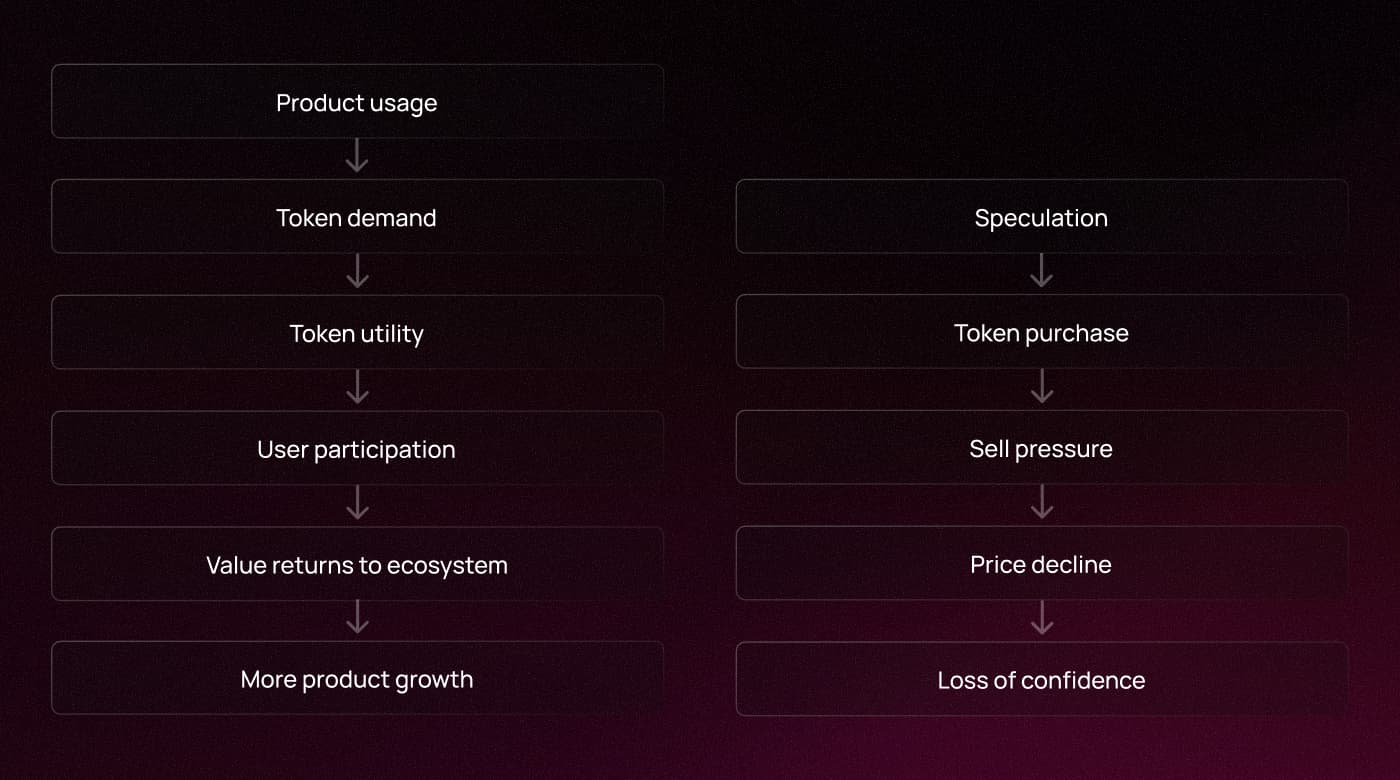
The surest sign of healthy tokenomics is simple – there needs to be a strong economic reason to hold or use the token year in, year out. It’s crucial that users are able to clearly answer the question, “Why should I keep this token instead of selling it?” If the answer is obvious and connected to the product itself, the token wields a foundation for sustainable demand. If they struggle to find an answer to that, demand probably won’t survive beyond the initial launch period.
If the primary motivation for buying the token is just so they can flip it for a profit at the TGE, that means the chosen economic model was weak. That’s regardless of how sophisticated the allocation, vesting, or marketing strategy may appear. Sustainable economies are built on utility, participation, and long-term value creation.
How the 8Blocks audit works: step by step
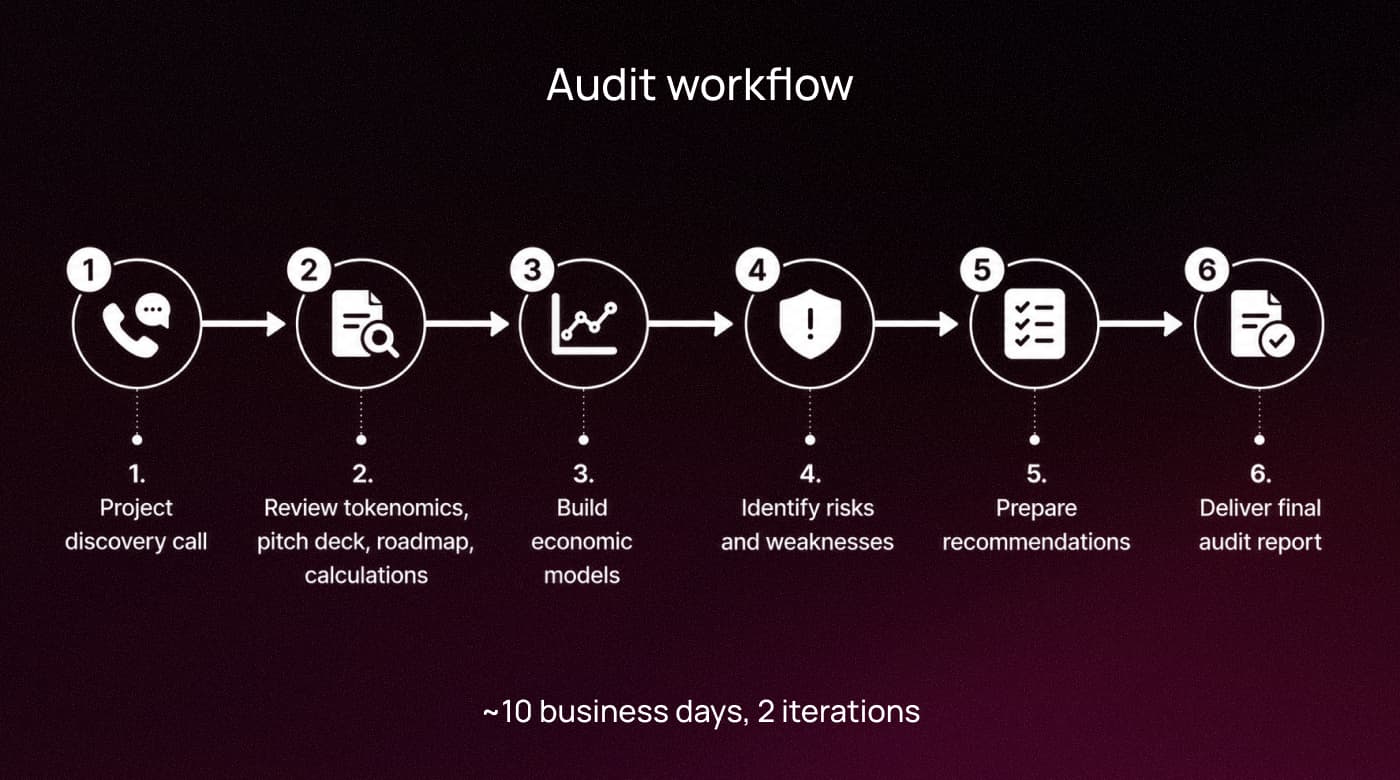
No two token economies are alike. But our audit process follows the same structured methodology – we process and analyze information from the client on their business and the economic model behind it. From there, we build a series of models that allow us to identify structural risk s.
What do we request from the client before the audit?
A thorough audit starts with an understanding of the project as a whole, not just the token. Before we begin, we request from the customer:
- The tokenomics model: the basis of the audit
- Their pitch deck: to gain a quick overview of their business plan, value proposition, product, and how the token will prop up the project.
- Their roadmap: to evaluate how token releases align with expected product development and user growth.
- Financial calculations and supporting spreadsheets, which we independently verify.
We also conduct a discovery call with the project team. This is essential, seeing as even the most detailed documentation cannot substitute for a direct discussion. Our goal is to render the project’s objectives, assumptions, and long-term vision crystal clear, ascertaining we’re exactly on the same page as the founders before we start to initiate any modeling.
What do we model during the audit, and how?
Now, with the information on hand, we go on to build models to project the token economy's behavior once it hits the open market.
We model:
- Weighted-average acquisition prices of early investors: this helps us estimate the price levels below which selling becomes economically irrational and, more importantly, identify the levels at which early investors are likely to begin taking profits.
- Entire vesting schedule: rather than simply reviewing unlock dates, we use the vesting data to estimate potential selling pressure over time. This helps tell us periods when large volumes of tokens may flood circulation before sufficient demand has a chance to materialize to properly absorb them.
- Staking: we’ll also model its expected behavior if included in the project. We evaluate whether staking creates meaningful long-term demand for the token, as well as whether participation is likely to decline once initiatives vanish.
- How tokens will enter the market over time: how they might circulate between different participant groups and how those flows impact product demand growth.
These, along with other important models, provide a much clearer, interactive idea of the tokenomics.
How is the tokenomics stress-tested?
Our standard stress test is based on the models themselves. Once the above models have been built, structural weaknesses often become immediately visible. This allows us to identify inconsistencies, unrealistic assumptions, stakeholder conflicts, or economic imbalances and provide practical recommendations on them.
Monte Carlo simulations
These are offered to projects requiring a deeper, more complex assessment. These are costly and purely optional. What they do is evaluate thousands of possible market scenarios to provide additional confidence for particularly complex token economies. However, because they require significantly more modeling work, they are typically reserved for engagements where the additional analytical depth justifies the cost.
What does the final audit deliverable include?
This structured analytical report contains between six and nine core sections, depending on how complex the project is.
These are compiled with the following segments:
- The introduction: outlining the scope of the engagement
- A summary of the findings: featuring the overall assessment
- The body (6 to 9 sections): covering different components of the token economy
- Conclusions and recommendations: complete with the risks and actionable suggestions
- 8Blocks methodology ratings (extra service)
How long does an audit usually take?
A typical tokenomics audit is completed in around 10 business days in two iterations. The exact timeline depends on the project’s breadth of functionality, level of detail, and the completeness of the materials provided at the start of the engagement. If all necessary documentation is available from the outset, there is the possibility of expedited delivery for tight launch schedules as well.
What we check in each area
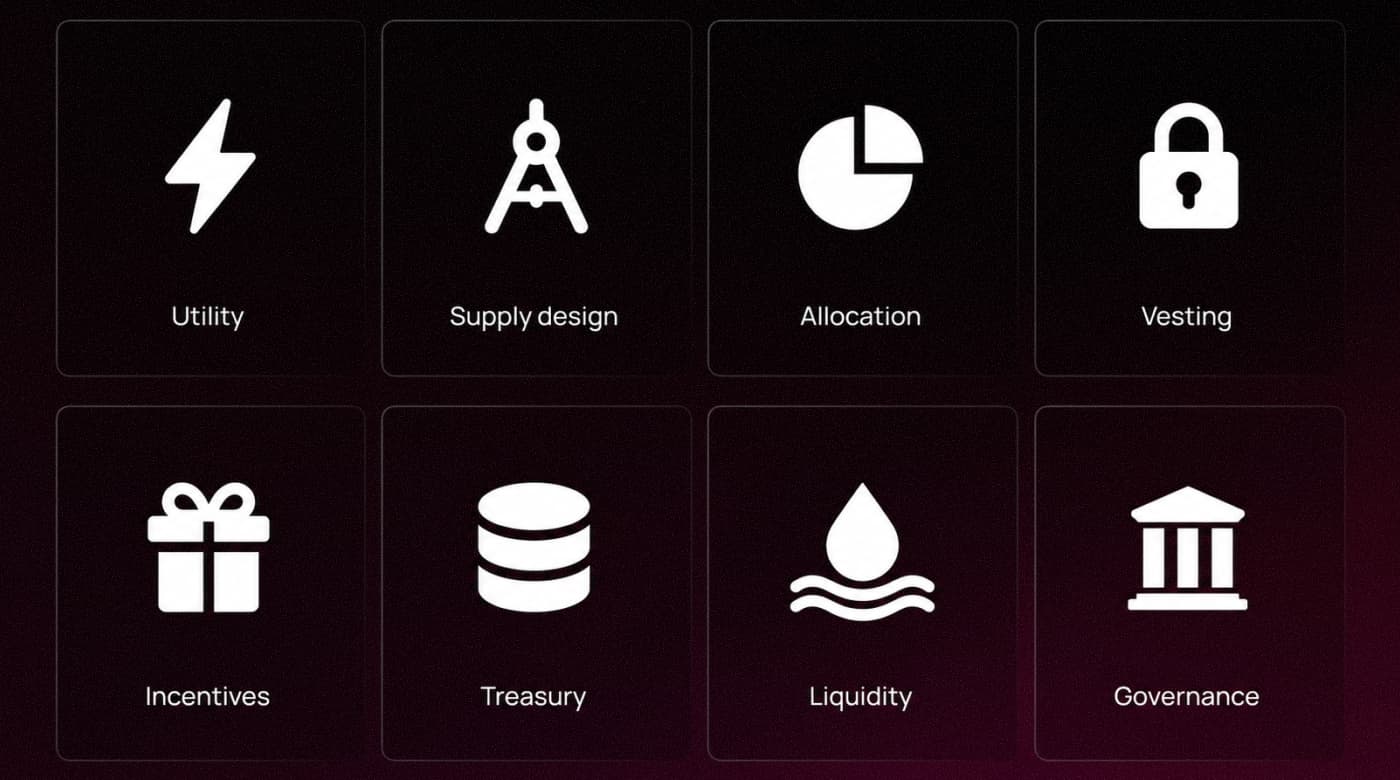
Let’s discuss the main components of the 8Blocks audit methodology, along with the red flags we look for and the benchmarks we consider healthy.
Supply & emission
There’s a big misconception in Web3 that token supplies are often either “too large” or “too small”. The truth is that overfocusing on the absolute number usually misses the point. What actually matters is whether the supply is logically connected to the project’s purpose.
A project, for instance, could issue one million tokens because every token can later be redeemed for one physical mystery box, and only one million boxes will ever exist. In another case, a charity-focused protocol might intentionally create one trillion tokens so users can donate fractions of a cent without having to worry about decimal places. Both approaches can be perfectly justified as long as the supply has a clear economic rationale.
Where projects go wrong is when the total supply they opt for is just because it “looks good” or follows some vague market trend without that having anything to do with the product.
Allocation
We categorize allocations under three main groups:
- Team tokens
- Investor tokens
- User and community tokens
As a general guideline, we prefer team allocations that do not exceed roughly three times the allocation given to investors. If investors receive X, the team’s allocation should generally remain at or below 3X. The remaining supply should ultimately become available to users, even if those tokens are gradually distributed through ecosystem participation rather than existing in circulation from day one.
This structure helps align incentives across everyone involved in building and growing the project.
Vesting schedules & unlocks
Every lock-up period should be logical from a business standpoint. For example, locking tokens for three months makes sense if a game is scheduled to launch in three months and that’s the point when token utility is set to begin. Likewise, certain team allocations may remain locked indefinitely until the company reaches a predefined milestone, such as generating $1 billion in revenue, after which those tokens are released specifically to finance expansion.
What concerns us are arbitrary dates with no relationship to product development. Vesting schedules need to follow the roadmap – not the other way around.
Token utility strength
A healthy token should provide at least one function that users genuinely want. The foundation should be difficult – or impossible – to replace.
Here are some examples:
- Access to a secondary marketplace only available to those who hold a certain amount of the token.
- A permanent 40% product discount available only through the token.
- Exclusive functionality that cannot be replicated via another payment method.
By contrast, if the token exists only for staking rewards or performs a role that another cryptocurrency could perform just as well, its utility can be declared relatively weak. Our objective is to determine whether people will still want the token after speculation fades.
Incentive evaluation
If good tokenomics are conducted, the reason to hold onto the token long-term or put it to good use should be immediately obvious. Users should understand full well what the economic benefit is that they’re receiving from participating in the ecosystem rather than simply expecting someone else to buy their tokens later at a higher price.
If the value proposition is unclear, the token often becomes little more than a speculative asset. In practice, that usually translates to holders selling it off en masse, thus introducing downward pressure on the price shortly after launch.
Governance
Many projects promote governance rights as a major utility, but not too many communities actively participate in governance over the long haul. Consequently, governance alone is rarely enough to justify a token’s existence. We evaluate whether governance creates genuine value or simply serves as additional marketing PR.
Treasury design
This is one of the most overlooked areas of tokenomics. A treasury allows projects to remove excess tokens from immediate circulation while establishing transparent rules for when and how those tokens may re-enter the market.
Imagine a project with 1,000 total tokens:
- 20 are allocated to investors.
- 20 belong to the team.
- 60 will eventually be earned by users.
- The remaining 900 currently have no immediate use.
Leaving those 900 tokens under team control breeds uncertainty since this could cause investors to get anxious as to whether they could be sold at any time. Burning them permanently may create future supply shortages if the ecosystem later expands.
Placing those tokens into a treasury instead, with predefined release conditions, breeds much stronger economic discipline. For instance, the project may specify that every additional 1,000 verified users unlocks 10% of the treasury allocation, which is then directed toward staking rewards or ecosystem incentives. This paves the way for predictable supply management as opposed to discretionary token issuance.
Liquidity & market readiness
Even well-designed tokenomics can fail if a project reaches the market without sufficient liquidity.
Centralized exchange listings
At least $50,000 initially is what we generally expect projects to allocate in these, together with an equivalent value in tokens.
Decentralized exchange launches
Here, the bar is raised to $200,000 or more, depending on the protocol and expected trading activity.
Insufficient liquidity is a major red flag because it increases volatility, widens spreads, and makes price discovery inefficient. We also assess whether the project has set aside plenty of capital for market-making operations if need be. The true amount they’re going to need, for the most part, depends on how many tokens are open for sale during the initial months after listing. Projects that neglect to prepare for these matters are blindsided by severe selling pressure even if the underlying tokenomics are otherwise quite robustly designed.
8Blocks ratings
For clients who want an additional layer of analysis, we also offer 8Blocks Methodology Ratings as an optional paid add-on. Our standard audit focuses mainly on identifying risks, validating assumptions, and issuing recommendations for people to consider incorporating. As for the overall rating, what it does is introduce a structured scoring framework that helps benchmark different aspects of a particular project’s tokenomics.
Because every project has different objectives, this rating is not included in every engagement and is used in exceptional cases where a standardized assessment provides extra value.
Tokenomics audits for UAE and Dubai-based Web3 projects
8Blocks is a Dubai-based token economy design firm registered in the DMCC free zone, working with Web3 teams across the UAE and the wider MENA region. Our audit methodology maps directly onto the expectations of local regulators such as Dubai's Virtual Assets Regulatory Authority (VARA) and the ADGM, which increasingly scrutinise transparent token distribution, clear disclosures, and economically sustainable design rather than incentive-driven hype.
For projects launching from the UAE, whether registered under DMCC, VARA, or ADGM, a rigorous tokenomics audit helps demonstrate that demand is driven by genuine utility rather than temporary incentives. That evidence supports both regulatory readiness and investor due diligence ahead of a TGE in the region.
What the client walks away with
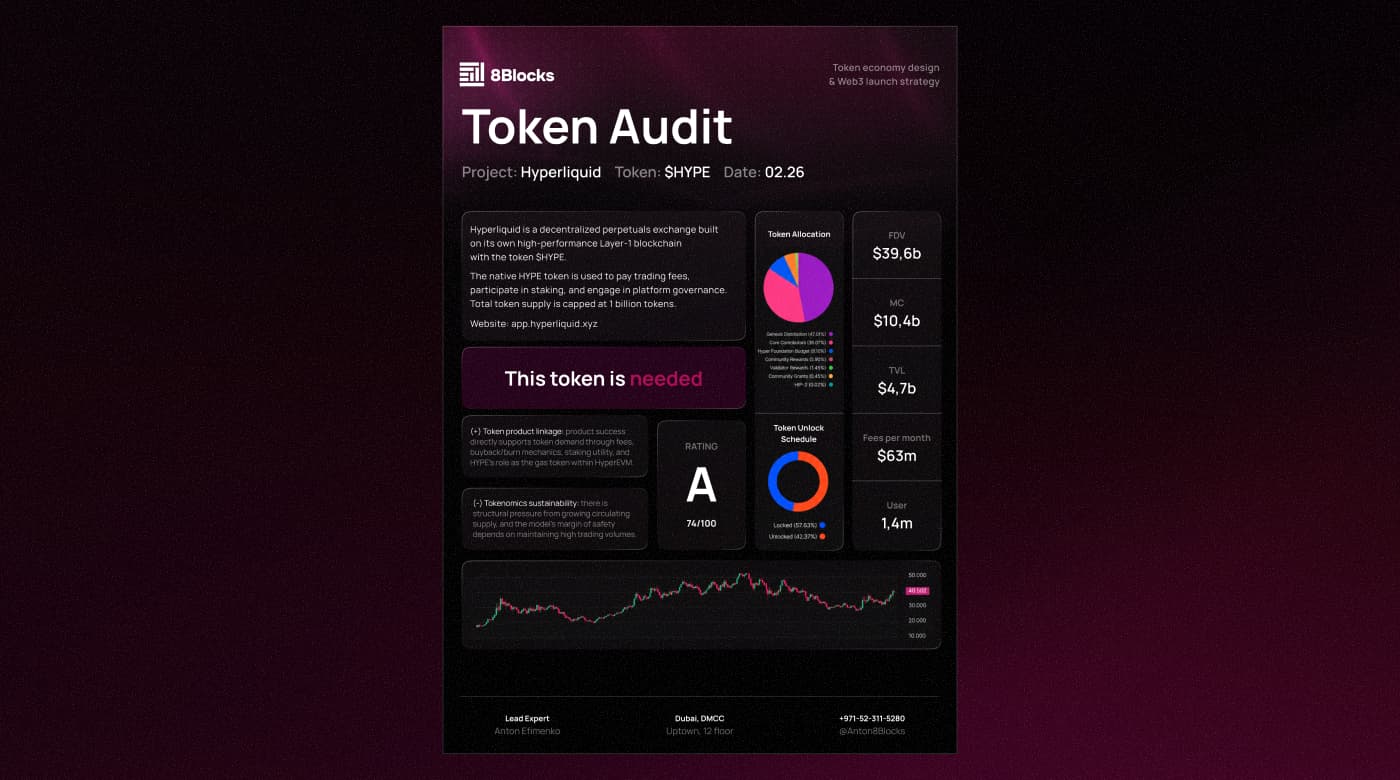
An audit should do more than just identify problems and issue tips – it should give founders the tools to solve them. Every 8Blocks audit methodology engagement is designed to produce deliverables that teams can immediately use internally, share with investors, and apply throughout the process of refining their token economy.
What does the final deliverable include?
Every completed audit includes the following:
- A comprehensive analytical report explaining our findings and methodology;
- Excel models containing the calculations and assumptions used throughout the audit.
- A concise one-page summary suitable for sharing with investors, partners, or on social media.
For projects preparing for fundraising or public launches, these materials entail a well-broken-down explanation of the token economy rather than a mere list of observations.
How are the recommendations presented?
Recommendations are provided at two different levels. Within each section of the report, we include concise comments specific to that area of the token economy, highlighting any weaknesses or opportunities for improvement. At the end of the audit, the findings are consolidated into a set of practical recommendations covering every significant risk identified during the review.
The goal is not to simply point out what is wrong, but to provide clear guidance on how the model can be strengthened before launch or updated after further development.
How do clients get the most out of the report?
Most clients use the audit as a decision-making tool, rather than simply as documentation.
Depending on the project, the report can be used to:
- Improve the token model before launch;
- Strengthen investor confidence during fundraising;
- Refine token utility and economic logic;
- Implement recommended mechanisms that reduce long-term risks;
- Support internal discussions between founders, product teams, and advisors.
Upon request, we will be happy to provide an 8Blocks team member to participate in AMA sessions to explain the audit findings and answer investor questions regarding the project’s tokenomics.
Is the audit confidential?
Yes. Confidentiality is one of the core principles of our business. We never publish audit findings, economic models, or project documentation without the client’s explicit permission. Many teams prefer to keep their tokenomics confidential while refining their model or protecting commercially sensitive information from competitors, and we fully support that approach.
Getting started
Planning a token launch from Dubai or the wider UAE, or reviewing an existing economic model? An 8Blocks audit, run by our Dubai-based team, provides an independent assessment of your tokenomics, identifies structural risks before they become expensive mistakes, and delivers practical recommendations to seize opportunities.
Request a tokenomics audit today to rectify mistakes and put practical recommendations to use before your TGE or a model redesign in the UAE.
The 8Blocks audit methodology in practice
The value of an audit is measured by the decisions it helps founders make before launch – not by how many pages the report contains. Below are two anonymized examples that demonstrate how the 8Blocks audit methodology works in action.
The vesting schedule of a client that didn’t match its business model
During the Play-to-Earn boom, a team approached us with a lending protocol whose tokenomics had been heavily inspired by successful gaming projects. They had planned a rather aggressive vesting schedule. Most of the early allocations were set to unlock within four months, since that timeline had worked for several high-profile token launches. There was just one problem – the underlying businesses were completely different.
A game can absorb large numbers of tokens almost immediately through mechanics like:
- Boosters
- Loot boxes
- Cosmetic purchases
- Player upgrades
A lending protocol, though, operates at a much slower pace, with many components substantially dragging on the timeline, in particular:
- Borrower verification
- Loan origination
- Repayments
- Ecosystem growth
Just the first of these elements alone could take a month to complete. If the organization had launched its protocol with that vesting schedule, the token would have gone straight to rock bottom. This is because the protocol could not possibly reach the rate of demand that they would need to be able to absorb that many tokens without crashing.
Thus, we recommended they restructure their vesting schedule to ensure the token releases better matched the expected pace of product adoption and protocol growth – to make sure to align the supply with the business’s true demand-generating capability.
How we identified sell-pressure in our client’s project before launch
In another one of our case studies, a project had already designed its tokenomics, finalized its vesting schedule, and completed a successful early fundraising round. On paper, the distribution appeared to be rather reasonable. However, things were far from simple.
Our analysis revealed that although investors were receiving tokens under a structured vesting plan, ordinary users had very few reasons to actually use the token during the first six months after launch. We calculated the weighted-average acquisition price of early participants, modeled future token releases, and analyzed the potential selling pressure those unlocks could create under different scenarios.
The conclusion we arrived at was that the utility, not the distribution, was the primary weakness. Thus, we recommended introducing mechanisms that tied access to certain parts of the product directly to the product’s native token, creating stronger organic demand than relying primarily on market sentiment. The client later implemented these mechanics as part of their product roadmap.
Key Takeaways
- A successful token economy starts with real market demand, not incentives, marketing, or speculative interest.
- The 8Blocks audit methodology evaluates tokenomics as a complete economic system, not as isolated metrics.
- The audit process combines documentation review, economic modeling, and risk analysis to identify risks and opportunities for recommendations before launch.
- Strong tokenomics requires more than giving a token a purpose on paper. The token must provide unique utility that users actually need.
- The strongest token economies are those where the product itself creates the reason for the token to exist – where usage drives demand, strengthens the ecosystem, and value stays connected to the business over time.
FAQ
What is the main principle behind the 8Blocks audit methodology?
The central principle is that demand for a token must come from the market, not from the marketing budget. A token economy must be able to survive beyond the point that incentives are no longer provided.
What materials does 8Blocks need to perform a tokenomics audit?
It needs the existing tokenomics model, the project pitch deck to understand the product and its objectives, the roadmap to evaluate token releases’ alignment with expected development milestones, and the financial calculations and spreadsheets to verify assumptions.
How long does an 8Blocks tokenomics audit take?
A typical audit takes around 10 business days to complete and is done in two iterations . The exact timeline depends on how complex the project is and how readily necessary documentation is provided. Expedited audits are also possible, however, for projects with a launch quickly coming up.
Does the audit include simulations?
The standard audit relies on economic modeling and analysis of the project’s token mechanics. More advanced Monte Carlo simulations are available as an additional service for projects that require deeper scenario analysis.
Is the 8Blocks tokenomics audit confidential?
Yes. 8Blocks does not publish audit findings, models, or project documentation without the client’s consent.
About 8Blocks
8Blocks is a token economy design firm working with Web3-native teams and Web2 businesses entering Web3. Since 2017, the company has designed tokenized economic systems where the token functions as part of the business model rather than a standalone asset. 8Blocks delivers tokenomics design, strategic consulting, tokenomics audits, and launch strategy, connecting business modeling, token mechanics, and investor materials into one coherent model.
Disclaimer
This content is provided for informational and educational purposes only. It does not constitute investment, financial, legal, or tax advice, and is not a recommendation to buy, sell, or hold any token or digital asset. Token design does not guarantee any financial return, token price performance, or regulatory outcome. Crypto assets carry a high risk of loss. The legal classification of a token depends on its specific structure and the applicable jurisdiction. Readers should conduct independent research and consult qualified legal and financial advisors.

What Is a Tokenomics Audit and Why It's So Essential
A tokenomics audit checks whether a token economy is sustainable and aligned with a project's goals — essential for UAE and Dubai Web3 teams preparing for a TGE, fundraising, or VARA/ADGM licensing. Learn what it covers, how it works, and when to get one.
Is Your Token Ready? The Complete Tokenomics Audit Checklist
Review every critical component of your token economy with this complete tokenomics checklist, from supply and incentives to governance and market readiness. Don’t launch a TGE, raise capital, or rework tokenomics until thoroughly covering your bases.
Why HYPE Is Stronger Than Most DeFi Tokens — and Where That Power Could Run Out
HYPE is one of the strongest DeFi tokens because its demand is built into Hyperliquid: the token pays gas on HyperEVM, unlocks trading-fee discounts through staking, and absorbs over 99% of platform fees through an automated buyback. That strength is real but conditional — it depends on Hyperliquid sustaining high trading revenue.