Listing on DEXs: Why Free Exchanges Are the Most Capital-Intensive Story in Web3
Listing a token on a Decentralized Exchange (DEX) has no listing fee, but it is not free. The real cost is liquidity: capital you must lock in a pool to absorb early sells. Under-fund the pool and Automated Market Maker (AMM) math turns the first trades into a price crash the project may never recover from.
Why projects choose DEXs — and what they get wrong
Every Web3 project preparing a token eventually asks where to launch trading. A Centralized Exchange (CEX) sounds ideal — trust, audience, a sense of having "made it" — but CEX listings are slow, demanding verification, documentation, proof of community, and market interest. So teams turn to DEXs on two assumptions: that DEXs are cheap, and that a project should start on a DEX and graduate to a CEX.
Both assumptions are half-true. On a DEX you skip the classic listing fee, the approval wait, and the negotiation. But the money does not disappear — instead of going to an exchange, it goes into liquidity. The cost moves; it does not vanish.
Centralized exchanges work as a filter
A CEX evaluates far more than the idea: community, user activity, tokenomics, legal structure, volumes, team reputation, and risk. Coinbase states that listing is free — no listing or application fees — yet runs a rigorous process of legal, compliance, and technical security reviews through its Digital Asset Listing Group.
Binance works the same way: submit an official application, then face internal evaluation, with direct listing oriented toward coins that already circulate on the market. So a DEX often becomes step one — a project lists, creates a pool, launches trading, shows initial volume, gathers demand data, and only then approaches a CEX with a trading history rather than a pitch deck.
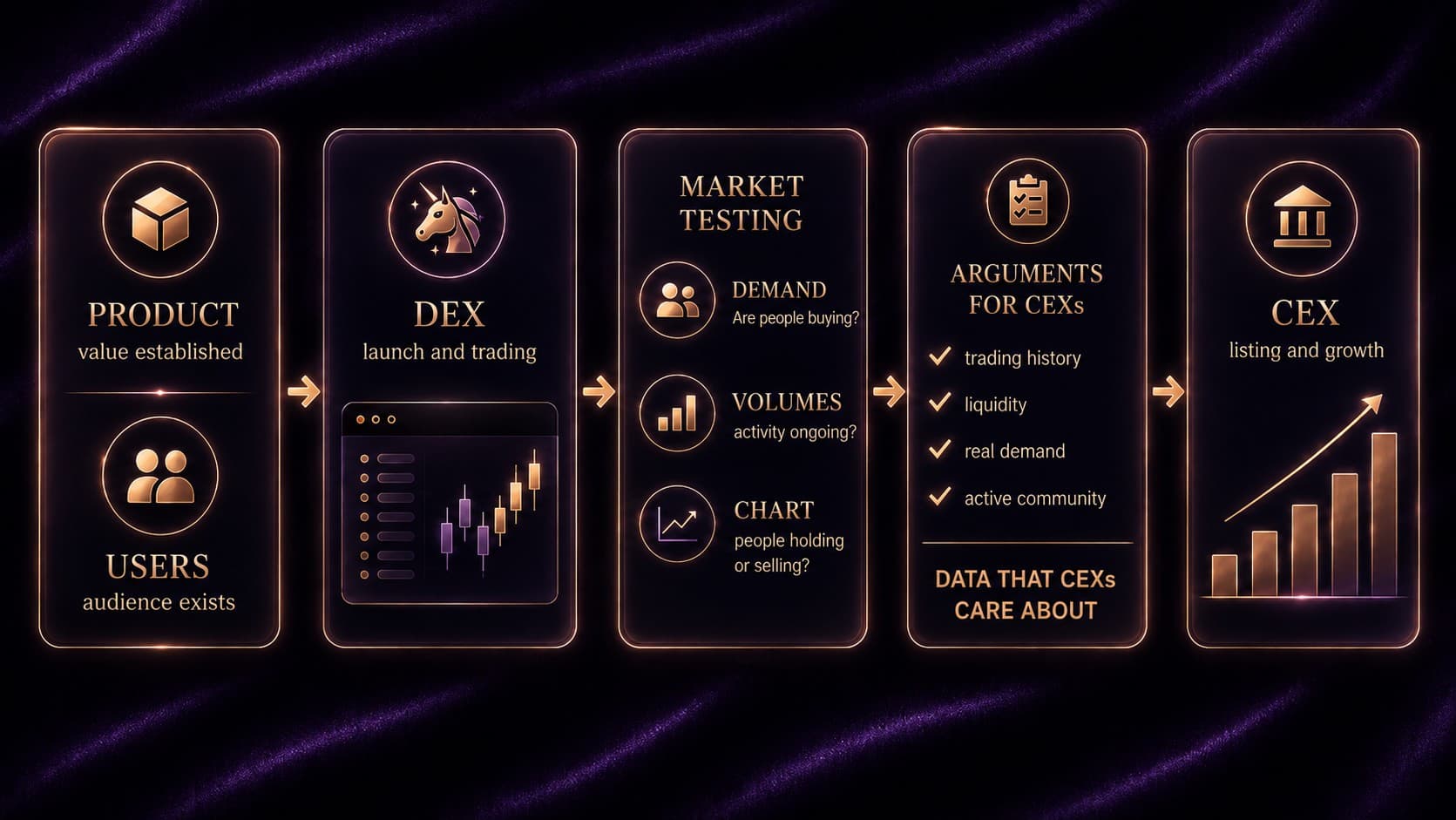
A DEX is a preliminary stage, not a cheaper alternative to a CEX.
When does the "first DEX, then CEX" strategy work?
It works when a project has a product and users but lacks a large public community, or has a community whose post-TGE behaviour is untested. Before listing, you can debate utility and roadmap endlessly; after listing, the market looks at the chart and asks where the money is. A DEX exposes the gap between promises and reality quickly.
If a project already has a robust community, ready demand, and a direct CEX path, the DEX stage is often unnecessary. An early start without preparation for volatility turns the price into a roller coaster the team never planned for.
Are DEXs actually cheap? The AMM does the math
Creating a pair is cheap; making it survive is not. A DEX has no order book. It uses an Automated Market Maker (AMM) — a smart contract holding two assets, for example a project token and USDT — where price follows the constant-product formula x × y = k, as Uniswap explains. Every trade changes the reserves, and the smaller the pool, the more each trade moves the price.
Worked example. A pool holds 100,000 tokens and 10,000 USDT, so the price is $0.10. The first user sells 10,000 tokens and receives about 909 USDT. The pool now holds 110,000 tokens and ~9,091 USDT, and the new price is roughly $0.083 — a 17% drop from a single trade. This is not manipulation; it is ordinary AMM math. Larger pools absorb larger trades with less price impact.
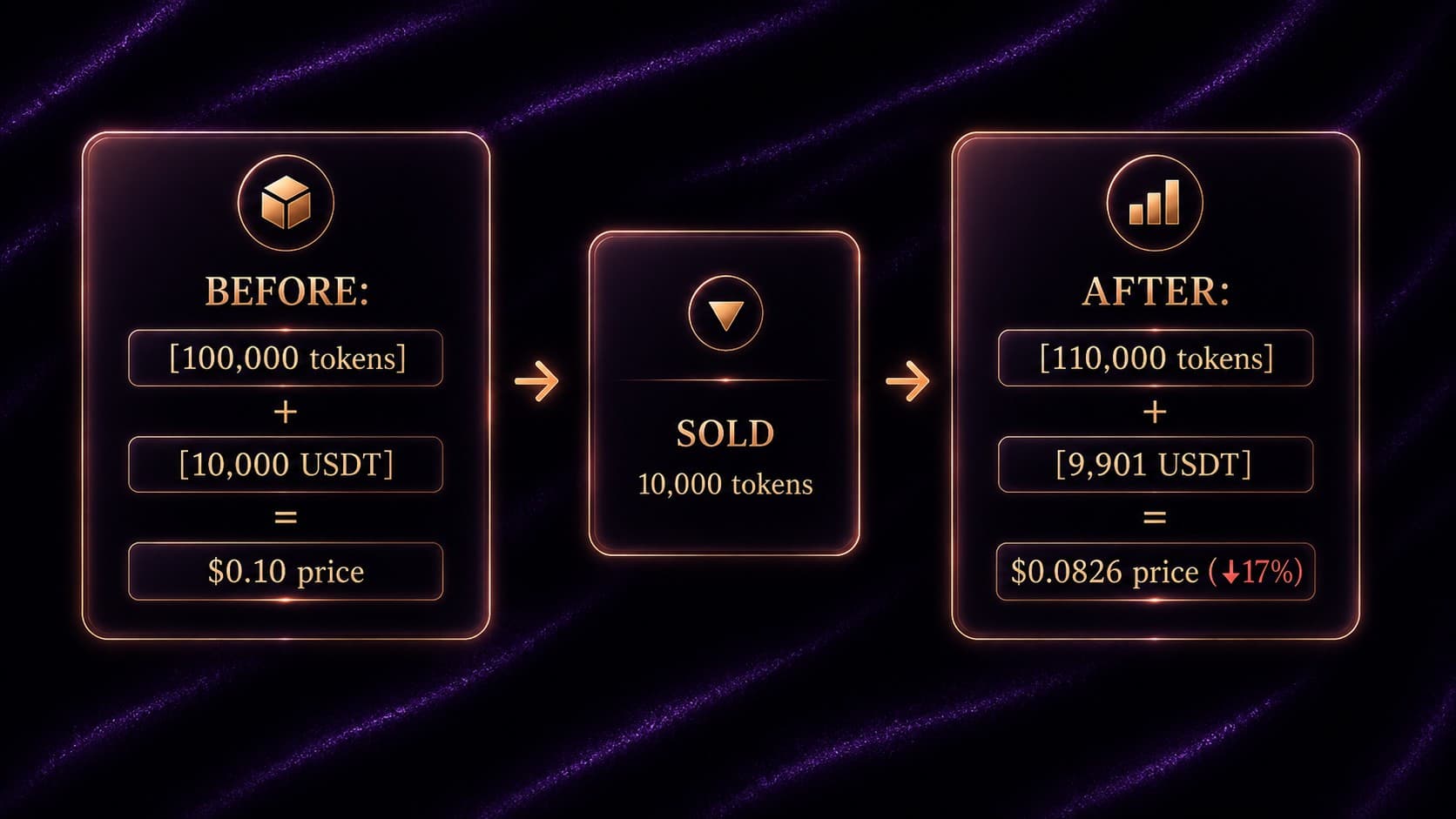
In a thin pool, one sell can move the price double digits — pure constant-product mechanics.
What is the most common DEX-listing mistake?
The most common mistake is sizing the pool to the starting price alone. Teams reason: "We want $0.10, so 100,000 tokens and $10,000 — done." But the starting price is just the first point on the chart. What matters is what happens an hour, a day, and a week after listing.
If those scenarios are not modelled, the listing becomes an expensive stress test. The pool turns out too small, a few sells push the price down, the chart goes red, new buyers wait for a lower price, and early holders rush the exit. Past that point, product quality stops mattering — the market reacts to the fall.
How much liquidity do you actually need?
There is no universal number. It depends on the community, Fully Diluted Valuation (FDV), circulating supply, vesting schedule, expected seller pressure, the network, the chosen DEX, and market conditions. The governing rule: the more tokens that can hit the market after launch, the deeper the pool must be.
A $10,000–30,000 pool is fragile — acceptable for a small launch community or a test, almost guaranteed to contract on the first real sells for a serious project. A solid pool is usually discussed in the hundreds of thousands: $300,000–700,000+ is not luxury but insurance, smoothing price jumps and absorbing early-investor sells without breaking community trust in the first hours.
This capital is not paid to anyone — it sits in the pool and earns fees, drawn from Uniswap v3's three standard fee tiers of 0.05%, 0.30% or 1% depending on the pair. But from the project's side it is still real money: it must be sourced, locked, and exposed to market risk.
How liquidity leaks out of the pool
The worst case is mechanical. A project funds a pool with its token and USDT; after listing, users sell — depositing tokens, withdrawing USDT. More project tokens accumulate in the pool, fewer stablecoins remain, and the price falls. Sellers walk away with a liquid asset; the project is left with a worsening chart.
That is the central risk of a DEX listing: a poorly designed launch turns your own liquidity into a discount sale of your token. Before launch you must calculate not only how much you put into the pool, but how much the market can take out.
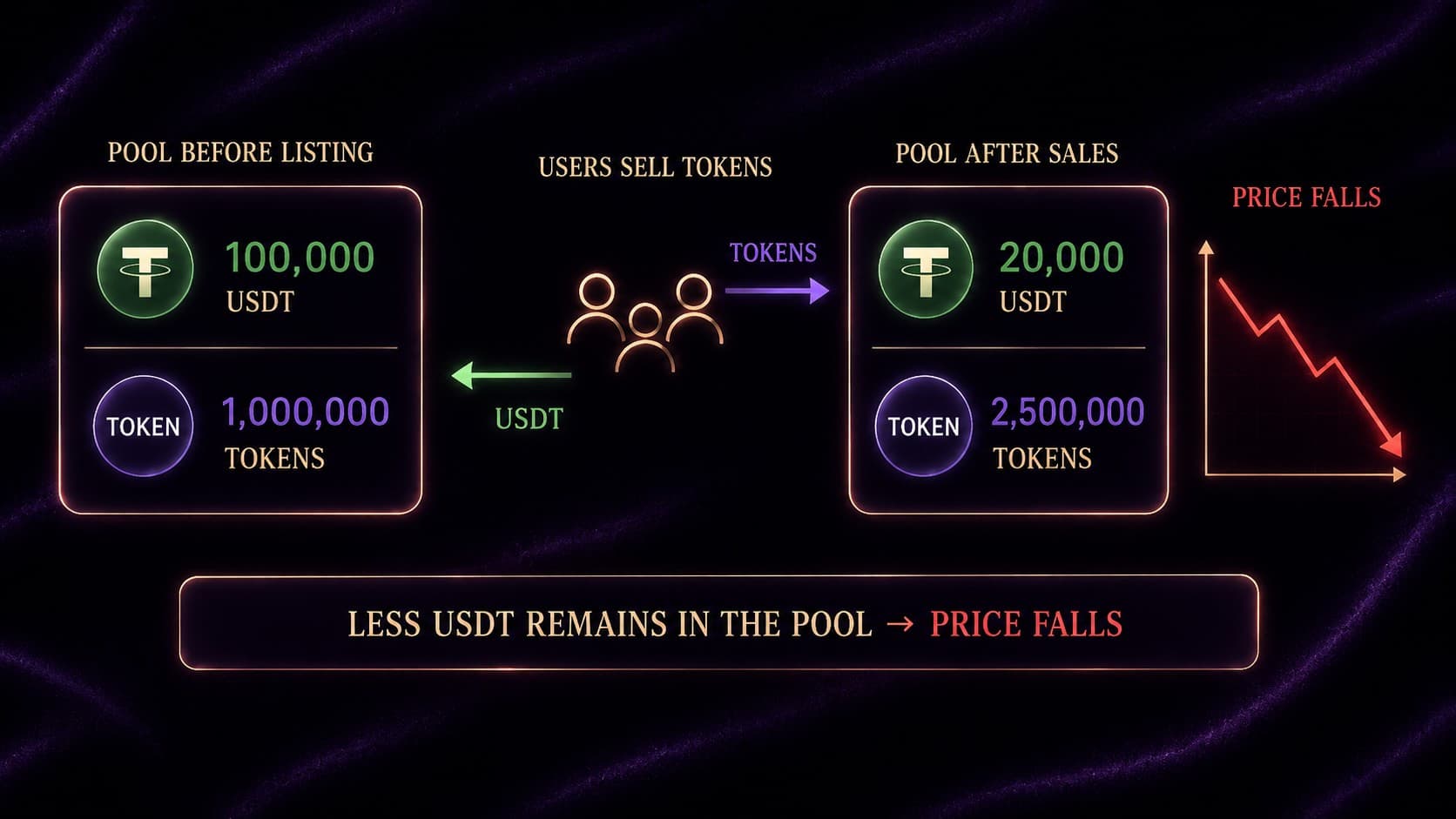
Sells deposit tokens and withdraw stablecoins — the pool drains and the price slides.
What to prepare before listing on a DEX
A DEX listing is not a "create pair" button — it is a full market launch around the token. Seven elements must be ready before debut:
- Tokenomics. Who gets tokens, when they unlock, and what share can reach the market right after the TGE.
- Liquidity. How much to put in the pool, how large a price contraction the project can absorb, and which sell scenarios are plausible.
- Vesting. If too many tokens unlock early, even a strong product faces heavy seller pressure.
- Community. It must understand what the token is for and why it is not just a quick speculative asset.
- Legal. The token must be checked for jurisdiction, compliance, and market restrictions.
- Security. Smart contracts, the pool, distribution mechanics, and admin rights must be verified before launch, not after the first incident.
- Post-listing plan. What the team does if the price falls, how it explains volatility, what it tracks, and when and how it moves to a CEX.
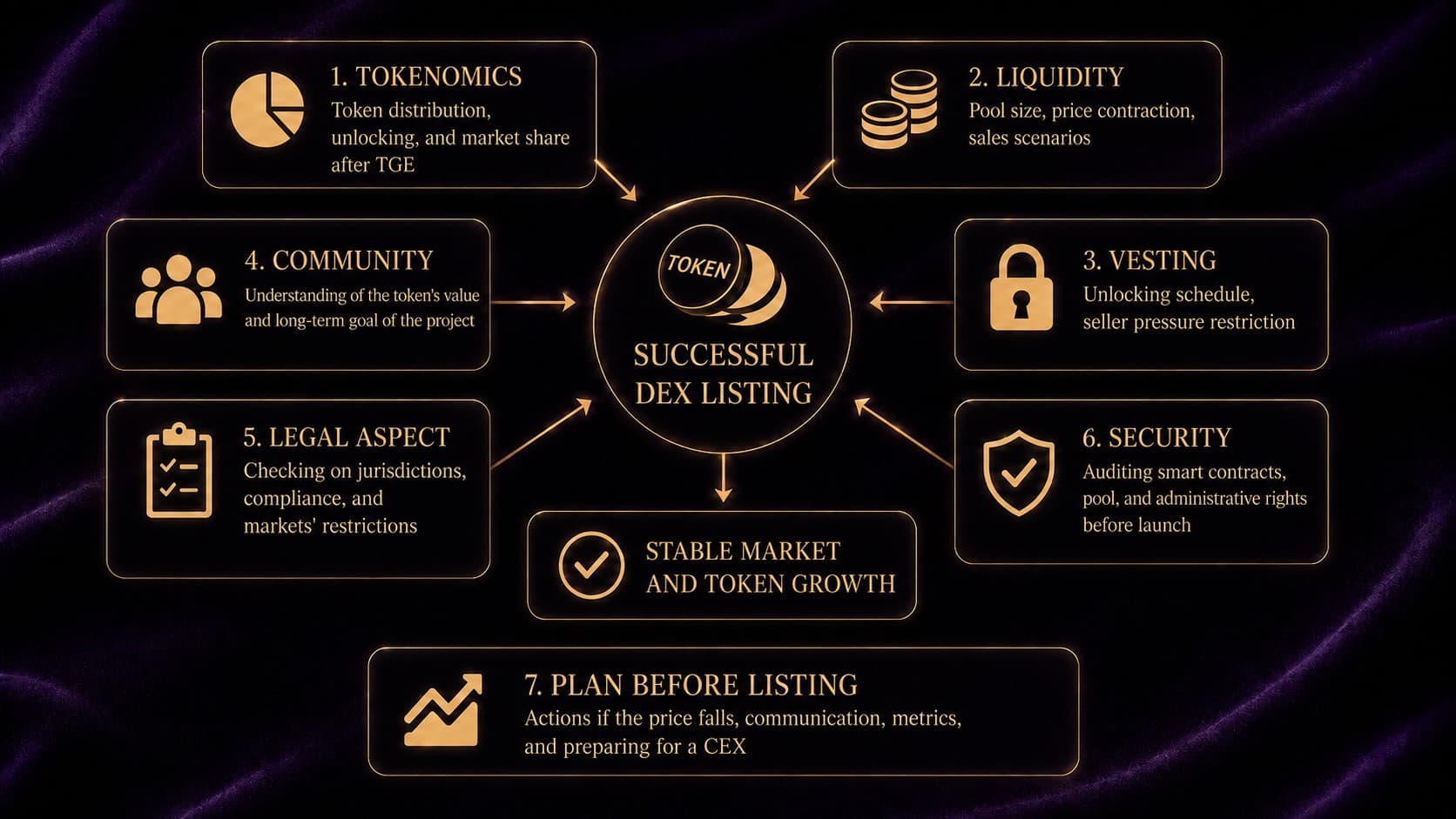
A DEX launch is a coordinated market event across seven workstreams.
When a DEX is the right option — including under VARA in Dubai
A DEX is justified as a strategic tool, not as the easier path: to test demand, give the early community access, and build a trading history — a portfolio for future CEXs. The strongest case is a token already integrated into the product, where users buy it because they need it, creating organic demand rather than speculation.
For teams launching from the UAE, the regulatory layer is part of the plan. The VARA Rulebook requires virtual asset exchange services in Dubai to hold a license with minimum paid-up capital from AED 800,000 and an application fee of AED 100,000, and obliges VASPs to maintain liquid-asset buffers. Marketing to UAE investors is regulated regardless of license, with fines up to AED 10 million. A DEX strategy targeting UAE users has to budget for these requirements alongside pool liquidity.
Which story will you choose?
A DEX listing is a point of no return: from that moment the token is a public asset, evaluated not by roadmap but by team behaviour. The real question before listing is not which DEX, but which story you present in the first weeks — a chaotic start where the team fights fires and explains contractions, or a managed debut where token roles, distribution logic, holder strategy, and the path to a CEX are clear. A DEX gives a strong advantage only as part of a calculated strategy, not a box-ticking listing.
Key takeaways
- DEXs charge no listing fee, but the real cost is liquidity locked in the pool and exposed to market risk.
- AMMs follow x × y = k: in a thin pool, a single sell can move the price double digits (Uniswap).
- A $10,000–30,000 pool is a test; serious launches usually need $300,000–700,000+ of depth.
- Model how much the market can withdraw, not just how much you deposit — sells drain stablecoins and crash price.
- UAE launches must budget VARA licensing (from AED 800,000 capital, AED 100,000 application) alongside liquidity.
FAQs
Can you list on a DEX with no money?
Technically yes — creating a pair on Uniswap or PancakeSwap is nearly free. But creating a pair and launching trading that survives are different things. Without adequate pool liquidity, even small sells can crash the price beyond recovery.
How much liquidity do you need for a DEX listing?
It depends on community size, circulating supply after the TGE, the vesting schedule, and expected seller pressure. A $10,000–30,000 pool suits a small test; a serious project usually needs $300,000–700,000 or more so the pool does not collapse on the first sells.
Is liquidity in a pool an expense or an investment?
Both. The money is not paid to an exchange — it sits in the pool and earns trading fees (in Uniswap v3, 0.05%, 0.30% or 1%). But it is real capital under market risk: if holders sell heavily, stablecoins drain out and you hold your own token at a lower price.
Do you have to list on a DEX before a CEX?
No. If a project already has a strong community, confirmed demand, and direct CEX access, an unnecessary DEX stage only adds risk. A DEX is step one when you need to prove the token survives the open market and build a trading history.
What are the rules for listing a token in Dubai under VARA?
Virtual asset exchange services require a VARA license with minimum paid-up capital from AED 800,000 and an application fee of AED 100,000. Marketing to UAE investors is regulated regardless of license, with fines up to AED 10 million. A DEX strategy targeting UAE users must account for these requirements.
Sources
- Coinbase — "Listing assets on Coinbase is free, and always has been" (2025): coinbase.com
- Uniswap — "What is an Automated Market Maker?" (constant-product AMM): blog.uniswap.org
- Uniswap Labs — "What are fee tiers?" (0.05% / 0.30% / 1%): support.uniswap.org
- VARA — Virtual Assets Regulatory Authority Rulebook (Exchange Services license, capital and liquidity rules): rulebooks.vara.ae
About 8Blocks
8Blocks is a strategic tokenomics consulting firm for Web3 teams. Founded in 2017 and headquartered in Dubai (8BLOCKS FZCO, DMCC), the company has delivered 30+ tokenomics models across DeFi, GameFi, and RWA projects. 8Blocks offers tokenomics design, tokenomics audits, and Token Lab — a free structural scoring tool available on Base App and Telegram.
The content of this article is provided for informational and educational purposes only. It does not constitute investment, financial, tax, or legal advice. Digital assets are volatile and carry a risk of total loss. Readers should conduct independent research and consult qualified advisors before making any financial decisions.

When the Product Grows but the Token Doesn't
The crypto market has changed fast over the past few years. Products are more complex, regulation is tighter, and users expect more. But one part of the industry is still stuck in the last cycle. It's tokenomics.

The 5 Most Common Tokenomics Mistakes and How to Avoid Them
Very few people understand tokenomics. Even in specialized crypto forums, most of the real discussions happen between funds, market makers, and teams that have already launched a token and learned the hard way. This article is for those who are about to launch and want to avoid the usual mistakes.
What Drives DASH Coin Demand? A Look at Real Utility
Dash is a rare success story as it combines sustainable coin demand with real utility. It demonstrates how hype and incentives fall short. Dash has achieved this via collateral requirements, decentralized infrastructure, data services, and treasury independence.