Web3Eco. Industrial RWA 2.0 — investing in trees with hedge-fund-grade returns
Web3Eco had tokenised 230 hectares of paulownia and caper plantations in the Fergana Valley and raised over $3M from 450 private investors, but sales of its HECTARE Security Token stalled. The asset was illiquid, a 16–19% USDT yield looked dull next to DeFi, and growth in harvest, land bank and profit had no effect on the token price. The task was to build tokenomics in which the value of the utility token depends on the profitability of the business.
Build a tokenomics model in which the value of the utility token depends on the project's actual profitability, and make a long-term agricultural asset liquid enough for crypto investors.
Web3Eco is a 15-person team of agronomists, lawyers and financiers — not blockchain developers or game designers. There was no capital and no time to build a lending protocol, a secondary-market platform or a farming game, and every additional product would have added smart-contract, regulatory and operational risk. The solution had to sit in the token economy itself, not in new products.
- 01
Designed the Proof of Asset protocol: 74.42% of W3ECO supply locked, with a fixed monthly unlock distributed pro rata among all HECTARE holders
- 02
Built the Utilization Window: 10% of annual profit funds redemption of W3ECO at internal value derived from the ecosystem's economics, not from market sentiment
- 03
Structured the two-token model (HECTARE + W3ECO) and a realistic roadmap through TGE and CEX listing
The utility token stopped being a passive digital certificate. W3ECO's internal value is now a function of the total annual yield of all HECTARE tokens divided by W3ECO supply, so it rises as the land bank and profit grow, and falls honestly if the business underperforms. Investors receive monthly access to future yield instead of waiting out a seven-year production cycle, and the Utilization Window gives them an exit at a value they can model years ahead.
Stage: Pre-TGE Seed Round (valuation: $48M FDV)
BlackRock and other banks are tokenizing billions in assets, but retail crypto enthusiasts aren't moving into RWA. Why? Because for them it's too boring, while for classic investors it's exactly the opposite: highly attractive.
But a quality asset alone doesn't guarantee success. Often a project simply lacks the resources to present itself properly to the market. We helped the agricultural project Web3Eco close that gap. We designed a utility token for it, built a two-token model, and laid out a realistic roadmap all the way to a CEX listing.
For the UAE this is more than a theoretical debate. Dubai and Abu Dhabi have become one of the world's main hubs for tokenised real-world assets: VARA licenses virtual-asset activity in Dubai, ADGM runs its own framework in Abu Dhabi, and Dubai Land Department has already put title deeds on-chain. The projects arriving here usually have the asset and the regulatory wrapper. What they lack is exactly what Web3Eco lacked — a token economy that reacts to the business.

A paulownia plantation: the physical asset behind the HECTARE token
Why RWA still hasn't taken off
Over the past two years, the market for tokenizing real-world assets (RWA) has become one of the most talked-about topics in the crypto industry.
JPMorgan is building out its Kinexys platform for asset tokenization, Franklin Templeton has been running tokenized money market funds for several years, and the total volume of such assets has already surpassed $15B.

Retail crypto capital still treats RWA as a slow, strategic game
It would seem this is the long-awaited bridge between TradFi and DeFi. Yet retail investors aren't moving into RWA.
Institutional players are, of course, coming in with multi-million-dollar checks. But the average crypto enthusiast, used to the yields on Aave or Yearn, looks at tokenized real estate or agriculture with skepticism.

Why is that? Most RWA projects stop at tokenizing the asset itself and barely engage with the token's economics. Legally, the investor does get a share in real estate, land, or a loan portfolio. Economically, though, the token remains a passive digital certificate that barely participates in the protocol's life and gains no additional value as the business grows.
— Toni Efren
Tokenization alone doesn't make an asset more attractive. If real estate can be sold successfully through traditional channels, it doesn't need tokenization. If it sells poorly because of low liquidity or high risk, issuing a token doesn't fix that. Only the form of ownership changes; the underlying asset stays the same.
That's why many projects try to solve this with a utility token. The idea is that it should attract a crypto audience through staking, rewards, discounts, access to services, and other Web3 mechanics.
But that doesn't work, because the token is disconnected from the business.
This is the problem the Web3Eco team brought to us. Their task was to build a tokenomics model in which the value of the utility token would depend on the project's returns.
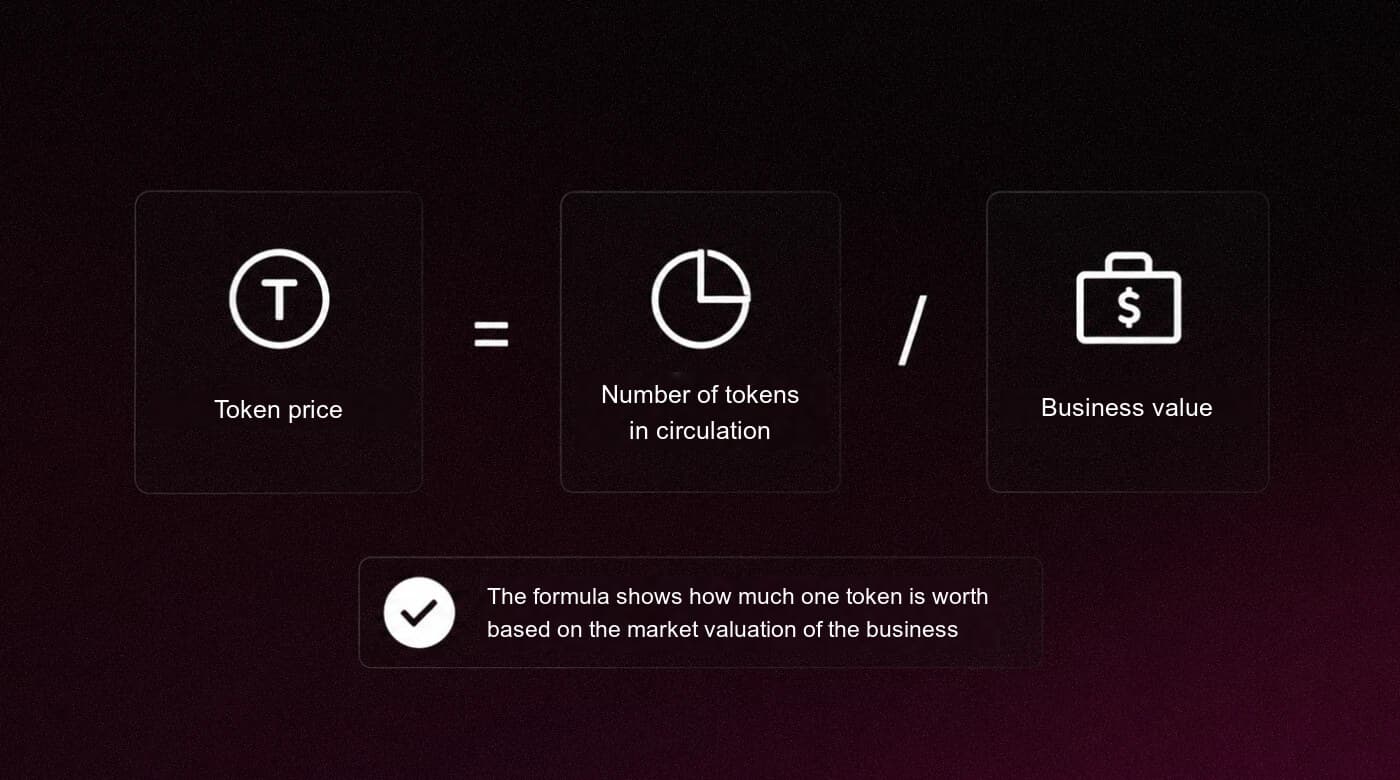
Token price = circulating token supply / business value (as stated in the project materials)
We found the answer not by making the ecosystem more complex, but through an elegant economic mechanism: Proof of Asset.
In this article, we'll trace the project's path from the first idea to the final mechanism. We'll pay particular attention to how consistently rejecting "trendy" solutions (lending protocols, gamified mechanics, and NFT farms) led to the creation of a universal tool. This tool can redefine the approach to tokenomics for any real-sector business with predictable cash flow.
— Toni Efren
Chapter 1. Anatomy of the problem. Why a Security Token doesn't work as an investment
Web3Eco began as a classic agribusiness. The company leased 230 hectares of land in the Fergana Valley (Uzbekistan), planted 150,000 fast-growing paulownia trees and 150,000 caper bushes. The legal structure follows Swiss standards, the land is held under a long-term lease, and it sits on the balance sheet of an SPV.
Web3Eco went on to successfully tokenize its assets, raising over $3M from 450 private investors and launching the Security Token HECTARE. But sales slowed and demand dried up.
Web3Eco: 230 hectares in the Fergana Valley, planted in 2023
Returns from selling timber and related products (capers, honey, essential oils) were projected at 16–56% annually, depending on the asset holding period. Maximum returns were expected in year 7.
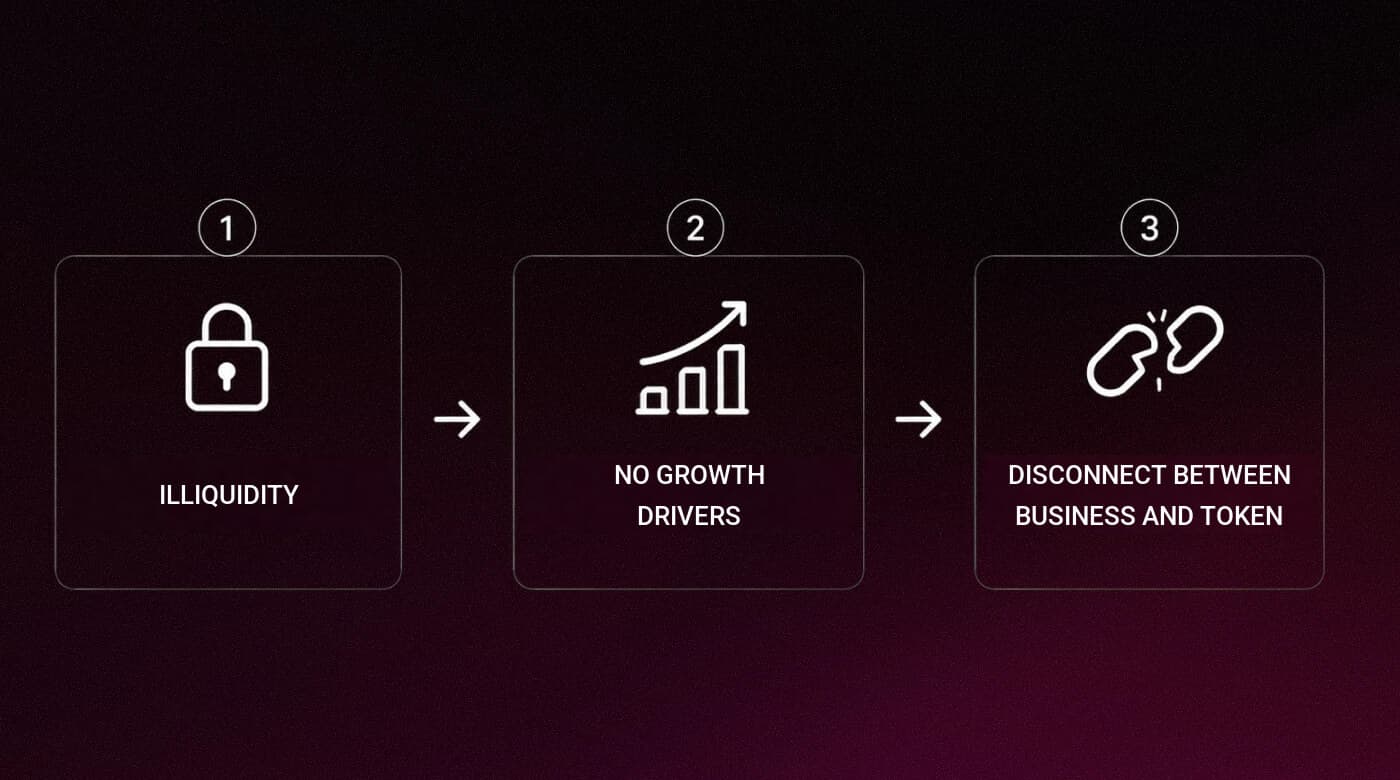
Three reasons HECTARE sales stalled
What caused the sales slowdown?
- First, illiquidity. The HECTARE token was tied to a real asset, but that asset couldn't be sold quickly. If you held a share in the field, your capital was locked until the company found a new buyer. A secondary market for the token effectively didn't exist.
- Second, the lack of growth drivers. While 16–19% annual yield in USDT for the first couple of years is a solid figure for conservative investments, most crypto market participants have traditionally higher expectations. Against the backdrop of yields on decentralized protocols (where you can get 50–100% APY in good times), agriculture looked boring.
- Third, the gap between the business and the token. Most importantly: growth in harvest yields, expansion of the land bank, and increased profit had no effect on the HECTARE price.
Chapter 2. Searching for a solution: three approaches and two dead ends
Before finding a working mechanism, we tried three options. Two of them were rejected. And that path of trial and error helps explain why the final solution turned out to be so elegant. Let's break it down below.
2.1. First idea: paying with tokens
The most obvious solution: make it possible to buy the project's real assets with tokens. In other words, if you want to acquire a share in the plantation (Security Token HECTARE), you'd have to pay with the utility token W3ECO.
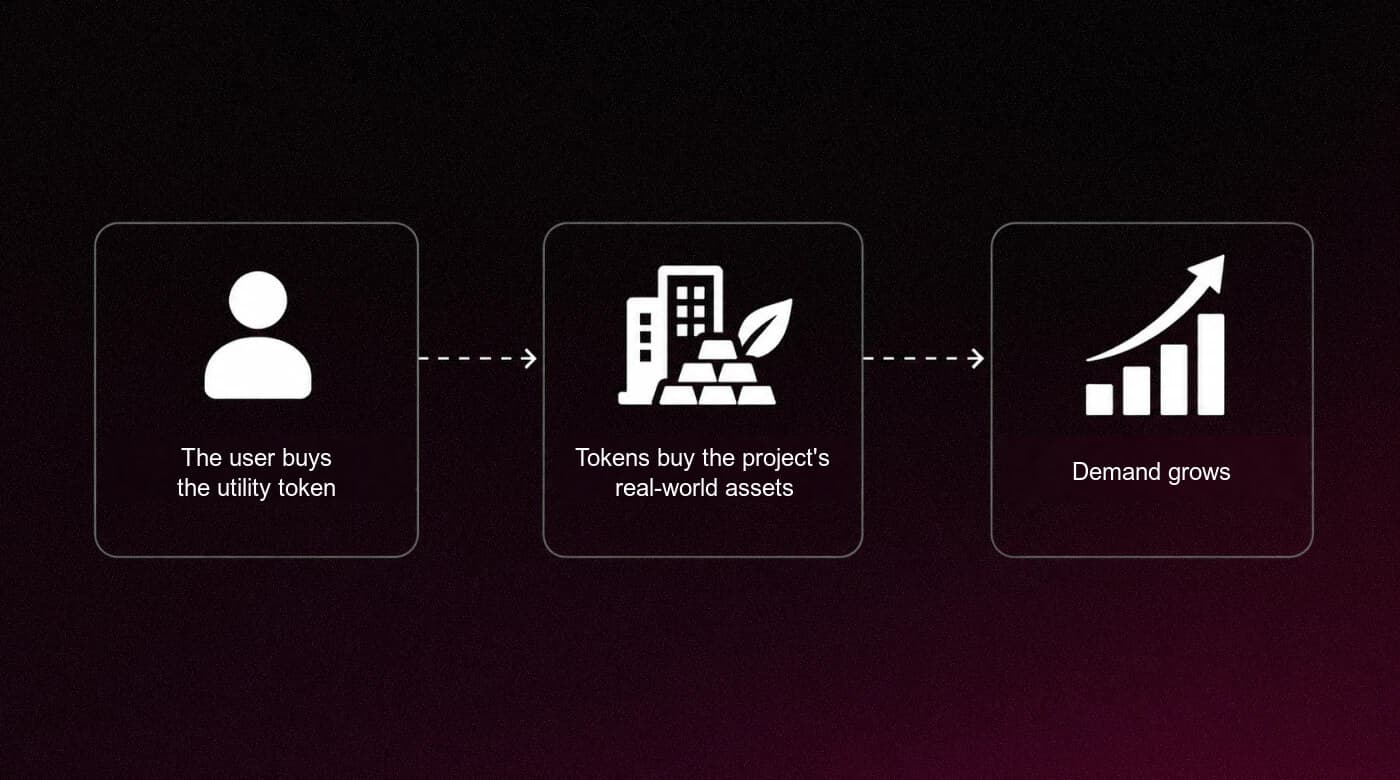
First idea: buying real assets with the utility token
This creates forced demand. To buy land, you first have to buy W3ECO on the exchange. Demand grows, the token price grows too.
But moving to the settlement mechanics, we run into a choice of pricing base. Should the land's nominal value be pegged to the internal W3ECO token, or should we keep the price tag in stable dollars and allow payment in tokens at the current rate?
At first glance the second option looks safer, but both models carry risk. If land value is fixed in tokens, the price of the asset itself starts to depend directly on the market value of W3ECO. If the token loses 50% of its value, the land automatically gets 50% cheaper, even though the asset itself hasn't changed at all.
A dollar peg doesn't solve the problem either. If a hectare always costs, say, $50,000, and payment is made in tokens at the current rate, the question becomes: why have your own token at all?
What's more, this opens the door to arbitrage. An investor can buy W3ECO at $1, hold it for a few years, and then, once the token grows to $10, buy land at the old dollar price, effectively paying ten times less for it. In this case, the token's price growth starts working not for the project, but for early holders.
Crypto volatility is too high to build the pricing of real-world assets on it. A company can't change an asset's value every day in step with its own token's exchange rate, since that breaks the business model and creates legal risk.
— Toni Efren
And while the idea looked elegant from a crypto-market philosophy standpoint, practice turned out to matter more than ideology.
2.2. Second idea: an ecosystem super-app
The second approach was more ambitious. We proposed building a whole ecosystem around the token. Its components:
- A lending protocol. HECTARE holders could pledge their tokens as collateral and take out loans in stablecoins against them. This would solve the liquidity problem, since investors wouldn't need to sell their shares to get cash.
- A secondary market. A dedicated platform for trading the Security Token, access to which would open up through burning or locking W3ECO.
- Gaming mechanics. A farming simulator in the style of Stardew Valley that would attract millions of users and create organic demand for the tokens.
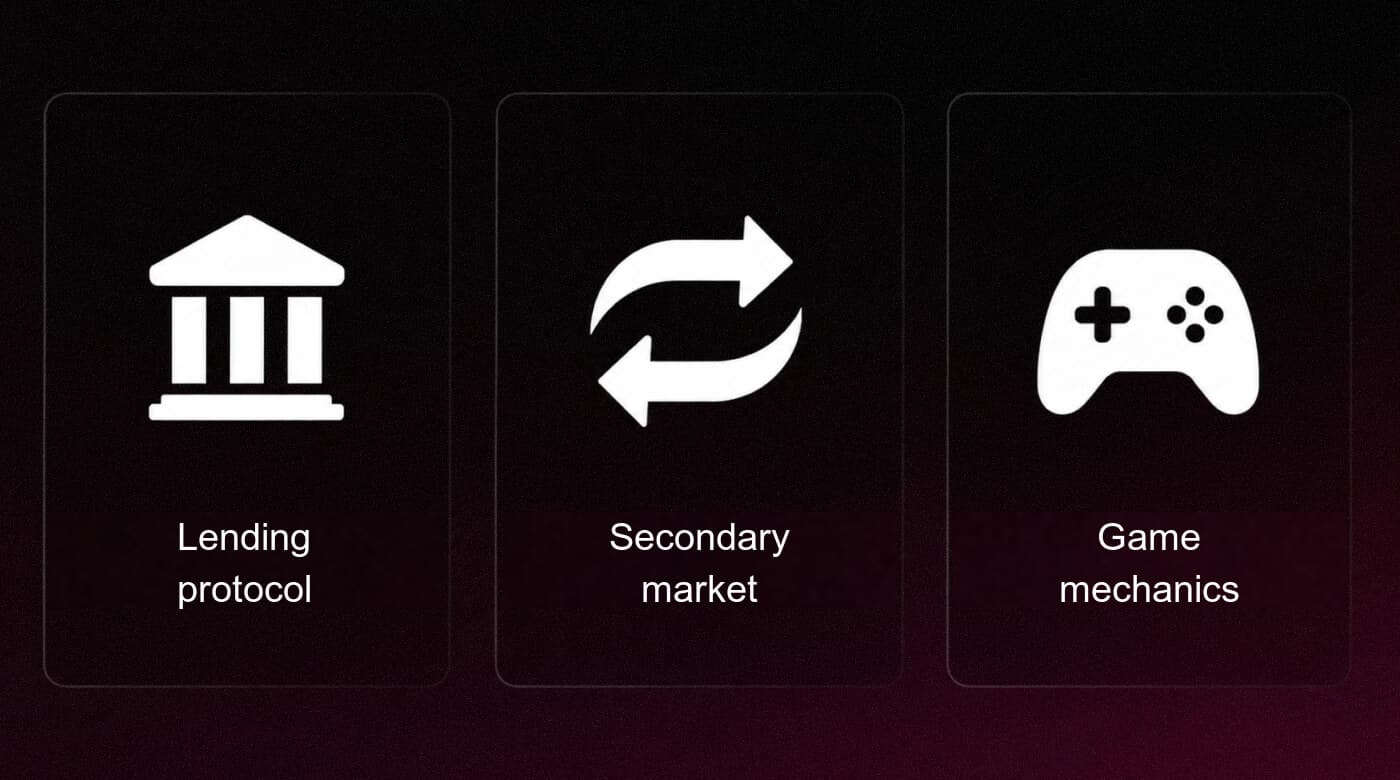
Second idea: a lending protocol, a secondary market and game mechanics
The idea was dropped because the project ran into a resource constraint. The Web3Eco team is only 15 people, and its core is agronomists, lawyers, and financiers, not blockchain developers or game designers.
Growing the team required extra capital (which wasn't there) and time (which also wasn't there, since the RWA market was growing fast and we needed to move quickly). On top of that, every new product created new risks: smart-contract vulnerabilities, regulatory pushback, operational failures.
2.3. Third approach: a paradigm shift
Having ruled out two unrealistic options, we went back to first principles. Instead of inventing new entities (lending, games, markets), we asked ourselves: "What does an investor actually need?"
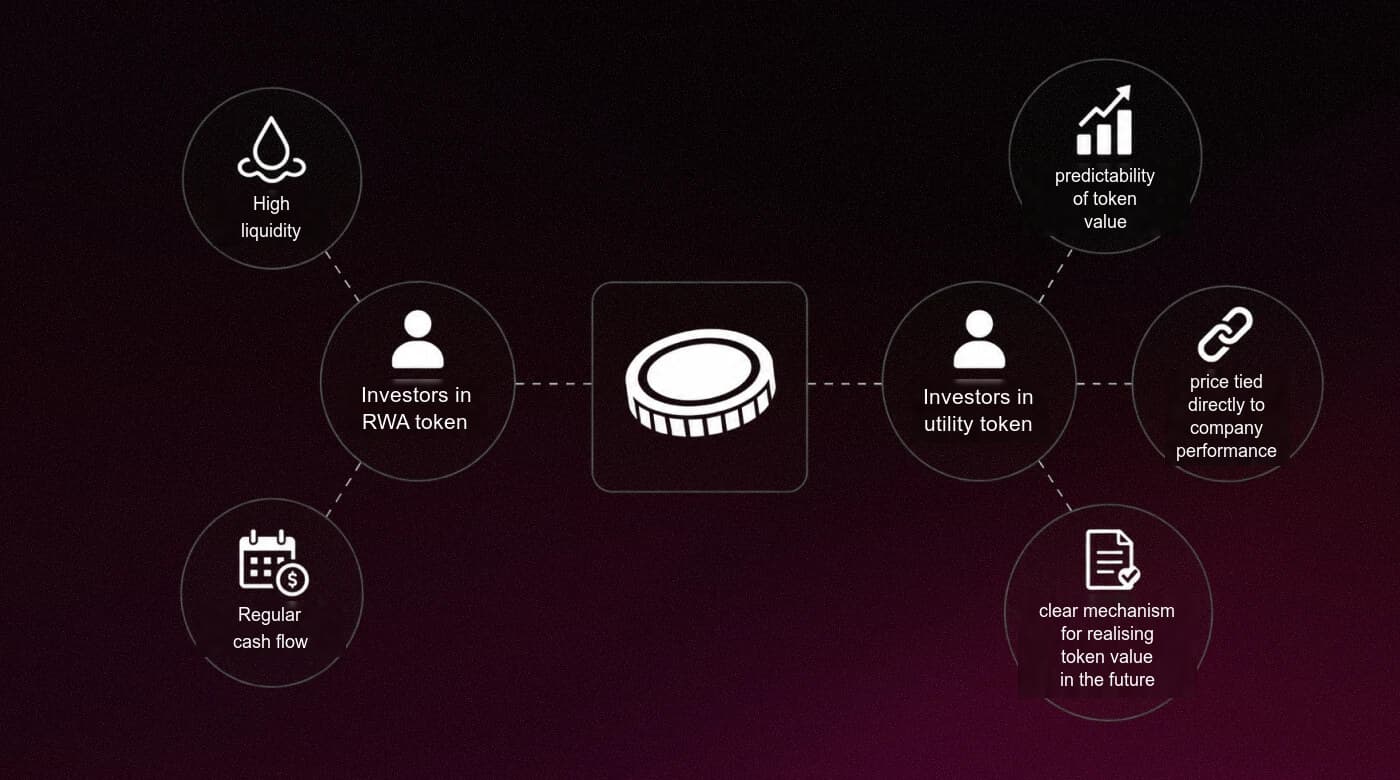
What RWA-token investors and utility-token investors each need
Investors in an RWA token first and foremost want economic benefit from owning a real-world asset. What matters to them:
- high liquidity, so they can exit the investment quickly if needed;
- regular cash flow, not waiting for an annual profit distribution.
Investors in a utility token, by contrast, aren't valuing the asset itself, they're valuing the ecosystem's growth potential. What matters to them:
- predictability of the token's value;
- a direct link between its price and the company's success;
- a clear mechanism for realizing the token's value in the future.
All of these requirements are incompatible with models where price is set purely by market demand or promises of future returns. The one solution able to meet all four needs at once is Proof of Asset.
Chapter 3. The Proof of Asset Protocol: how to make a long-term asset liquid
The problem with RWA projects is that even high-yield assets only start generating cash flow once the full production or investment cycle is complete.
With real estate, that means collecting rental payments or selling the property. In agriculture, it means growing, harvesting, processing, and selling the crop. Until those events happen, the investor sees no real cash flow.
For traditional long-term investments this is normal, but in a crypto-market context the investor's capital ends up locked up for months or even years. Even if an asset can deliver a 30% annual yield, the investor has to wait for the cycle to finish to get actual confirmation that their investment is working.
— Toni Efren
It's exactly this gap between an asset's real return and access to it that the Proof of Asset Protocol closes.
3.1. Monthly monetization of future yield
Proof of Asset is built on a pool of W3ECO utility tokens. At the time of writing, 74.42% of the total W3ECO supply is locked in the protocol — these tokens are not in free circulation but are used to run the protocol.
Every month, the protocol automatically unlocks a strictly fixed number of tokens (for example, 1,000,000 W3ECO) and distributes them proportionally among all holders of the HECTARE Security Token.
HECTARE — Security Token
- Confirms ownership (or an economic right) to a real asset
- Grants the right to the plantation's yield
- Its yield is backed by a real business
- Issued against specific hectares and assets
W3ECO — Utility Token
- Used inside the protocol's ecosystem
- Grants no ownership of the asset
- Its value is tied to the protocol's mechanisms
- Used for settlement, liquidity and Proof of Asset
The principle works like this:
- If the project has only 2 HECTARE holders, each receives 500,000 W3ECO.
- If the number of holders grows to a million, that same million tokens is split among a million participants, and each receives 1 W3ECO.
It's important to understand, though, that the investor doesn't receive W3ECO as an extra bonus — it's a digital representation of a share of their future yield.
Suppose an investor's share of HECTARE is set to generate $12,000 in annual profit. The protocol then pays the investor X tokens every month, which serve as a unit of account. At the end of the year, the investor can redeem all the tokens received and claim their annual yield on HECTARE.
— Toni Efren
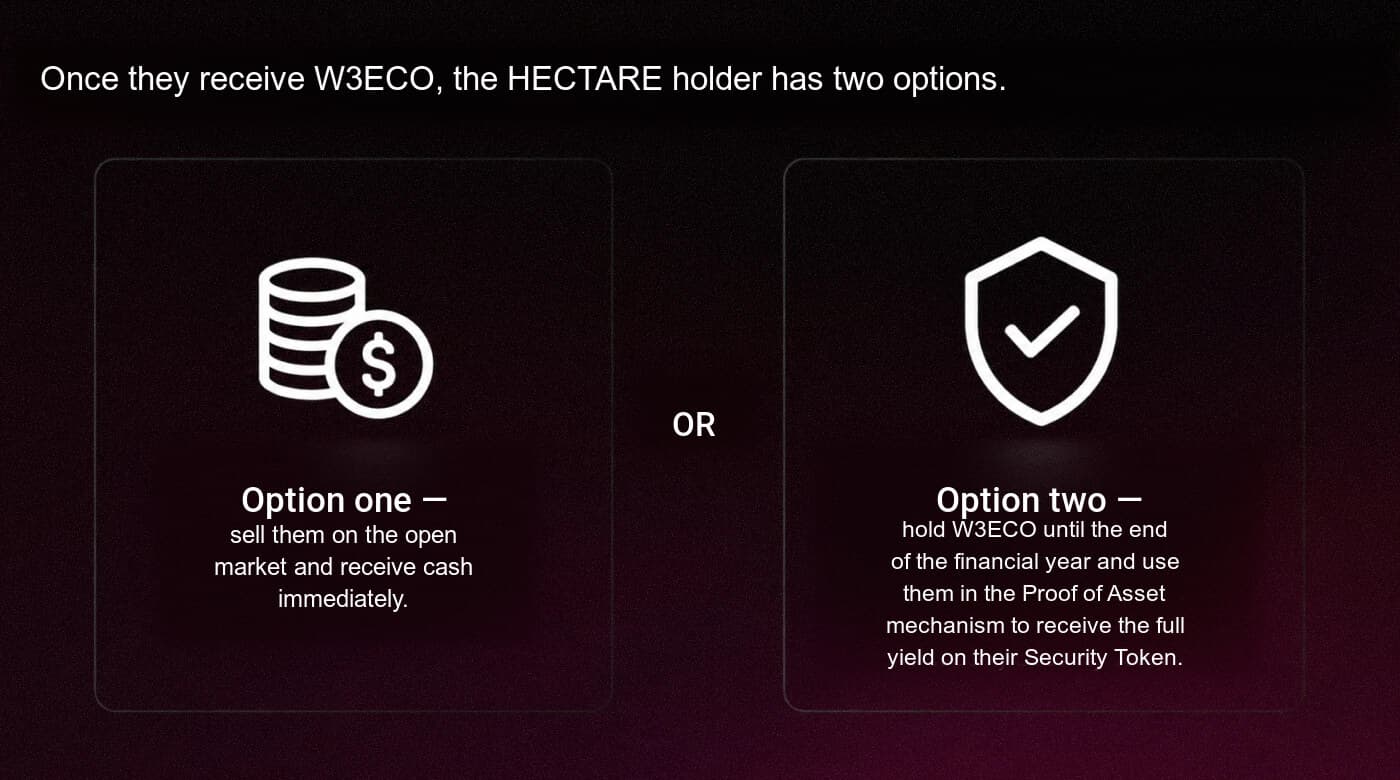
Two options for a HECTARE holder after receiving W3ECO
Once a HECTARE holder receives W3ECO, they have two options.
- The first is to sell them on the open market and get cash immediately.
However, at the end of the financial year, to receive 100% of the yield on their Security Token (HECTARE), the investor must redeem the exact amount of W3ECO credited to them for the reporting period.
For example, if an investor was credited 1,200 W3ECO over the year (100 tokens each month), they must return all 1,200 W3ECO to receive the full annual yield. If during the year the investor sold part of their tokens, say 600 W3ECO, they'll be left with only 600 tokens at settlement time. In that case, they can only claim the corresponding portion of their annual yield. If the investor wants to receive the full yield, they can buy the missing 600 W3ECO on the open market, redeem all 1,200 tokens, and receive the payout in full.
— Toni Efren
- The second option is to hold the W3ECO until the end of the financial year and use them in the Proof of Asset mechanism to receive the full yield on their Security Token.
Knowing the annual yield of HECTARE tokens and the number of W3ECO tokens paid out, we can calculate the internal value of the token and utilize them through a special "Window." We'll cover this mechanism in detail later.
3.2. How the internal value of W3ECO is formed
The distribution mechanism described above doesn't just provide liquidity — it also establishes a value benchmark for the utility token.
The key factor here is simultaneous movement in two directions.
- First, as described in section 3.1, each investor's share of the fixed W3ECO pool objectively shrinks as the number of Security Token holders grows. The token supply per participant decreases.
- Second, the business scales in parallel: planted acreage, processing volumes, and the company's net profit all increase. This drives growth in the yield distributed among HECTARE holders.
The economic mass of the business grows, while the number of tokens per investor shrinks. This means an ever-greater value becomes concentrated in an ever-smaller number of W3ECO.
In other words, the larger the business becomes and the more investors participate in it, the higher the accounting value of each W3ECO.
3.3. A worked numerical example
In the example below, the W3ECO supply stays fixed at 1,000,000 tokens. But as the business grows, the number of HECTARE tokens and the aggregate yield they generate both increase.
- 2026 — $100,000 total HECTARE yield, 100 HECTARE, 1,000,000 W3ECO, $0.10 per W3ECO
- 2027 — $300,000 total HECTARE yield, 280 HECTARE, 1,000,000 W3ECO, $0.30 per W3ECO
- 2028 — $2,000,000 total HECTARE yield, 1,350 HECTARE, 1,000,000 W3ECO, $2.00 per W3ECO
It works out that:
Internal value of W3ECO = Aggregate annual yield of all HECTARE / Total number of W3ECO.
If the company doesn't scale, the internal value of W3ECO stays at $0.10. If the business shows losses, the price will fall, and that becomes an honest signal to the market.
Chapter 4. The Utilization Window: a liquidity mechanism for utility token holders
The key question for any utility token is: why buy it? In many projects, the answer amounts to: "Investors can always sell the token on the market."
But that answer just pushes the problem further down the line. If one participant sells a token, someone else needs to want to buy it. A new question arises: "Why would a new buyer want to acquire this asset right now, at this price?"
This is exactly the problem the Utilization Window mechanism solves.

The Utilization Window: an exit at internal value rather than at market emotion
4.1. From selling on the market to internal value
The Utilization Window is not a classic buyback. In a buyback, the company goes onto the open market and starts buying back its own tokens. The price is then set by market supply and demand. If liquidity is low or the market is in a panic, the token's value can diverge sharply from its fundamental worth.
The Utilization Window mechanism works differently. Instead of buying tokens on an exchange, the holder is given the option to exchange their W3ECO at internal (accounting) value, calculated from the economic indicators of the entire ecosystem.
Technically, the tokens are returned to the protocol, and the operation itself is treated as a contribution to sustaining and running the whole ecosystem. As a result, the price is set not by current market sentiment, but by an objective value formed by the yield of real-world assets.
— Toni Efren
4.2. Where the money comes from
Every year, part of the ecosystem's profit is directed into the Utilization Window fund.
In the Web3Eco project, 10% of annual yield is allocated for this purpose. During a set period, W3ECO holders can submit a request to utilize their tokens.
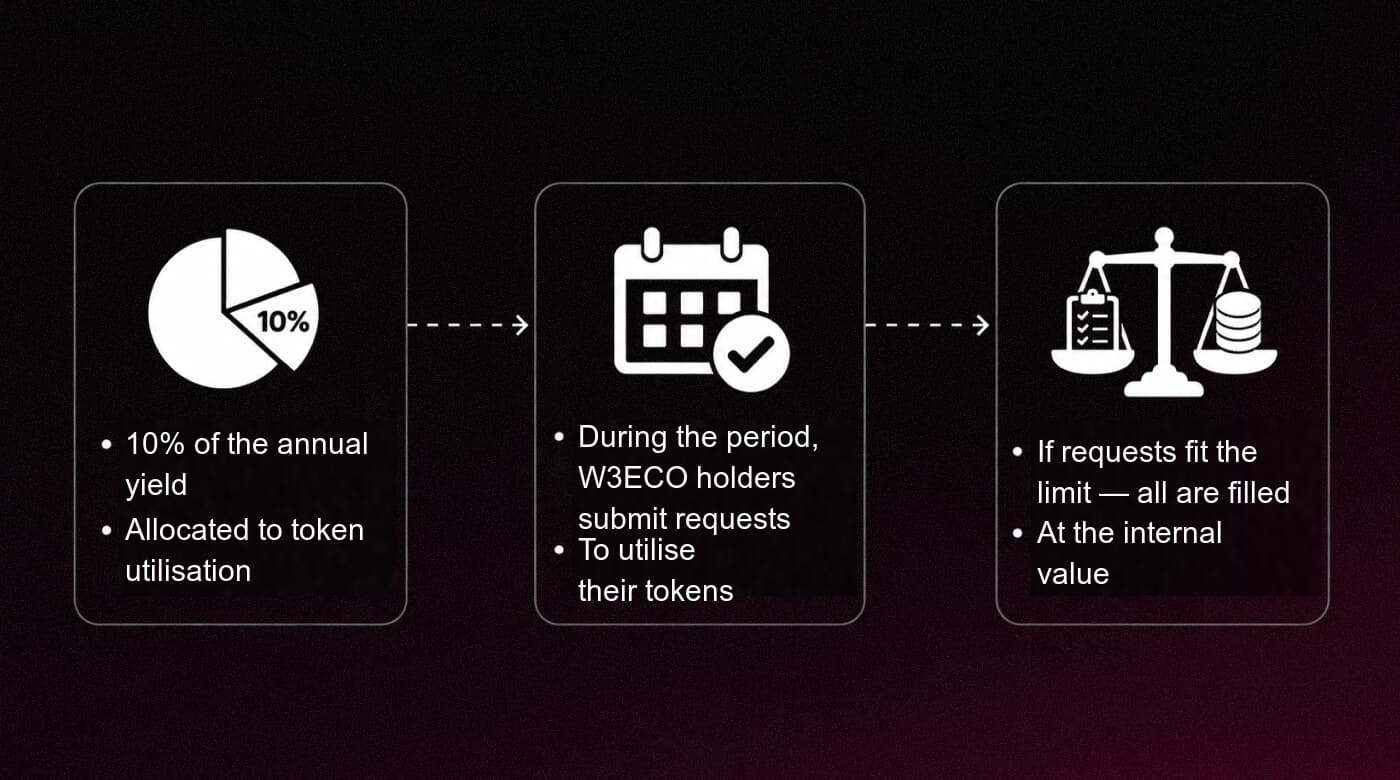
How the Utilization Window is funded
If the total volume of requests fits within the available limit, all requests are fulfilled at internal value.
If there are more applicants than money in the pool, requests are shifted to the next cycle. Investors do have a lever, though: they can offer a lower price, effectively triggering a downward auction, and in that case their requests get fulfilled sooner.
4.3. Long-term valuation of the token becomes possible
The advantage of the Utilization Window is that it enables fundamental analysis. A user can open the company's financial model and see:
- how many hectares of land will be purchased in 2027;
- the projected profit per hectare (accounting for tree growth);
- how many W3ECO tokens will be issued;
- what the internal price in the Window will be in 2, 3, 5 years.
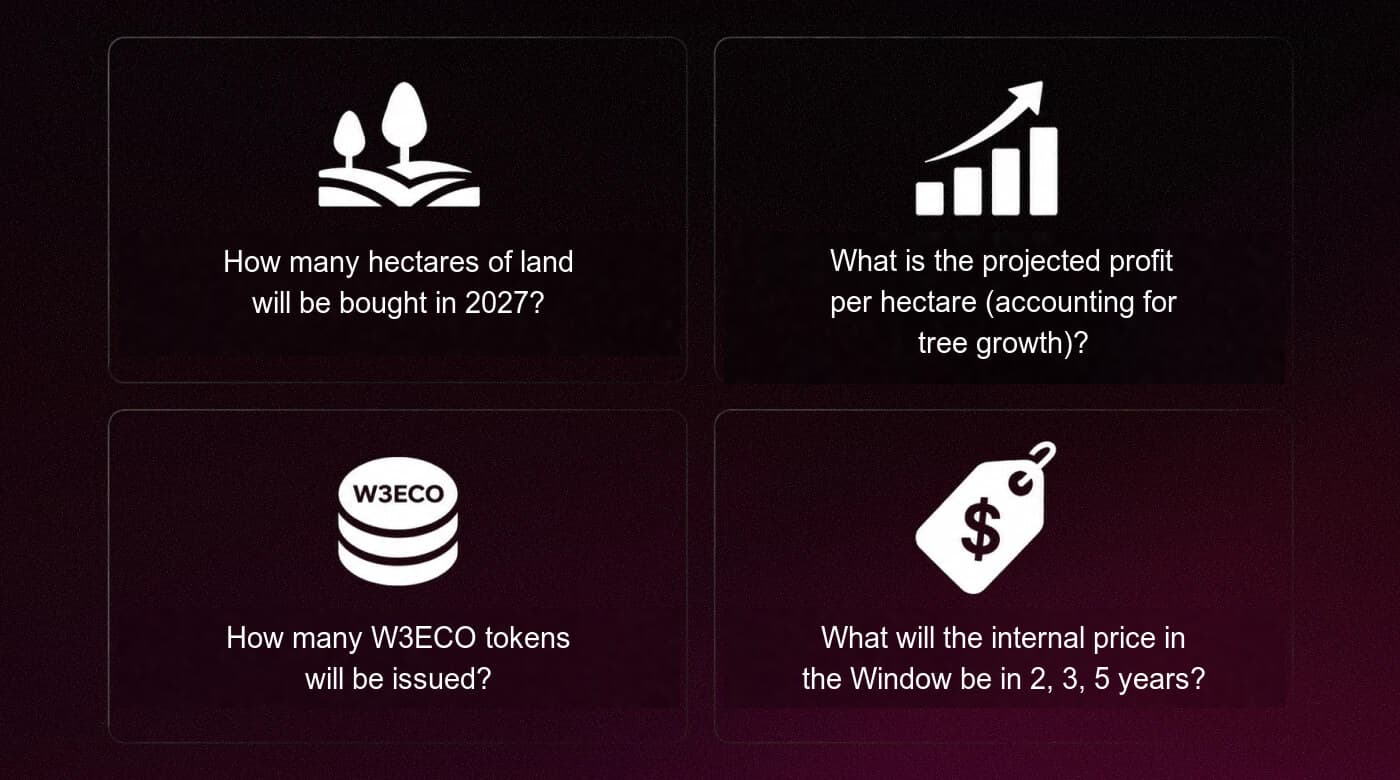
What a long-term W3ECO valuation can be built on
Here, the token is an indicator of business success, a mathematically calculated measure of the company's real achievements. And a unit of account that is exchanged back for yield on the security token, rather than bought back by the company.
This gives the user the ability to build long-term forecasts. Now they can estimate: in 2 years the token will be worth X, because the company will have planted Y trees.
— Toni Efren
Chapter 5. The symbiosis of the two mechanisms
On their own, Proof of Asset and the Utilization Window solve different problems. The first speeds up an investor's access to future yield, the second creates a mechanism for realizing the internal value of the utility token. But the real effect only emerges when they work together.
Proof of Asset ensures a steady inflow of W3ECO into the ecosystem and turns the long-term yield of real-world assets into a liquid digital instrument. The Utilization Window, in turn, ties the value of that instrument to the business's financial results and gives it a fundamental basis.
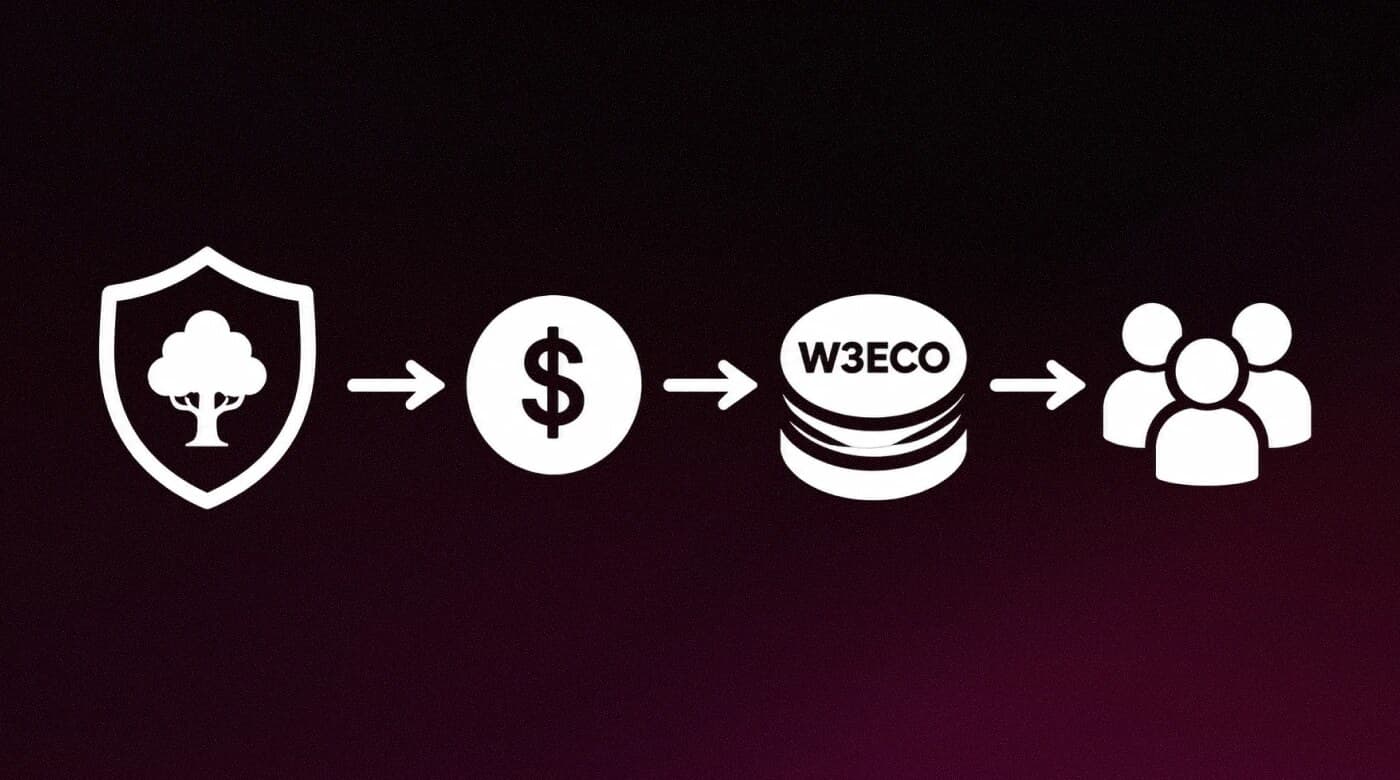
The closed loop: real asset, revenue, W3ECO, holders
The result is a closed economic loop. The yield of real-world assets becomes the source of value for W3ECO, and W3ECO becomes the instrument through which that value becomes available to investors well before the production cycle is complete.
At the same time, every new tree planting, every expansion of the land bank, and every increase in profit strengthens both mechanisms at once. The aggregate yield of the Security Token HECTARE increases, the internal value of W3ECO rises along with it, and the economic appeal of the entire ecosystem grows.
It's important to understand that W3ECO is not just a unit of account, but a full-fledged utility token. Beyond its accounting function, it opens access to loyalty programs, the secondary market, environmental initiatives, and carbon footprint reduction projects. That's why the value of W3ECO is determined not only by its role in the financial model, but also by the opportunities it provides within the ecosystem.
— Toni Efren
Chapter 6. Why this works for any business
Proof of Asset and the Utilization Window are universal across the entire RWA market and are not tied solely to trees and land. They rest on a universal economic principle: a company must be able to forecast future cash flow and objectively calculate the internal value of its assets.
If these conditions are met, the model can be applied in practically any industry.
For example, a developer could tokenize the yield of rental real estate, a manufacturing company could tokenize the future profit from its equipment's operation, an energy business could tokenize the cash flow from solar or wind power plants, and a venture fund could tokenize a portfolio of technology companies.
In the UAE the nearest candidates are obvious: rental yield on Dubai residential stock, cash flow from solar generation, receivables of trading companies operating through DMCC and JAFZA. In each case the asset already exists and the cash flow is forecastable — the only precondition Proof of Asset actually requires.
In every case, the logic stays the same. The real business generates profit, the Security Token secures the investor's right to that profit, and the utility token becomes the instrument that makes long-term value more liquid and easier to trade within the ecosystem.
Chapter 7. Numbers and facts: where the project stands today
To give you a sense of scale, the table below shows Web3Eco's current metrics as of this writing (July 2026):
- Land bank — 230 hectares in the Fergana Valley, Uzbekistan
- Plantings — 150,000 paulownia trees and 150,000 caper bushes
- Year planted — 2023
- Jurisdiction of the operating company — Switzerland
- Jurisdiction of the token issuer — Singapore
- Land title — lease agreement registered in Uzbekistan's land registry
- Assets tokenised — $10M
- Security Token sold — $3M
- Private investors — 450
- Community — 20,000+ members
- W3ECO locked in Proof of Asset — 74.42% of total supply
- Planned assets (2027+) — by-products (oils, honey, biofuel), orchards (fruit and nuts), CO₂ reduction projects
Chapter 8. Project roadmap
The project's development plan is split into several stages. As it scales, the land bank, sales volume, and the ecosystem's fundamental value all grow. That, in turn, lays the groundwork for a rising internal value of the token.
- Foundation (2022 – H1 2025) — 150 hectares, $2M in sales. Team assembled; pilot tokenisation.
- Release (H2 2025) — 230 hectares, $3M in sales. Platform v1 launch; referral programme launch.
- Growth (H1 2026) — 500 hectares, $15.5M in sales. TGE; Proof of Land integration; listing.
- Ecosystem (H2 2026) — 700 hectares, $27.5M in sales. RWA launchpad; secondary market for security tokens.
- Feature Expansion (2027+) — 50,000 hectares, $1B in sales. Land-plot IPOs; CO₂ reduction projects; timber processing plant.
Chapter 9. Token economics and forecasts
As for the market cap forecast, we're building in gradual growth in the ecosystem's value as the land fund scales up, new tokenized assets launch, and a larger share of tokens gets locked into Proof of Asset.
These figures are based on a conservative forecast for land bank growth and yield per hectare. Under an optimistic scenario (accelerated scaling, strong demand for carbon credits), the numbers could be higher.
An extra bonus for W3ECO holders: the Utilization Window can potentially deliver up to 150% APY over the next 5–7 years. That's because as the business grows, the buyback amount increases, while the number of tokens in free circulation stays capped thanks to the PoA mechanism.
— Toni Efren
Chapter 10. How this changes the rules of the game
The Web3Eco case shows a new approach to building tokenomics for RWA projects.
What we did:
- Instead of blindly copying buybacks or models from other projects, we analyzed the client's unique situation, a real-world asset with predictable returns, and built a custom solution.
- Rather than spreading ourselves across lending protocols, games, and metaverses, we focused on the economic link between the business and the token.
- In a world where 99% of crypto tokens behave chaotically, creating an asset with predictable value is a solid competitive edge. Institutional investors who fear volatility can now enter a project with clear, understandable math.
- The PoA mechanism can be adapted for any business with regular cash flow. That opens the door to tokenizing not just agriculture, but real estate, infrastructure projects, patent pools, and much more.
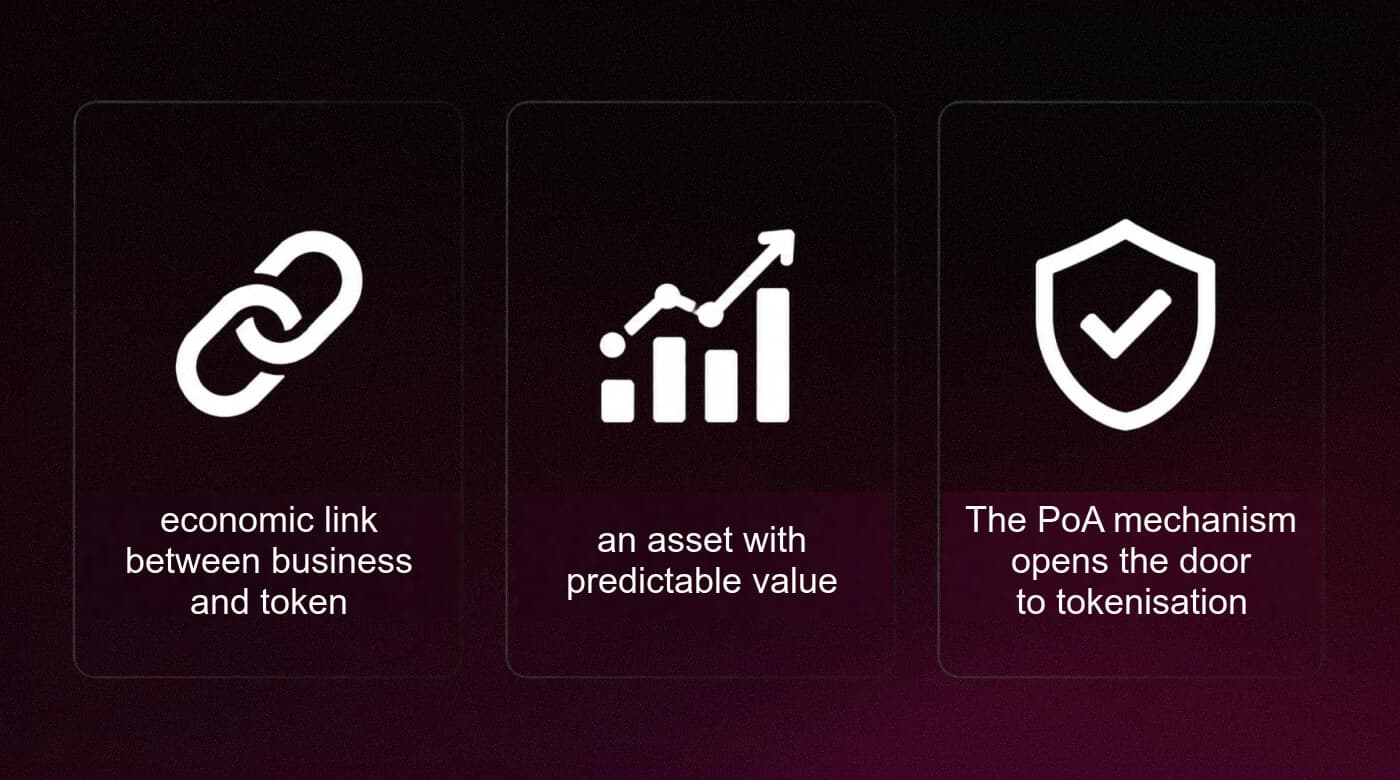
What the Web3Eco case delivered
Instead of a conclusion
Coming back to where this article started. If you look at the history of financial markets, infrastructure has almost always been worth more than the individual products built on top of it. Visa doesn't own stores, SWIFT doesn't issue currency, and exchanges don't own the companies whose shares trade on them. Their value lies in the rules that govern how market participants interact.
The same is likely to happen with RWA. Competition won't be between individual tokenized properties or farms, it will be between the standards that determine how a token's price forms, how cash flow gets distributed, how liquidity is secured, and how investor and business interests stay aligned. Over time, these mechanisms could become the new financial infrastructure for tokenized assets.
— Toni Efren
In traditional finance, standards like these took decades to form. The RWA market probably won't have that luxury. Institutional capital is already flowing into tokenization, which means the market's architecture will take shape at the same time as its growth.
Projects that are first to offer scalable economic models could become more than just successful issuers, they could become the providers of infrastructure standards for the entire industry.
That's why we see PoA not as a mechanism for a single project, but as a hypothesis about what the next generation of RWA economic standards could look like. There's no guarantee this particular approach will win. But the models most likely to gain an edge are the ones that take the token beyond a simple digital receipt. A token like that stops being just a copy of a share and becomes part of a loyalty program, opening up new possibilities for users that traditional instruments simply can't match.
— Toni Efren
If you want to understand how your tokenomics should behave, where the weak points are and how to make the token work, message me on Telegram. We will help you break the model down, test the hypotheses, rebuild the economics and take the project to the next level.
And, of course, take a look at our website. There we share more about our approaches, case studies and examples of how the right economics changes the fate of an entire industry.
8Blocks is a Dubai-based tokenomics design and audit firm. We work with RWA issuers across the UAE and the wider MENA region, and we build token models that a VARA or ADGM reviewer can read as economics rather than marketing.