How Hadronica Turned Warehouse Copper into Stablecoin Collateral
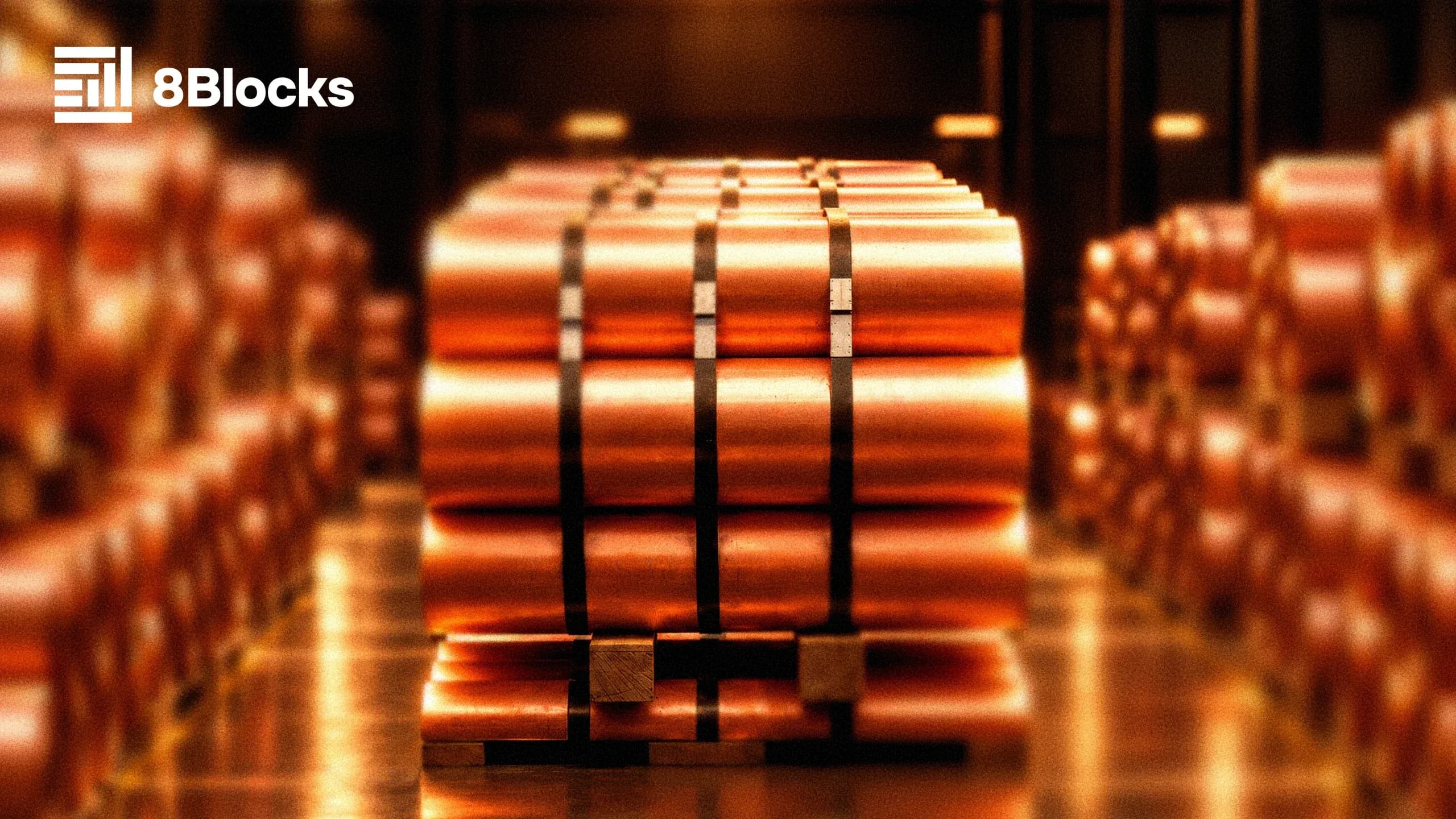
Hadronica trades ultra-high-purity copper from Central Asia: the company is in Kyrgyzstan, the metal sits in a vault in Switzerland. The asset is valuable, but between waves of industrial demand it sits idle — frozen capital that can't fund the next purchase and earns nothing. The task was to let capital move while the metal stays put: make the copper liquid and turn it into stablecoin collateral.
Turn illiquid 6N copper into a liquid asset and use it as stablecoin collateral: split backing and incentives across two tokens and add a network of guarantor buyers for the metal.
Liquidity and collateral pull in opposite directions: the token must trade freely, but the backing must stay put and stay verifiable. A typical "physical metal" redemption right backs nothing — a token holder needs money, not ingots, and has no use for 6N copper. The exit had to be designed around a real buyer, not a fictional one.
- 01
Split two roles across two tokens: NAN — a stablecoin backed by copper and stable against it, and HAD — a utility loyalty token whose staking accelerates NAN accrual.
- 02
Designed a network of guarantors: traders and chipmakers committed in writing to buy the copper at market price on redemption, turning redemption into cash instead of metal.
- 03
Separated physical and digital flows into distinct rails — the commodity sale and the token sale never intersect — and added a listing and liquidity-protection strategy to keep the market price near the value of the backing.
Hadronica's copper, which used to wait for the next wave of industrial demand, now works as a financial asset that trades and earns every day. An NAN holder exits into cash through the guarantors, not into metal they can't use. The backing stayed clean, incentives moved to HAD, and redemption rests on natural buyers of copper.
A holder of a copper-backed token doesn't need copper. They need their money back. We built the entire model around that simple fact.
| Client | Hadronica, a trading company supplying copper from Central Asia |
|---|---|
| Where | Company in Kyrgyzstan, metal in a vault in Switzerland |
| Asset | Copper with 99.9999% purity |
| Objective | Make an illiquid asset as liquid as possible and use it as stablecoin collateral |
| Scope of work | Token design, guarantor mechanism, capital flow architecture, listing strategy and liquidity protection |
The client came to us with metal, not a token
Hadronica trades high-purity copper from Central Asia. The company is based in Kyrgyzstan; the metal is held in a specialized vault in Switzerland. The commercial side lives in one jurisdiction, the physical asset in another, and any structure had to account for both.
Hadronica didn't come to us for a token. It came with a business problem: the company holds a valuable asset that spends too much of its time doing nothing. The token became our answer to that problem, not the starting point.
The problem had two goals. First: liquidity — making a slow asset behave like a fast one. Second: collateralization — using the copper as backing for a stablecoin, so that the value of the metal in the vault becomes the foundation of a digital asset.
These goals pull in opposite directions. Liquidity requires the token to trade freely and frequently. Collateralization requires the backing to stay put, remain verifiable and predictable. Our task was to satisfy both at once.

The Metal That Sells in Waves
What 6N Copper Is and Who Buys It
Copper with a purity of 99.9999% — known in the industry as 6N — is used wherever maximum electrical conductivity, stable material properties, and minimal impurities are critical. Even a trace impurity changes how the material behaves, and the buyer is paying precisely for the absence of that risk.
That is why the buyer pool is narrow. These are companies whose products depend on the purity of the metal. They buy to specification, from vetted suppliers, and in volumes tied to their own production cycles.
How Big the Niche Is
Research firms value the ultra-high-purity copper segment at $2.3b in 2024 (WiseGuy Reports) and $3.82b in 2025 (Dataintelo). Within copper targets for chip manufacturing, the 6N grade accounts for 28.3% of a $1.46b market (Dataintelo).
The estimates diverge and measure slightly different slices of the market, but they all point to the same conclusion. This is a specialized market measured in the low billions of dollars, not a commodity market where any volume finds a buyer before the trading day is out. A market like this does not absorb supply on demand.
Demand That Doesn't Bend
Demand for 6N copper is real but inelastic. It does not grow simply because the metal is available, and it does not disappear when the price moves.
In some periods the market takes a great deal; in others, almost nothing. Buyers operate on their own production schedules, not on the seller's need for cash. When orders slow down, the metal waits in storage for the next wave.
Herein lies the trader's core contradiction. Copper costs money every day, but turns into money only when a buyer arrives. Between those days, capital is locked in storage. Storage costs money. Capital frozen in inventory cannot finance the next purchase and generates no return. The longer the pause between waves, the more the business pays simply for the privilege of owning its own asset.
Tokenization has a single job here: to let capital move while the metal stays put.
What tokenization changes, and what it doesn't
Tokenization does not create new industrial demand. Chipmakers will not buy more copper just because a token exists. Nor does the metal go anywhere: the copper stays in a Swiss vault.
What changes is the financial layer above the metal. Tokenization separates ownership of copper's value from taking delivery of the copper itself. Previously, the only way to turn Hadronica's copper into cash was to find an industrial buyer. Now the value can pass to investors who want exposure to the metal, while the metal itself, as before, waits for its buyer.
The waves of physical demand remain. Capital simply stops waiting for them.
But a physically backed token has to answer three questions before any serious investor will hold it:
- What is the token worth? There must be a clear link between the token's price and the asset behind it.
- How do you exit? There must be a working exit, especially when the market turns.
- Who is legally responsible for what? Regulators and counterparties need a structure that the law already knows how to interpret.
Most projects answer the first question well, answer the second with a redemption right, and leave the third for later. That is precisely the order in which they break. We designed our model first and foremost around the second and third questions.
A Redemption Right Nobody Will Use Backs Nothing
The standard design looks airtight. The token is backed by copper. If the price swings sharply, the holder exchanges the token for metal. Since he can always claim the copper, the token cannot trade far below its value. On paper, the peg holds.
In practice, the design breaks at the exit. Look at who holds a token like this: funds, retail investors who want exposure to a real asset, crypto participants searching for a stable yield-bearing asset. Almost none of them run a plant that consumes 6N copper.
Once he receives the metal, the holder has no idea where to store it, what to use it for, or who will buy it quickly. Physical copper requires a warehouse, transport, insurance, and certification. It requires a buyer who trusts its purity and who needs it right now. The very same inelastic demand that left the metal idle in the first place now lands on the token holder.
He does not need copper. He needs his money back.
So when the price falls, the rational holder does not redeem the token — he sells it on the market: that is the only exit that returns cash. Sell pressure hits the token while the redemption mechanism sits unused. The peg slips not because copper got cheaper, but because the exit was designed for a buyer who does not exist.
The question, then, was never how to issue the token. It was something else: who buys the copper when holders want out?
First We Designed the Exit, Then the Token
The model consists of four parts that work as a single system: two tokens with different roles, a network of guarantors that turns redemption into cash, a capital flow structure that keeps physical and digital assets separate, and a listing and liquidity protection strategy.
Two Tokens, Two Roles
- NAN: a stablecoin backed by copper held in a Swiss vault. Its price is pegged to the value of the asset. Holding NAN in a wallet generates passive annual yield in the form of new NAN tokens.
- HAD: a utility loyalty token. Staking it accelerates NAN accrual.
Separating the roles keeps the collateral clean: NAN carries the asset, HAD carries the incentives.
The tokens' objectives conflict, which is precisely why they were split apart. A collateral token must be predictable; its value must be determined by copper and nothing else. If it also carried loyalty mechanics or speculative potential, its price would start reflecting those too, and the link to the metal would blur. An incentive token has the opposite job: to reward behavior, and that requires its own value and its own demand. The separation allows NAN to stay boring and HAD to stay useful.
NAN: The Token That Carries Copper
NAN is stable relative to copper, not relative to the dollar. The holder owns exposure to the value of high-purity copper in a form that trades like a token. When copper's value rises, NAN's underlying value rises. When copper falls, it falls. NAN's stability lies in a clear and verifiable link to a real asset.
For Hadronica, this is exactly the mechanism that unfreezes capital. The copper stays in the vault. Investors buy NAN. The metal's value starts working as a financial asset long before a physical buyer arrives.
For the holder, NAN does what a copper ingot cannot: it pays. Yield is paid out in new NAN, not in dollars and not in another token. This keeps the holder inside the system: every accrual increases their position in a copper-backed asset rather than draining value out of it. Even a holder who does nothing grows their share over time.
HAD Sets the Payout Frequency
Without HAD, new NAN accrues once per quarter. If HAD is staked, accruals accelerate, up to daily, depending on the volume of locked HAD.
Frequency matters because new NAN starts generating yield immediately upon crediting. A token accrued today becomes part of the position that same day and generates yield itself. A token accrued at the end of the quarter sits outside the position until that moment.
The earlier it arrives, the earlier compound interest starts working.
Over a single quarter, the difference is small. Over a horizon of several years, it accumulates. With the same starting amount and the same stated yield, a holder who stakes HAD ends up with a larger NAN position. HAD does not change the rate on paper. It changes the speed at which the yield starts working.
Why HAD Works for the Model, Not Just the Holder
It ties demand for HAD to NAN volume. The more NAN a holder has, the more they gain from frequent accruals and the more reason they have to lock HAD. Demand for HAD grows alongside the copper-backed position, not just on speculation.
It takes HAD off the market. Staked HAD is locked. The more actively holders use the acceleration, the smaller the share of HAD that can reach the market at any given moment.
It rewards commitment. Short-term holders receive the base yield. Long-term holders receive it faster.
None of this touches the collateral. HAD shapes behavior around NAN, not the value inside it.

Guarantors turn copper back into money
Several companies that genuinely need this copper have issued letters of guarantee. These are traders, chip manufacturers and other industrial buyers of high-purity metal. Each undertakes to buy back the copper at market price if holders present tokens for redemption.
The holder retains the right to exchange NAN for copper during sharp price swings. Now there is a buyer standing behind that right. The metal goes not to a holder who has no use for it, but to a company that needs it, at a price set by the market.
Redemption now ends in money, not metal.
The mechanism works because each party gets something:
- The holder gets an exit. Redemption becomes a path back to money, backed by specific counterparties with a written commitment. That is the difference between a peg on paper and a peg that holds.
- The guarantor gets raw material. In a narrow market with inelastic demand, reliable access to 6N copper is valuable in its own right. The guarantor buys at market price, not at a premium, metal it would have bought anyway.
- The peg gets a buyer. Holders gain a reason to redeem tokens rather than dump them on the market during a decline. Every redemption removes tokens from circulation.
Who the guarantor is matters. These are not financial institutions selling insurance. A financial guarantor would price the risk and charge for it. A natural buyer sees the commitment as supply, not risk, because its interest in copper exists with or without the token. And having several guarantors from different parts of the market, traders on one side and manufacturers on the other, removes any single point of failure.
Physical and digital flows never intersect
The hardest part of tokenizing a physical asset is often legal, not technical. The moment a single entity handles both the metal and the tokens within one transaction, the regulator has to classify the structure from scratch. That means time, legal costs, and frequently requirements that make a project too expensive to pursue.
We structured the movement of capital so that real-world and digital assets never meet in the same transaction. Selling copper to an industrial buyer remains a commodity transaction. Selling tokens through an exchange remains a digital asset operation. Neither one requires a new legal category.
Issuance:
- An investor buys NAN.
- The management company in Kyrgyzstan sells the tokens through a licensed exchange.
- The management company purchases copper from the producing plant.
- The copper enters the vault and backs the newly issued tokens.
Redemption:
- A holder presents NAN for redemption.
- The management company buys back the tokens through the same exchange.
- The copper behind those tokens is sold to a guarantor company in Switzerland.
- The guarantor pays the market price for the metal.
Every participant deals only with what is familiar to them. The investor deals with tokens and money. The guarantor deals with copper and money, exactly as it would without any token involved. The plant sells copper and needs to know nothing about tokens. The management company runs both legs, but each leg is a separate transaction governed by its own rules.
The obvious upside: lower legal costs. The less obvious one: counterparties are comfortable. A chip manufacturer will sign a raw material purchase commitment, but is far less willing to sign anything that makes it a party to a token transaction. It is precisely these separated flows that made the guarantor network possible. The structure is also easier to explain: investors, exchanges, and service providers each see their part of the scheme in familiar terms, and due diligence at every step moves faster.
In the UAE the same separation reads through VARA in Dubai and ADGM in Abu Dhabi: a token backed by a physical commodity is a regulated virtual asset, and keeping the commodity sale and the token sale in separate legs means each one stays inside a regime the regulator already understands. A guarantor network that buys the metal at market price fits the same logic — it is a commodity buyer, not a financial guarantor.
Listing and Liquidity Protection
We developed a strategy for bringing the tokens to exchanges, onboarded the necessary service providers, and built out strategies to protect the token against liquidity swings.
For a stablecoin this is not a marketing exercise. An incentive token can survive a thin order book and wide spreads; a stablecoin cannot. If NAN trades sluggishly, its market price can drift away from the value of the copper behind it even when the backing is fully in place. The holder sees a gap between what they own and what they can sell it for. Liquidity protection works hand in hand with the redemption lever: redemption provides an exit at the value of the metal, while the liquidity strategy keeps the market price close to that value, so that most holders never need to redeem at all.
Who's Who in the Scheme
| Participant | Role in the model | What they get |
|---|---|---|
| Hadronica | Business owner and initiator of tokenization | Capital that no longer waits for a wave of industrial demand |
| Management company in Kyrgyzstan | Runs both legs: issuance and redemption | A working scheme in which tokens and metal are never mixed |
| Licensed exchange office | Carries out the sale and buyback of tokens | Clear, straightforward operations with digital assets |
| Manufacturing plant | Sells copper when new tokens are issued | An ordinary commodity transaction |
| Vault in Switzerland | Stores the copper that backs NAN | A storage client with metal of clear provenance |
| Guarantor companies | Buy back copper at market price upon redemption | Priority access to 6N copper |
| NAN holders | Own exposure to copper | An annual yield in new NAN and a working exit |
| HAD holders | Stake HAD alongside their NAN position | More frequent accruals and faster compounding |
Every participant does what they do best and gets what they need. No one has to step outside their own business.
How the System Behaves in Practice
In calm markets. Investors buy NAN. The management company sells tokens through the exchange desk and purchases copper from the plant. The metal is delivered to the Swiss vault. Holders earn yield in newly issued NAN, and those who have staked HAD receive it faster. Staked HAD never reaches the market. Hadronica's copper, which previously sat waiting on industrial demand, now backs a financial asset that trades and generates yield every day. The metal hasn't moved an inch. The capital has.
Under stress. The copper price swings sharply and some holders want out. Instead of dumping NAN, they present their tokens for redemption. The management company buys them back, and the copper goes to the guarantor in Switzerland at the market price. Holders get their money. Tokens leave circulation. The guarantor receives metal it would have bought anyway.
At no point is a holder left holding copper they cannot use. At no point does a single entity mix the token transaction with the sale of the metal. And at no point does the peg rest on a redemption right that nobody would ever exercise. This is precisely the test the model had to pass.
Six Mistakes the Model Avoids
Most real-world asset tokenization projects stumble over the same set of decisions. Each part of the Hadronica model closes off one of these traps.
One token for every job. It makes the project easier to explain and easier to list, but the price of such a token starts to reflect everything at once, and the link to the asset is lost. Here, collateral and incentives are split across two tokens: NAN handles the copper, HAD handles holder behavior.
Redemption in the physical asset only. The right to receive metal looks good on paper, but if the holder cannot actually exercise it, it backs nothing. Here, the redemption right is backed by buyers of the metal, and the holder walks away with cash.
A single guarantor, or a guarantor from outside the industry. In the first case, the exit depends on one company. In the second, the guarantor charges a fee for the risk, and that cost lands on the project's economics. Here there are several guarantors, and all of them are natural buyers of copper.
Metal and tokens in a single transaction. This is the simplest structure and the most expensive one legally: the regulator has to make sense of a construct with no ready-made category. Here, tokens move through an exchange desk, while the copper moves between the plant, the warehouse, and the guarantors.
Yield paid in an external token. The holder receives a reward token and immediately sells it, because they have no use for it. Yield turns into constant sell pressure. Here, yield is paid in NAN and increases the holder's position in the collateralized asset.
Listing without a liquidity plan. Getting a token onto an exchange is not the same as giving it liquidity. Without protection, a stablecoin trades thinly and drifts away from the value of its collateral. Here, the listing and liquidity protection were designed together with the redemption mechanism, not after it.
What This Means If You Have a Real Asset
The model works for almost any physical asset with genuine value and slow-moving demand: specialty metals, industrial materials, stored commodities. Don't start with a whitepaper or a choice of blockchain — start with three questions. Who is the natural buyer of your asset, and are they willing to sign a binding commitment? How do you separate the physical and digital flows so that no single transaction ever mixes them? What will hold the token's market price near the value of its collateral on the day the market turns? The answers define the model. The token is designed around them.
A redemption right is worth exactly as much as the buyer standing behind it.
- Bring in natural buyers. Companies that already need your asset make the best guarantors: they see a commitment as supply, not as risk.
- Separate the asset and the token into distinct circuits. When the physical and digital flows never meet, each stays within the regulatory regime it understands, and industrial counterparties are willing to sign on.
- Keep collateral separate from incentives. Let the collateralized token stay predictable. Move staking and loyalty mechanics into a second token.
- Pay yield in the asset token. Holders stay inside the system, and their positions grow without draining value out of it.
- Treat liquidity protection as part of the peg. A stablecoin that trades thinly drifts away from its collateral even when that collateral is fully in place.
- Inelastic demand is itself the reason to tokenize. An asset that sits waiting for a buyer gains more than any other from a liquid layer built on top of it.
We designed this model out of Dubai, and the same capital-flow split applies to teams structuring commodity-backed tokens under VARA or ADGM.
Is your asset sitting idle between deals? Talk to 8Blocks about a model that puts it to work.