Virtuals Demonstrates How a Thriving Protocol Can Still Leave Token Performance in the Dust
Virtuals has done particularly well at enabling users to generate income via its AI bots. Ironically, the protocol’s success and VIRTUAL token’s price have become decoupled, and interest in holding has been replaced by incentives, as the potential for supply flooding looms.

Virtuals protocol is fascinating, since it has utility, revenue, and widespread adoption, yet the profits did not translate into a duly appreciating token. The AI bots bring in massive revenue, but traders treat it as a vehicle for short-term gains. Incentives and points have replaced initiative to hold onto VIRTUAL long-term. Meanwhile, the treasury retains a huge portion of the tokens.
This analysis is also written with the UAE and Dubai Web3 community in mind. With virtual assets regulated locally through Dubai's Virtual Assets Regulatory Authority (VARA) and Abu Dhabi's ADGM, the Emirates have become one of the world's fastest-growing hubs for AI, token projects and crypto funds — and for regional investors weighing an AI token like VIRTUAL, the key question is exactly the one this case raises: does ecosystem activity actually reach the people holding the token?
Virtuals has managed to achieve a level of utility so many crypto models dream of. The protocol has all kinds of trading going on, revenue keeps flowing in, and it’s all happening via its very own VIRTUAL token – fully used within the product. Its revenue scheme? Offering AI agents users can launch to generate revenue.
It maintains liquidity in spades with the VIRTUAL token set up as the base token to trade additional incentive tokens for. The ecosystem has little trouble generating new activity. However, not everything is as rosy as the initial enthusiasm would lead on.
The predicament of a token becoming decoupled from a boisterous protocol is all too familiar, however. One of the issues is that if a token fails to actually capture revenue that can reach the holders, investors set their sights on incentives and have little other reason to chase the tokens instead. And the market gets highly dominated by narratives, and investors just stop caring about any value holding onto the token long-term might provide.
Fortunately for Virtuals protocol, it was among the few fortunate projects not to crash beyond the initial wave of hype. However, the price dynamics behave much more like a market driven by incentives, points, and speculation, as opposed to being dictated by the protocol’s growth, currently setting the price of VIRTUAL token at $0.86.
Why VIRTUAL appeared to be one of the stronger AI token models at the outset
So many other projects have revolved around vague promises of AI while their token floats independently of any real activity. Other times, the token may have existed first while the actual product layer either remained extremely thin, or never materialized. VIRTUAL went far above and beyond that. The ecosystem of AI agents that it offered could be launched, tokenized, interacted with and monetized – all within the actual platform.
VIRTUAL token was integrated into multiple layers of the system:
- A payment asset for agent-related services and interaction
- A large portion of agent-token liquidity pools are paired directly against VIRTUAL
- Locked in exchange for VIRTUAL: granted access to governance participation, staking rewards, Virgen points, and ecosystem campaigns
- AI agents had their own accompanying tokens to stake independently in specialized pools
VIRTUAL acted as one of the central settlement and coordination assets tying the system together. So it appeared quite robust as it wasn’t based solely on passive holding. At the same time, the ecosystem was expanding during the height of AI hype. All of the different layers of utility reinforced each other more:
- agents launching
- liquidity pools appearing
- staking activity emerging
- speculation coming into play
- users participating in campaigns and farming opportunities
The protocol used buy-and-burn mechanics and commissions to fix the total supply without looming vesting cliffs too. So the protocol appeared to be one of the more structurally developed AI-token economies out there.
Why the protocol’s growth ceased to translate to comparable growth for the token
During the first major phase of expansion, the token and the protocol almost moved together. As enthusiasm around AI agents accelerated following its launch in December 2023, VIRTUAL surged alongside the ecosystem itself. But over time, the protocol kept on developing while the token stopped proportionally corresponding to that growth.
Bright beginnings
Initially, the market started off interpreting all the nice action going on as a direct reinforcement of the token’s value. That is precisely what led to the first major rally. The public narrative around AI agents was absolutely exploding. At its peak in light of a wave of FOMO, it posted $5.07 at the start of 2025.
Sticking points
However, more and more of that value was kept inside the system. A large portion of it was not reaching ordinary VIRTUAL holders in a sufficient, direct way. In many cases, users were participating primarily to maximize incentives, not because they believed its value would steadily compound.
What proved to determine the token’s price instead were campaigns, hype, and AI market sentiment in general.
So it wasn’t coming from organic token demand. Temporary incentives caused spikes in interest in the token, before it was sold off, enthusiasm cooled, and the protocol remained stronger while the token would dip back down in price. Users simply didn’t view holding the token as the primary way to benefit from the ecosystem’s growth.
More and more investors started asking:
- How much demand will stick around?
- How much buy pressure comes from real usage?
- What happens once AI hype slows down?
- How much of the protocol’s revenue do holders actually get a hold of?
How incentives and points started replacing organic token demand
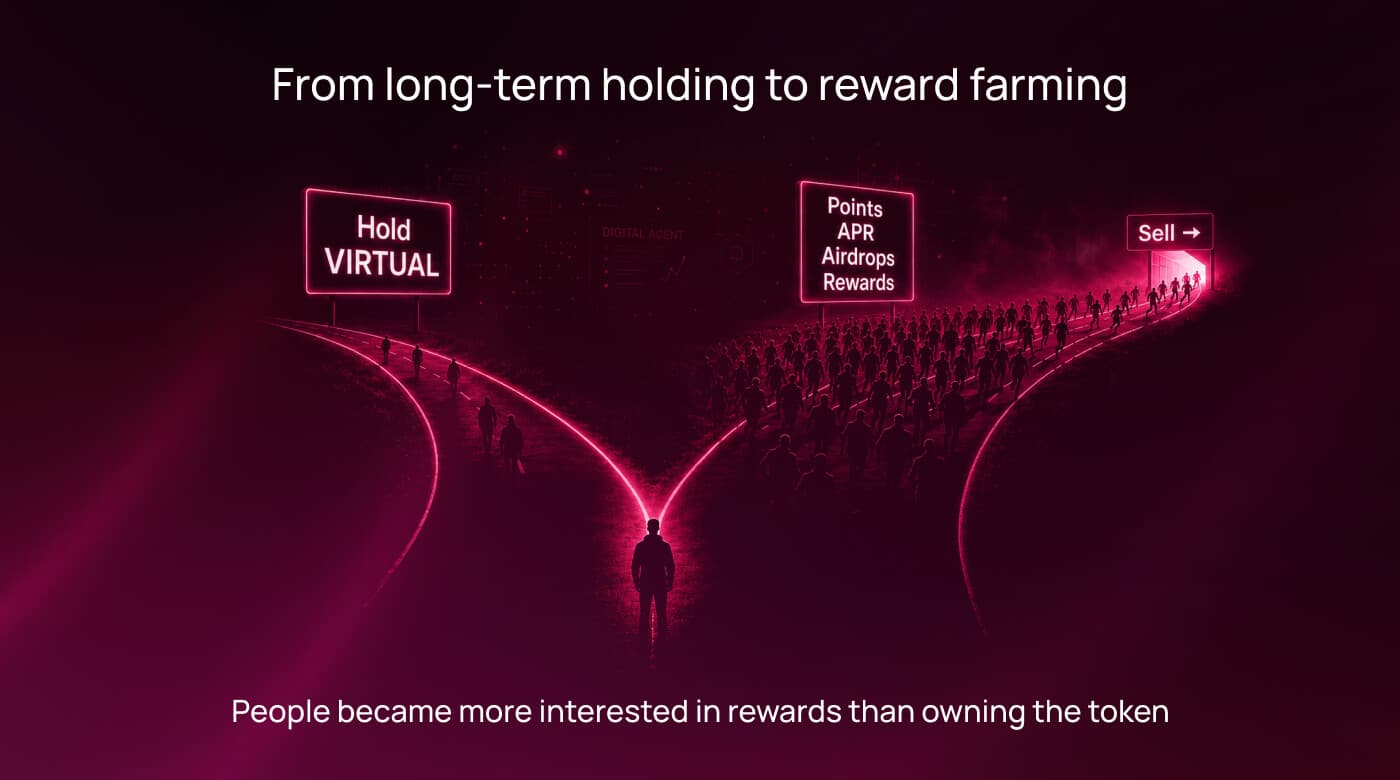
One of the most important transitions inside the Virtuals ecosystem demand centered around the token itself shifting toward participation and incentive programs instead. In the very beginning, people entered the ecosystem because AI agents were gaining traction, new launches were drawing attention, and VIRTUAL seemed to be at the center of that economy.
But over time, participation started to become not about conviction in the token but the surrounding reward structure. And that distinction made all the difference. On paper, the ecosystem looked super active, but structurally it also shifted user behavior. Instead of the token itself serving as the primary destination of demand, everyone’s eyes instead shifted to the secondary rewards. So it all became “get in, get out” quick. Another issue is that people interested in investing in AI bots is quite a small pool of investors.
Temporary vehicle
Organic demand normally emerges when users believe a token plays some kind of long-term role that they are going to need it continuously for. Instead, users enter because the APR is temporarily attractive, their points are accumulating, campaigns are ongoing, and future airdrops appear promising. Thus, it’s mostly little more than a temporary vehicle.
Misdirected demand
Virgin Points operated as one of the central gravitational forces in the ecosystem, like a meta-economy sitting above the token structure itself. Everyone is gunning to position for future rewards and obtain launch access. This comes at the expense of directly cutting demand for the token itself.
Why treasury structure proves much more important in models like this
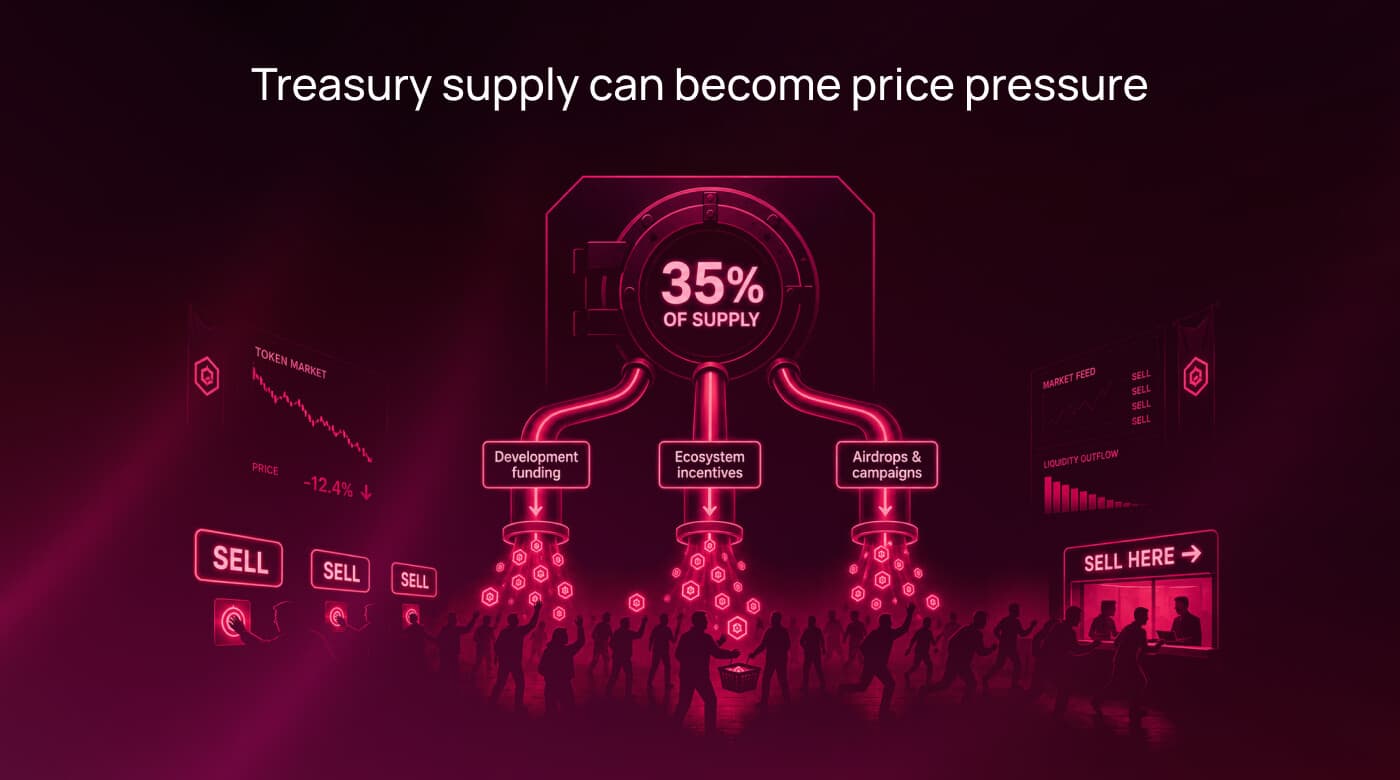
In many crypto projects, the treasury is viewed mostly as a reserve pool sitting in the background, designed in a specific way to fund development, liquidity, grants, partnerships, or ecosystem expansion. But in models like Virtuals, where the treasury holds a massive 35% of the supply, the treasury takes on a much bigger role as one of the core forces influencing the entire balance of supply, incentives, and market confidence.
The more abundant the campaigns, rewards, and stimulation, the truer this becomes. Here, a very large share of supply remains concentrated in the treasury. Meanwhile:
- The token had no future inflation schedule
- No major unlock calendar remained
- Most of the future supply pressure came not from vesting contracts, but from managerial decisions around treasury usage.
Whenever additional tokens enter the market, they’re going to exert some kind of additional price pressure. The market is no longer primarily worried about automatic emissions, and incentives are supplemented by treasury resources, as was the case for the VIRTUAL token. Incentives rarely sustain themselves through organic protocol economics during growth stages.
As these tokens are released, thereby pushing down the price, many of the users will sell them off right away. This creates a difficult balancing act. In models like this, the treasury doesn’t just finance development but often indirectly finances participation itself. The market eventually starts pricing governance risk into the token too. This is especially true when:
- Reserves are large
- Distribution rules remain flexible
- There’s a lack of strict limitations on how the tokens will be deployed.
Why this doesn’t make VIRTUAL a useless token
Despite all the weaknesses, VIRTUAL still possesses something many crypto tokens never manage to achieve: real integration into a functioning ecosystem. The token is not purely decorative.
That matters because there are many tokens whose ecosystems could continue operating almost unchained if the token disappeared entirely. VIRTUAL cannot be described as such. The protocol genuinely uses it.
The issue is not that there is a lack of utility but rather that the utility alone was not strong enough to create a sufficiently strong transfer of value from the ecosystem’s growth to the long-term token holders.
There are still active launches, meaningful infrastructure around the token, substantial liquidity, and a functioning AI-agent ecosystem with real user activity. The problem is it’s become overburdened with incentives, speculative participation, and campaigns.
What Virtual demonstrates about AI-token economies more broadly
One of the most important takeaways here is that Virtual’s weaknesses are not unique to the project but emerge throughout a large portion of the AI-token sector. Initially, AI ecosystems appear extremely attractive to the market since AI is, in fact, a very hot topic right now. Many technologies are blowing up around it, and autonomous agents sound scalable.
New launches, ecosystems, and activity metrics rise fast during strong market phases. So it’s understandable for investors to assume that ecosystem growth will naturally translate into token growth. But as VIRTUAL’s case demonstrates, things aren’t so simple. A protocol can get a lot of things right, and the token itself can still struggle to take off and keep a high price if the funnel of appreciation is weak.
AI ecosystems also tend to invite a lot of speculation. They are particularly vulnerable to hype cycles as they combine both emerging technology narratives and crypto market reflexivity at the same time. But once speculation becomes one of the main drivers for participation, projects will be tempted to go heavy on incentives, hype, and new launches. Utility is not enough in and of itself. The real test begins once the market excitement cools and weaknesses eventually become revealed.
What this case means for UAE and Dubai builders
For founders and investors operating under Dubai's VARA and in Abu Dhabi's ADGM, VIRTUAL is a useful benchmark. VARA's disclosure-oriented rulebook pushes issuers toward demonstrable, product-linked utility, transparent treasury policy and disclosed token flows — precisely the areas where VIRTUAL's model shows strain. In a MENA market that increasingly rewards substance over narrative, the tokens that age well are those that channel real demand back to holders rather than lean on points, incentives and campaigns.
Gaining clarity in crypto projects
Virtuals highlights a lesson that extends far beyond AI agents: protocol and token success are not necessarily the same thing. Building a sustainable digital asset requires more than utility, hype, and user growth. It requires economic mechanisms that consistently connect ecosystem activity to long-term token value.
As a Dubai-based Web3 consulting firm (8BLOCKS FZCO, DMCC) specializing in tokenomics, token launch strategy, stress-testing, and digital asset design, 8Blocks helps blockchain projects build economic systems that are resilient beyond the initial excitement cycle. Through tokenomics audits, incentive design, supply and emission modeling, and pre-launch readiness assessments, we work to identify structural weaknesses before they become costly problems.
Planning a token launch or reviewing an existing token model?
Contact us to evaluate your tokenomics and build an economic framework designed for long-term stability today.

When the Product Grows but the Token Doesn't
The crypto market has changed fast over the past few years. Products are more complex, regulation is tighter, and users expect more. But one part of the industry is still stuck in the last cycle. It's tokenomics.
Why HYPE Is Stronger Than Most DeFi Tokens — and Where That Power Could Run Out
HYPE is one of the strongest DeFi tokens because its demand is built into Hyperliquid: the token pays gas on HyperEVM, unlocks trading-fee discounts through staking, and absorbs over 99% of platform fees through an automated buyback. That strength is real but conditional — it depends on Hyperliquid sustaining high trading revenue.

Crypto Token Deflation: a Crash-and-Burn Strategy
Deflation is a common practice to bolster a crypto token’s value, which achieves the opposite effect. This short-sighted view restricts opportunities for benefits, acceleration, and problem-solving. Furthermore, tokens behave differently from money and are much less stable. Developers must pursue true utility and functionality before focusing on simpler tactics like scarcity and marketing.