TiBiTi: a meta-hotel token model where supply unlocks only when a hotel gets built
An 8Blocks case: how we replaced a 76.9% "ecosystem support" reserve with a rule — a Treasury tranche reaches the market only against a built hotel, with demand assembled from the hotel's own flows.
Task. An international e-commerce and IT group (800+ employees) is building a crypto offline hotel on 370 hectares in Costa Rica with a metaverse copy and an AR layer. First version of the tokenomics: 10B tokens, 20% staking yield, a 20% room discount, 76.9% of supply "frozen for the ecosystem" with no unlock rule. The task: a model in which every number is derived from a flow and the reserve does not read as an overhang.
Challenge. Concept stage: no revenue yet, the hotel takes 2–2.5 years to build, and the token has to be sold to funds now. Yield cannot be promised, but investors will not buy a token with no functions. The right to the asset (villas) and the unit of account were mixed in one token; governance created no demand.
What we did:
- Separated the right to the asset from the unit of account: NFT villas with 100 fractional tokens, timeshare and a share of AR income — and the TBTI utility token for payments, access, DAO and staking
- Replaced the "ecosystem reserve" with a rule: the 76.1% Treasury is frozen under an initiating event — a tranche is released only against a built hotel and funds the next one
- Assembled demand from hotel flows: 5–15% of revenue into buybacks paid out as guest cashback, staking by formula from what the quarter earned, a DAO with a one-year freeze
Result. The reserve stopped being an overhang: 76.1% of supply reaches the market only against a verifiable fact — a new hotel in the network. Circulating supply is under 1% at TGE and 21.5% after 72 months; early investor and team locks end when the first hotel is already taking guests. Staking and governance lost their fixed promises.
Stage: concept and pre-seed, 2022. The token model was designed before the first hotel broke ground.
A hotel on 370 hectares of Costa Rican rainforest, an exact copy of it in the metaverses, and an augmented-reality layer tying the two worlds together. That was the project an international e-commerce and IT group with more than 800 employees brought to us. The team had written the first version of the tokenomics themselves: 10 billion tokens, staking at 20% a year, a 20% discount on rooms, and 76.9% of supply "frozen in a smart contract to support the ecosystem".
Our job was not to rewrite the numbers. It was to answer the question investors and exchanges would judge the project by: what exactly unlocks that 76.9%, and who controls it.
For a team building the same model in the UAE, the unlock rule is not only an investor argument. VARA's rulebooks in Dubai and the ADGM framework in Abu Dhabi both expect an issuer to document how reserved supply is released and who controls that release, and a milestone key — a tranche against a delivered asset — is far easier to defend in a licensing file than a line that reads "at the team's discretion".
What would have been built without a token
The project first, because the token model grows out of it and not the other way round.
TiBiTi is the first crypto offline hotel: villas and apartments on 370 hectares in Guanacaste province, a conference hall in the OntoArte style, jungle with fed wildlife, and land reserved for buildings that partner games and metaverses design in their own style. Every object in the hotel is digitised and mirrored in Decentraland, The Sandbox and other metaverses. At the entrance a guest receives AR glasses: through them the grounds are scattered with quests, partner ad integrations and game events invisible in ordinary reality.
The conference hall is the centre of the ecosystem. Blockchain, AR/VR and gaming events run simultaneously in the real hall and its meta copy, so a speaker on stage in Costa Rica draws an audience from both worlds.
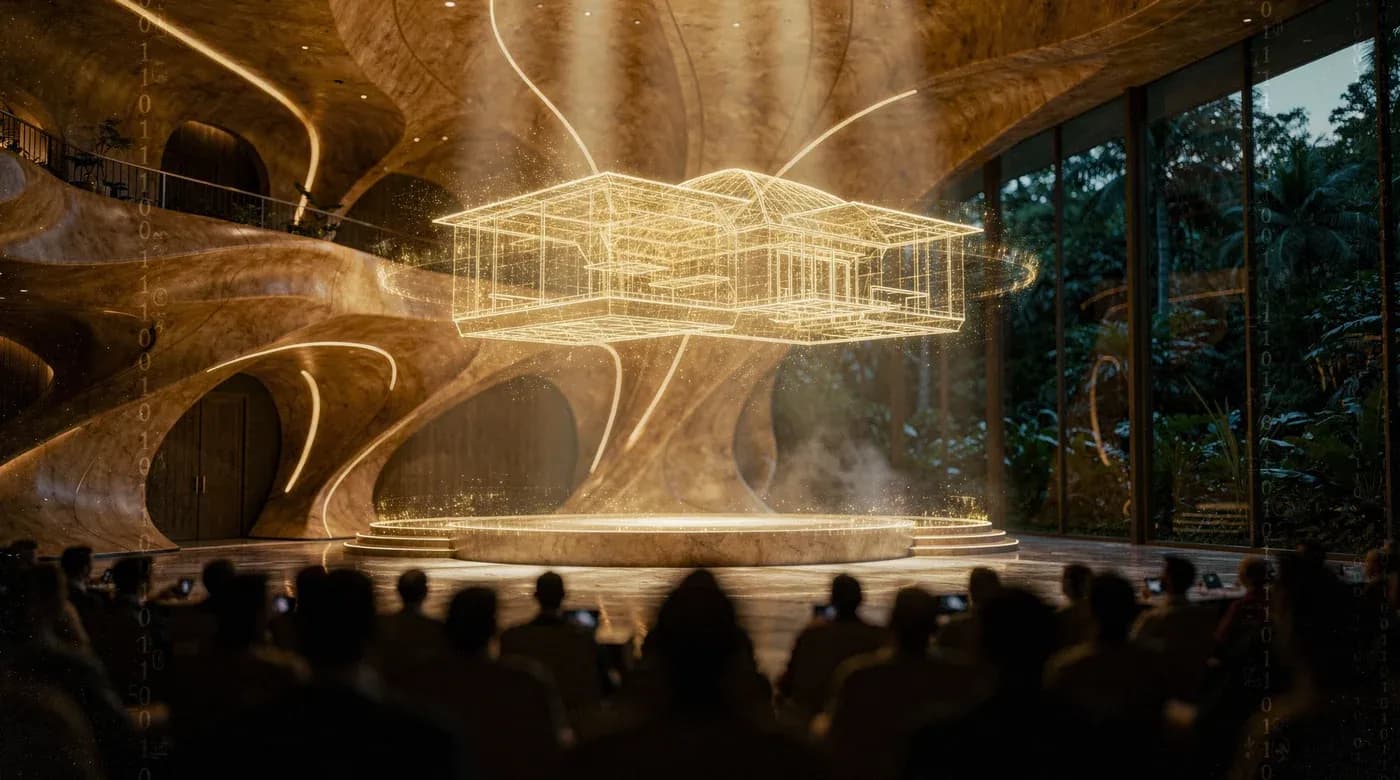
The OntoArte conference hall: one event, two audiences — in the hall and in the metaverse.
That is what made the project worth tokenising. The hotel has revenue, the events have tickets, the AR layer has advertisers. The token had something to attach to. The problem with the first version of the tokenomics was different: it attached to promises rather than to those flows.

The first version promised 20% a year on staking before the hotel had taken its first guest. That is the most common mistake in projects with a real asset: yield gets assigned instead of derived from revenue. We started by removing every number from the model that had no cash flow behind it.
— Toni Efren
Taking apart the first version: four promises with no source
The original model had four problems, and each one looked like market practice in 2022.
- Staking at a fixed 20% a year. No source of payment was named, which means either emission or new buyers' money.
- A 20% discount for paying for a room in tokens. The hotel subsidises demand for the token out of its own margin, and the better the token sells, the worse the hotel's economics.
- A 76.9% reserve "to support the ecosystem" with no unlock rule. To an investor that means the team can put three quarters of supply on the market at any moment.
- Governance functions with no link to network usage. Voting on which animals to buy neither creates demand for the token nor retains it.
A reserve without an unlock rule is not a reserve, it is an overhang. An investor does not read the whitepaper, they read the unlock schedule, and if the schedule says "at the team's discretion", to them that reads "any day now". We made the unlock rule the main parameter of the model.
— Toni Efren
Two assets instead of one token
The first decision was to separate what the client had mixed into one token: the right to an asset and the unit of account inside the ecosystem.
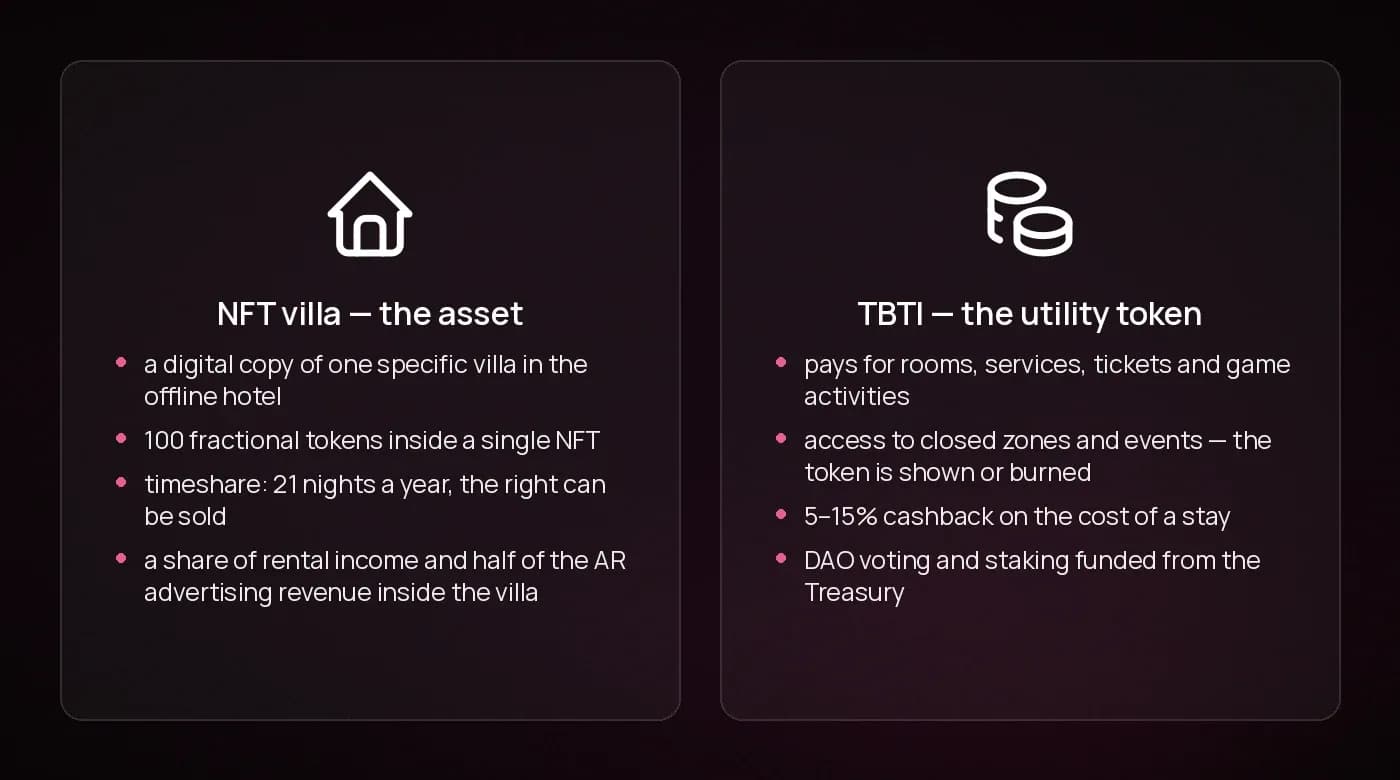
The right to the asset lives in the NFT villa; payments and access live in the TBTI utility token.
Villas and apartments became second-generation NFTs. Each NFT is a digital copy of a specific room in the offline hotel, and it holds 100 fractional tokens: several people can own a villa in different shares. The holder receives a timeshare — 21 nights a year that can be transferred or sold — a share of the villa's rental income, and half of the revenue from ad integrations partners place inside the villa in augmented reality. Whatever happens in the villa's AR layer is partly paid to its owner.
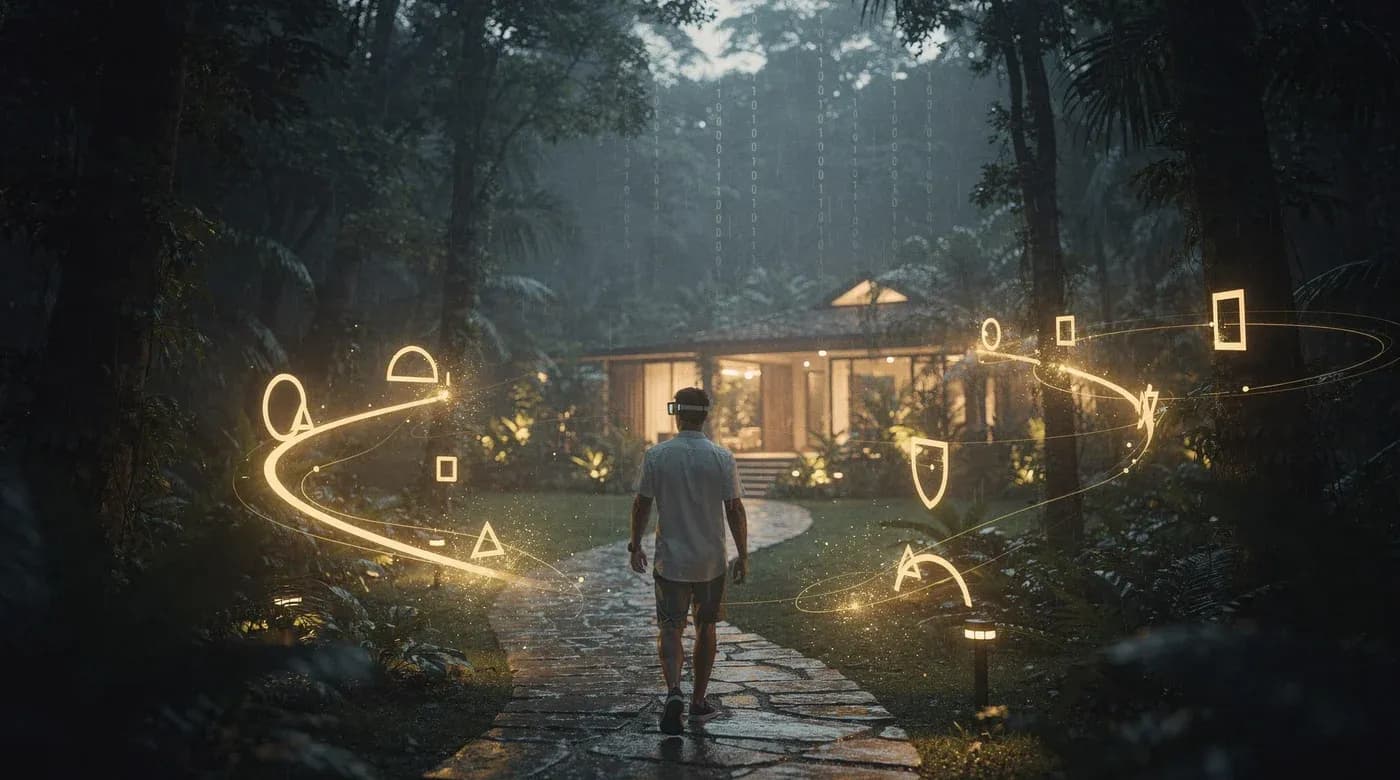
The hotel's AR layer: quests, ads and game events visible only through the glasses, earning income for the villa owner.
TBTI is the utility token, with a supply of 10 billion. It pays for rooms, services, event tickets and game activities; it opens closed zones of the hotel, where the token is shown or burned at the entrance; DAO and staking run on it. The token promises nothing by itself: its value is the number of ways to spend it inside the hotel and its meta copy.
When the right to an asset and the unit of account live in one token, the investor buys real estate and gets utility-token volatility. When they are separated, the NFT villa has an understandable base — the income of a specific room — and TBTI has understandable demand: the number of guests, events and advertisers.
— Toni Efren
Supply that a built hotel unlocks
The second decision is the heart of this case. We kept the client's idea of freezing most of the supply, but replaced the wording "to support the ecosystem" with a rule.
The Treasury — 76.1% of supply, 7.6 billion TBTI — is frozen in a smart contract and cannot reach the market other than through an initiating event. In this model there is one initiating event: a new offline hotel. While the first hotel is under construction, the Treasury is closed. Once the hotel takes guests, the DAO unlocks a tranche — on the order of 10% of supply — and sells it to investors to fund the next hotel. The next tranche stays locked until a hotel is built.
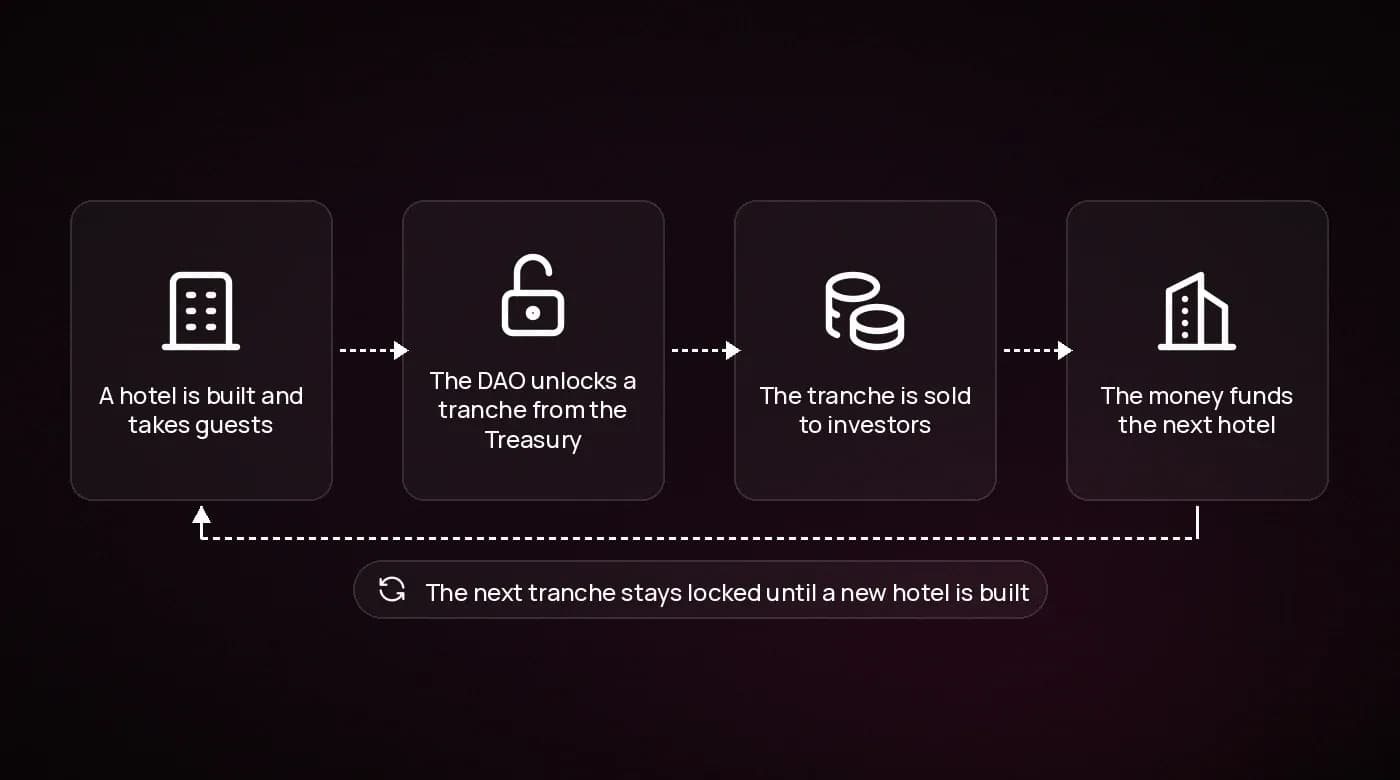
The network's funding loop: a hotel unlocks a tranche, the tranche funds the next hotel.
For an investor this changes how the unlock schedule reads. The unlock is tied neither to a date nor to a team decision, but to a fact that can be verified: the network has one more hotel. Every new hotel adds guests, events and advertisers, so demand for TBTI grows together with supply rather than against it.
Unlock on achievement is what the market now demands from every model with a large reserve: not "48-month vesting" but "the tranche opens when this specific thing is done". In 2022 we built that rule for a hotel network; today it is the standard for any project that wants to explain to an exchange where demand for the next billion tokens will come from.
— Toni Efren
| Round | Tokens | % of supply | Initial unlock | Lockup, months | Vesting, months |
|---|---|---|---|---|---|
| Treasury | 7,607,500,000 | 76.1% | on event | — | — |
| Market Maker | 250,000,000 | 2.5% | on demand | — | — |
| Pre-Sale | 575,000,000 | 6.0% | 0 | 24 | 24 |
| Private | 455,000,000 | 5.0% | 0 | 18 | 24 |
| Team | 700,000,000 | 7.0% | 0 | 24 | 48 |
| Core contributors | 300,000,000 | 3.0% | 0 | 12 | 48 |
| Community | 62,500,000 | 0.6% | 5% | 6 | 12 |
| Own funds | 40,000,000 | 0.4% | 0 | 24 | 24 |
| IDO | 10,000,000 | 0.1% | 0 | 0 | 3 |
The remaining 24% is split between investors (11%), the team (10%) and ecosystem rounds. The founders put their own $4 million into the hotel's infrastructure and receive TBTI at the IDO market price with a 24-month lock — on the same terms as the earliest investors.
Circulating supply: under 1% at launch
The third decision was to stretch the token's arrival on the market so that demand from the hotel keeps up with supply.
At TGE less than 1% of supply is in circulation: the IDO and 5% of the Community round. Pre-Sale and Private are locked for 24 and 18 months, then vest linearly for another 24. The team and core contributors are locked for 24 and 12 months with 48-month vesting. Over 72 months circulating supply grows to 21.5%, and that is the ceiling: the Treasury is not counted as circulating, because each of its tranches is released only against a new hotel.
The Pre-Sale and team locks end at month 24 — exactly when, on the roadmap, the first hotel takes its guests. An early investor gets liquidity at the moment the token already has revenue behind it, not two years before.
Where demand comes from
A model with frozen supply only works if the token is needed for something other than resale. We assembled demand for TBTI from flows the hotel has in any case.
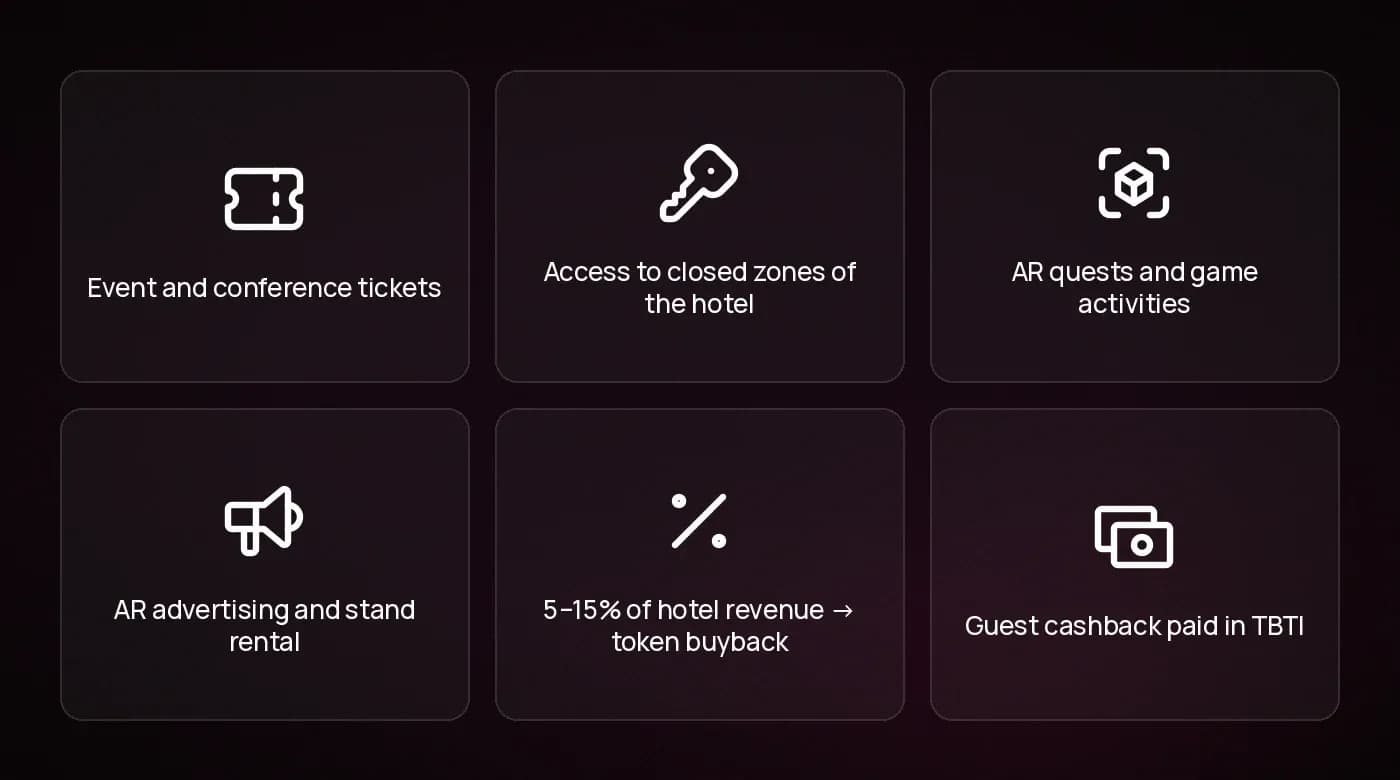
Six sources of demand for TBTI, all of which exist regardless of the token price.
Between 5% and 15% of hotel revenue goes to the market maker to buy TBTI back from the market. The repurchased tokens are not burned; they are returned to guests as cashback on their stay. So every night in the hotel creates two things: a token purchase on the exchange, and a new holder with a reason to spend the token on the grounds.
Staking lost its fixed rate. Payouts come from the Treasury, from the Staking Found line, and are credited once a quarter by formula:
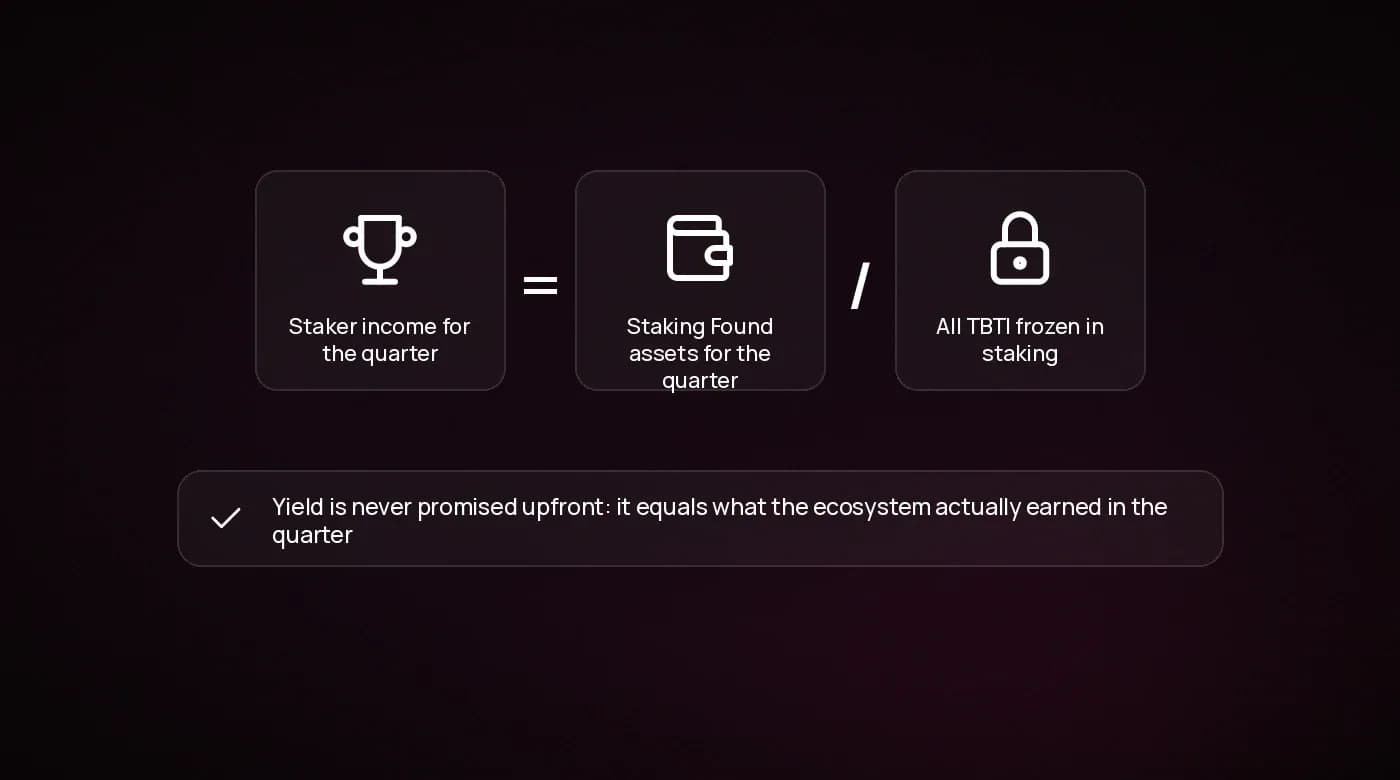
The staking rate is not a promise but the result of a quarter.
The Staking Found is fed by shares of all revenue lines of the Treasury: 80% of Cash Flow Meta, and 50% each of Cash Flow Active, Found NFT, Found Crypto and Cash Flow Event. At launch 250 million TBTI are placed in the line so that payouts run before the revenue side is live; after that the rate depends on what the ecosystem has actually earned.
The Treasury itself is a set of lines with written rules for replenishment. Development, the line for the next hotels, holds assets with a market value of at least $50 million as of 2025 and is rebalanced quarterly from all other lines equally. The Burning found collects tokens from every burn mechanic and burns them once a quarter. No line is spent without a vote or an initiating event from the roadmap.
A DAO where a vote costs a freeze
Governance stayed, but now it has a price. To propose an event, vote for it or block a harmful one, a user freezes TBTI for 12 months. Tokens spent on blocking are burned.
An example of the mechanic: an initiator proposes a partner NFT collection, the community votes and locks the amount of ETH it is prepared to buy it with. The bonus NFTs the partner sends into the ecosystem are split: 10% to the initiator, 15% raffled through loot boxes among everyone who voted, 75% to the Treasury.
Freezing a token, on top of DAO participation, confers status. Three tiers — 2,000,000, 200,000 and 20,000 TBTI — unlock everything from free online conferences to a flight and 14 nights a year in the hotel. These are the same rights an NFT villa gives, only earned through participation rather than bought.

The TiBiTi hummingbird: an NFT companion that lives in the hotel's AR layer and farms TBTI by finding flowers on the grounds.
What the client got
Instead of a token with four promises, a model in which every number is derived from a flow.
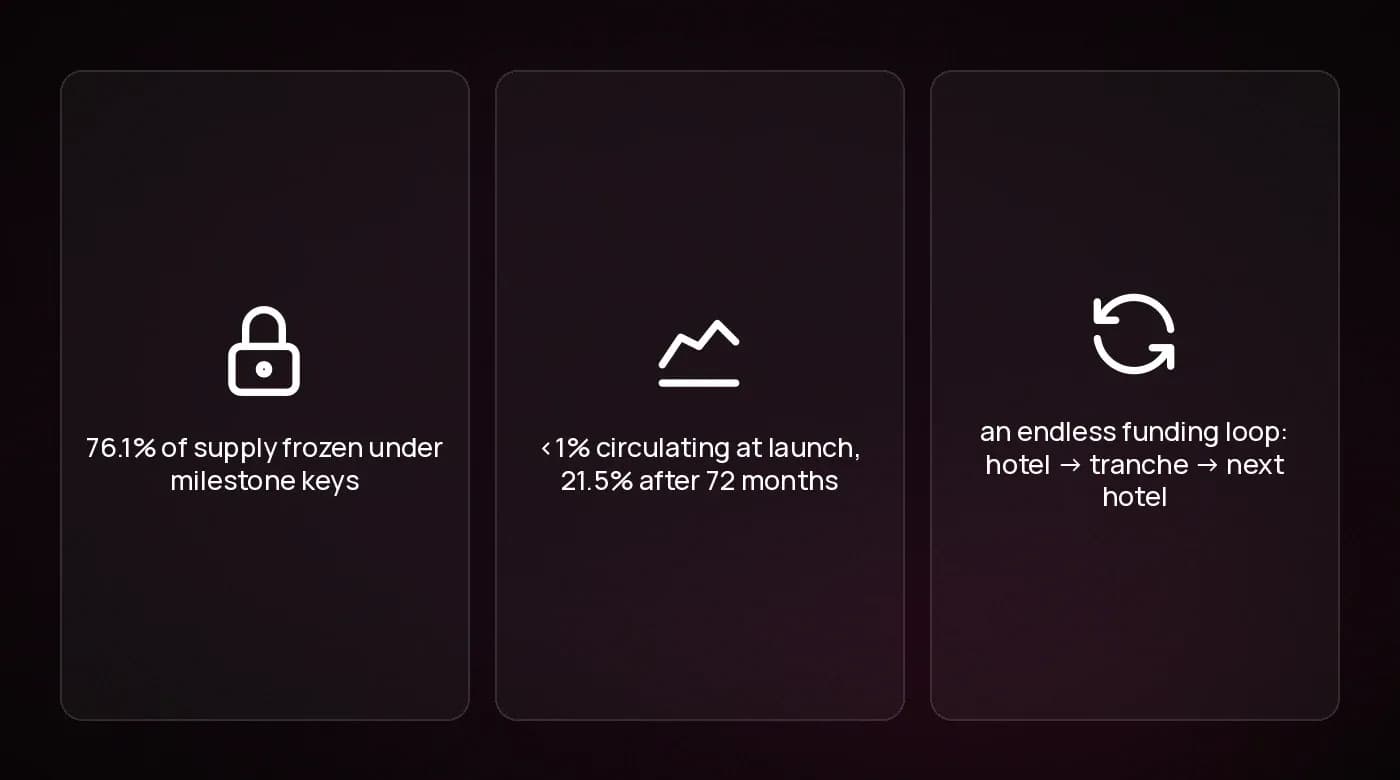
The three parameters of the TiBiTi model an investor looks at.
- 76.1% of supply frozen under milestone keys: a tranche is released only against a built hotel.
- Circulating supply under 1% at launch and 21.5% after 72 months; the Treasury is not counted as circulating.
- Two assets instead of one: an NFT villa with fractional shares, timeshare and AR advertising income — and a utility token whose demand is created by guests, events and advertisers.
- Staking and a DAO with no fixed rates: payouts equal what the ecosystem earned in the quarter, and a vote costs a one-year freeze.
The most valuable thing in this case is neither the hotel nor the metaverse but the rule: the next tranche stays locked until the next thing is done. It is investor protection that can be verified without trusting the team, and at the same time an endless source of funding for the network. A model in which growth in token supply literally means growth of the business.
— Toni Efren
If you are designing a token for a project with a real asset and want the unlock schedule to read as a business plan rather than a threat, message us. We will take the model apart, find the promises with no source, and replace them with rules.
More on our services: tokenomics design and tokenomics audit. You can test your own supply and demand assumptions in the Token Lab calculator.
We run these model reviews out of Dubai, so if the asset itself sits in the UAE — a hotel, a building or a fund — we can go through the unlock rule, the demand side and the local regime in one pass.
8Blocks is a tokenomics design and audit firm. We work with RWA issuers and Web3 teams worldwide, connecting business modeling, token mechanics and regulatory logic in a single model.

Ondo Runs the Best RWA Business in Crypto. Its Token Owns None of It.
Assets under management rose to $3,466b, product fees run at $57,9m a year, and what reaches the ONDO holder is $0. Fundamentals score 86,4, Token Product Linkage 16,2, total 38 out of 100. Three layers of money, a $614,97m cliff on 17 January 2027, and half the supply with no rulebook.
Necessity Is Not Value Capture: The Zcash Lesson
Zcash earned the highest coin-necessity score on our scale, 5,0 out of 5,0, and still finished at 66 out of 100. Net emission of 3,89% with no sink, a burn proposal sized at 0,05% of a single year of issuance, and a lockbox that defers supply instead of retiring it.

Pump.fun Buys Back Half Its Revenue. The Price Is Still at Its Low
Pump.fun sends half its fee revenue into PUMP buybacks and has burned 36% of supply, yet the token sits at its all-time low. Why a buyback worth 2% of daily turnover cannot replace demand: coverage, procyclicality, optional utility and the unlock schedule.