What Drives DASH Coin Demand? A Look at Real Utility
Dash is a rare success story as it combines sustainable coin demand with real utility. It demonstrates how hype and incentives fall short. Dash has achieved this via collateral requirements, decentralized infrastructure, data services, and treasury independence.
Dash demonstrates how critical offering utility is in maintaining a strong coin, rather than permitting speculation. By way of payment adoption, decentralized infrastructure, masternode collateral, and long-term storage-fee mechanisms, the ecosystem creates multiple connections between coin usage and ownership. This is a great lesson on why demand-driven design matters more than hype or artificial scarcity.
So many coins out there get by solely on hype and continuously lure in new participants with sophisticated, advantageous incentive systems. However, a token economy can never flourish in the long run without one key central ingredient — a business-first orientation providing utility that a large number of people simply need. The stronger the utility, the clearer the reason users have to acquire and hold a token beyond short-term market expectations. Granted, that's easier said than done.
Countless speculative tokens and cryptocurrencies plummeted during the crypto market crash of October 2025. One of the coins that did survive thanks to having heavily built utility around its native coin is DASH. Rather than using cheap gimmicks, the ecosystem has developed multiple mechanisms that connect the coin to practical use cases — across payments, decentralized infrastructure, governance, and data services. Its background in providing technological advances has been extensive.
At the user level, DASH functions as a digital payment asset, which users expect to need later, thus directly creating utility. A long-term relationship is maintained with many users, in particular through its masternodes like EvoNodes. This case demonstrates how there is no substitute for utility when it comes to a token project's long-term health.
Dash changes in autumn 2025
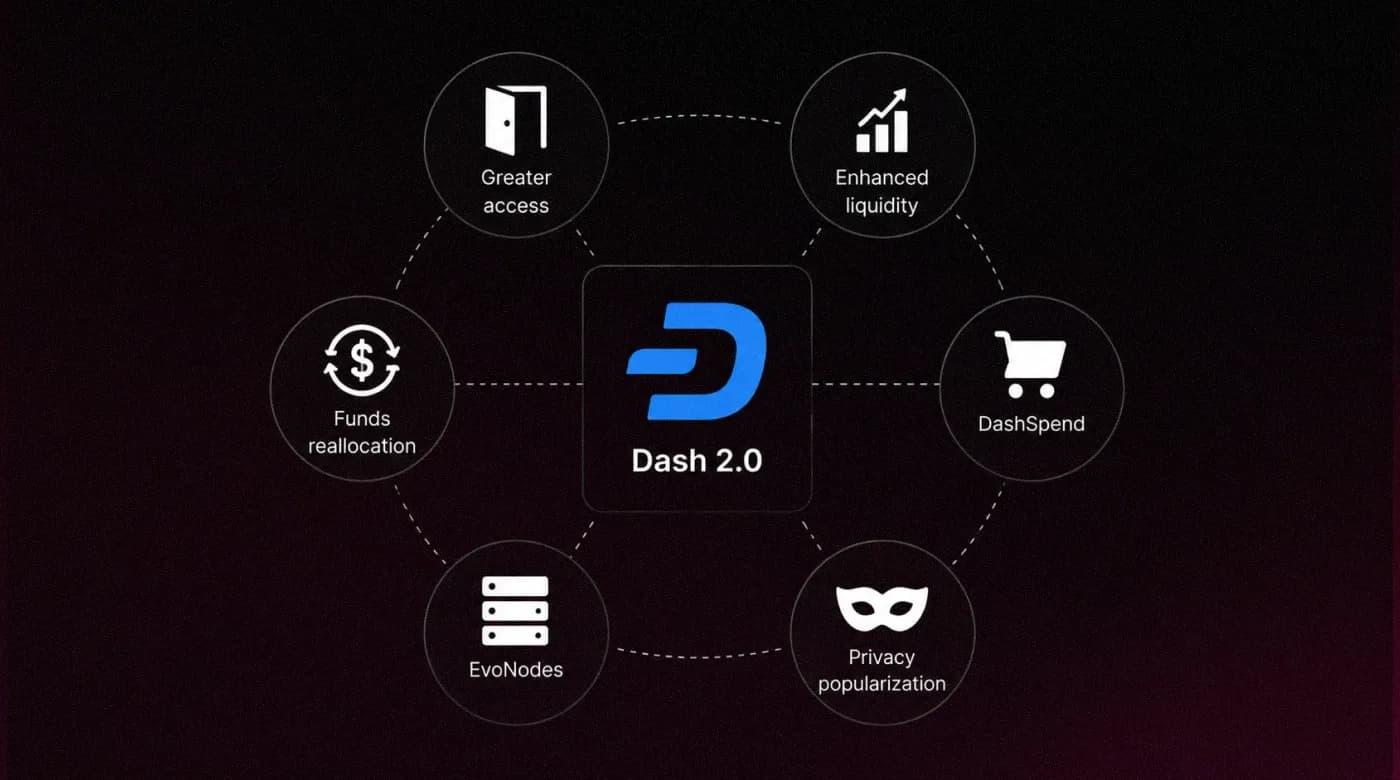
The autumn of 2025 was a critical period for both Dash as well as the blockchain world at large. As the crypto market swung wildly, Dash kept building on the features that its ecosystem offers. Despite not encountering significant shifts in network activity metrics, this period did nevertheless see a number of developments that enhanced users' access to DASH and introduced new sources of utility.
DEX integrations: expanding access and liquidity
One of the clearest changes during these days was the expansion of DASH's decentralized exchange presence. The Dash team highlighted the significance of its onboarding to NEAR Intents and the growth and stabilization of volume through Maya Protocol.
These improved users' ability to access and exchange DASH. Though DEX volume alone didn't create coin demand, this made it easier to accommodate users' needs.
DashSpend: connecting to real-world payments
This focused on expanding the practical use of DASH as a payment asset. The DASH team lauded integrations that provided access to thousands of merchants worldwide. Thus, more users could spend DASH in more real-world contexts.
In 2024, its DashPay system had added new features to facilitate its payments, such as:
- Usernames
- Contact lists
- Encrypted transaction metadata
- Built-in spending functionality
Privacy overhaul
Dash had historically highlighted privacy as one of its core technological features. According to the Dash team, the broader market's renewed interest in privacy technologies coincided with Dash's own fortifications on that front, which they believe bolstered attention to the project.
Privacy and its expanded DEX presence are what Dash recounts promoting as its two main flagship benefits at the time.
Dash Platform
Dash Platform's Evolution introduced a deeper connection between network activity and DASH demand through decentralized apps, data storage, and infrastructure benefits. Originally, Dash began in January 2014 as a fork of Bitcoin, originally designed to improve on some of the limitations that affected early cryptocurrency payments. 2025 is when it launched DASH 2.0, featuring these brand new features.
EvoNodes: propping up price by temporarily removing supply
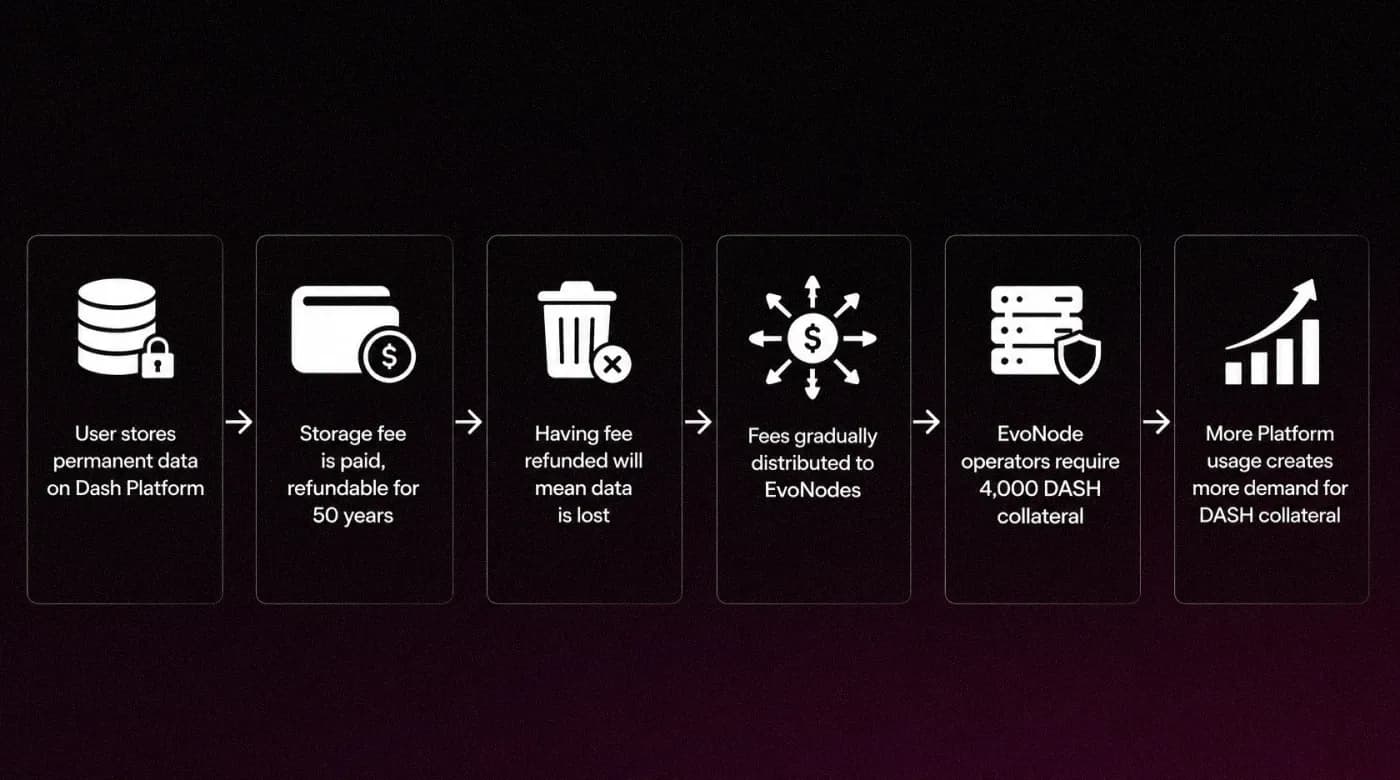
Most central to that was its EvoNodes service. These masternodes offered permanent data storage, refundable for up to 50 years. That meant that increased platform usage created a growing amount of DASH that was committed to long-term payment flows rather than immediately circulating back into the market. Growing usage for data storage purposes is their ultimate catalyst. They project the mainnet release of Yappr to be huge, a decentralized social media, blogging, and commerce platform.
Which of these affects the coin?
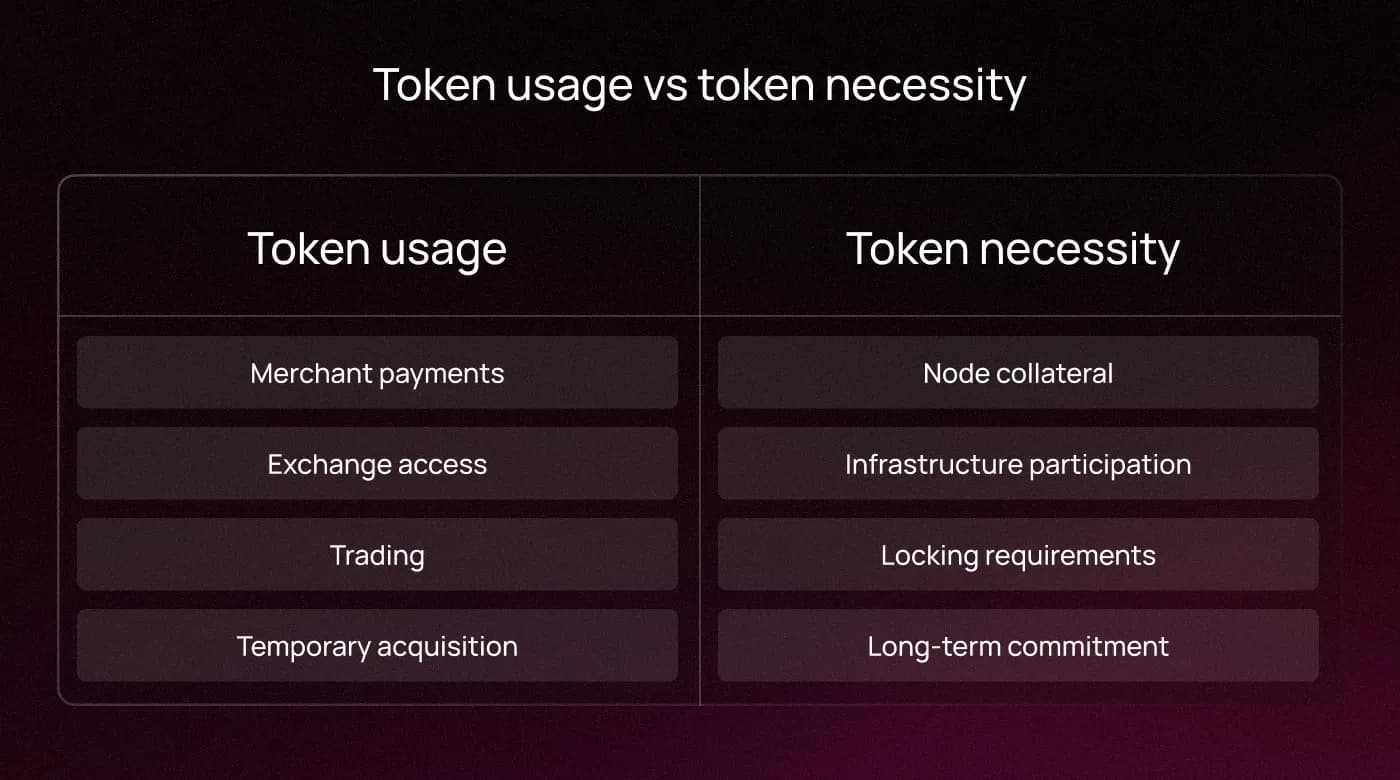
There are many great improvements that get made to blockchain ecosystems. There has to be a very specific closed loop for them to actually help generate demand, and many of them don't contribute anything relevant.
A project can add users, integrations, merchants, and visibility, but the key tokenomics question is whether these developments create a reason for the token to be acquired and held rather than being sold off. These can take the form of distribution mechanisms that expand access to the coin and economic mechanisms that directly involve the coin.
Here is what happened in DASH's case.
How DASH bolstered distribution and access
Quite simply, it became easier for users and merchants to utilize the functions in interacting with each other more often, and thus more of that started to happen. There is less friction in the system. That said, a person may be able to spend, trade, or access DASH without necessarily needing to hold significant amounts of the asset long-term.
From a tokenomics perspective, these mechanisms improve the environment, but they are not the strongest source of demand on their own.
Beyond data storage, Dash Platform introduced private assets, which expand the potential use cases built on the network by allowing developers to create additional assets and apps in the ecosystem.
Coin-linked mechanisms
Here is where DASH becomes economically necessary. Mechanisms where participation requires holding or locking DASH are the strongest demand mechanisms. In masternodes, operators have to lock DASH collateral to gain network services, thereby creating a connection between infrastructure participation and coin ownership.
Using vs needing a coin
A coin, like a token, could be integrated into a product, an ecosystem, or a protocol, but that doesn't mean it's going to generate meaningful demand. If there is any alternative way to pay for that service or to use that protocol, they will tend to do so. Even when users pay fees using a coin, stake it, vote with it, or receive it as a reward, that does not in and of itself translate into sustained buying pressure, because users may only acquire the coin temporarily and immediately sell it off.
This is an extremely common practice in the crypto world, as there are lots of traders looking to make a quick profit. This is not something a tokenomics project should want, as this can create a cascading selloff that instead ends up exerting downward pressure on a token's price.
Establishing token or coin demand
Demand doesn't happen by accident. It requires understanding how supply mechanics, utility, and user behavior interact over time. 8Blocks helps projects build token models where the asset serves a clear economic purpose rather than existing purely as a speculative instrument. Our tokenomics methodology analyzes these interconnected factors to identify risks, strengthen demand mechanisms, and align the token with the long-term goals of the ecosystem.
The storage-fee lock: collateral as demand
Dash's original masternodes required 1,000 DASH as collateral, and they supported core network functions like:
- Transaction features
- Governance
- Network services
EvoNodes, mentioned earlier, is the foremost of these. These high-performance nodes require 4,000 DASH collateral and support Dash Platform functionality. Its storage fee lockup is the strongest coin-demand mechanism that they have. As the platform activity grows, the demand for infrastructure providers becomes more closely connected to the requirement to hold DASH. The platform does not take the DASH away, but the masternode for the storage will only function as long as the coins are locked.
Price-propping mechanism
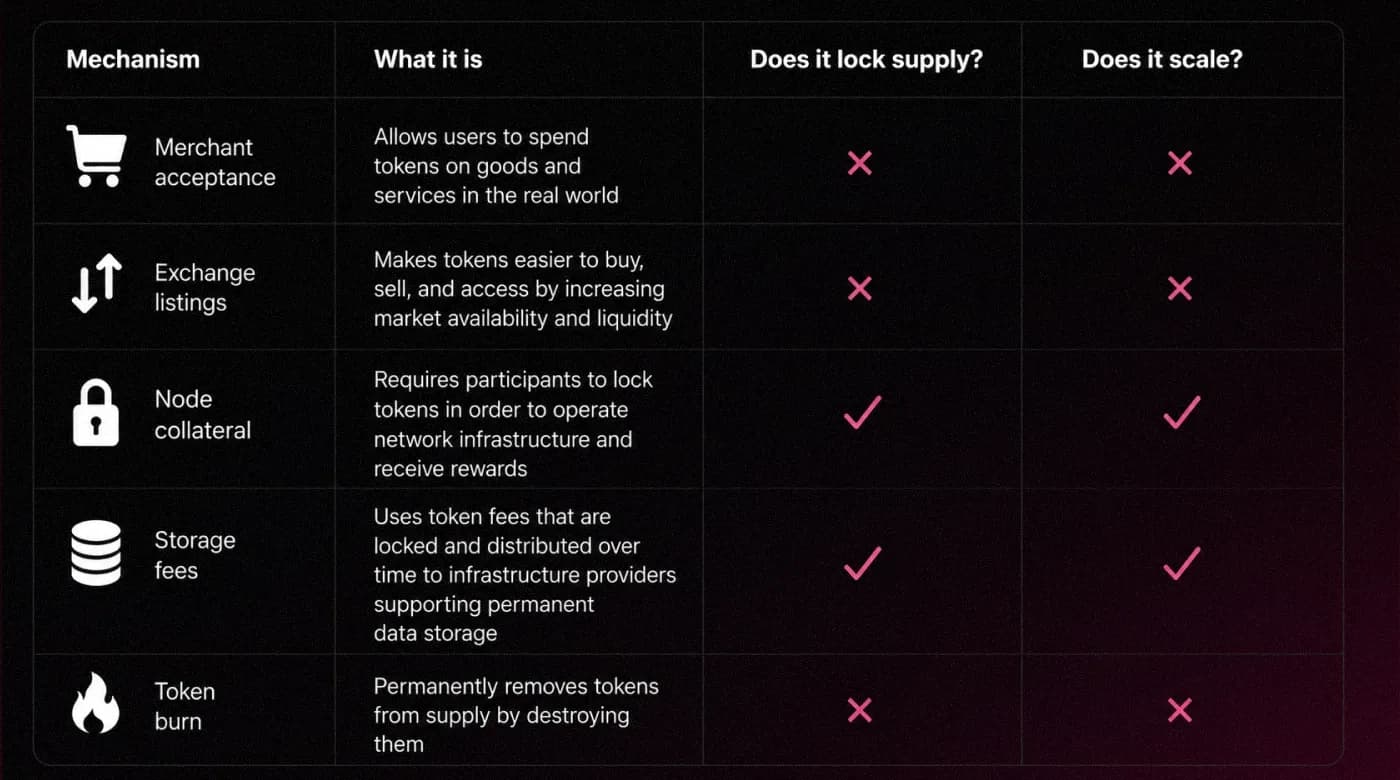
Essentially, this is a permanent payout to EvoNodes. It is a bit reminiscent for some people of a token burn mechanism. However, they are different in a crucial way. In a token burn, the token is destroyed forever. However, in this case, the DASH is not destroyed, just removed from active circulation, refundable for up to 50 years. This creates a direct connection between network usage and coin demand.
The Dash team describes the chain of effects as follows:
- Increased platform usage generated fee revenue
- EvoNode revenue thus increased
- Demand for DASH collateral required to operate EvoNodes went up as well.
Rewards
Locking thousands of DASH as collateral would make little sense if there were no economic incentive to operate the network. DASH addresses this by distributing a portion of every block reward to the operators who provide its infrastructure.
Demand matters more than supply
A lot of the time, projects fuss too much over whether they're creating too big of a supply of the token or too little. The reality is that these aspects are overrated. It's the proportions in which different participants hold the token and having a thorough plan for tokenomics that matters. What also matters more than supply is the demand.
As for supply, Dash does incorporate long-term constraints.
- Its block subsidy declines by approximately 7.14% each year: meaning fewer new DASH enter circulation over time.
- Maximum long-term supply of 18.9 million DASH: creates a predictable issuance schedule rather than one where supply expands indefinitely.
This is a big deal since it reduces the rate at which new coins are entering the market, thereby rendering DASH coins themselves scarcer.
Why this matters for UAE-based token projects
Dubai's Virtual Assets Regulatory Authority (VARA) and Abu Dhabi's ADGM both scrutinize whether a token has genuine utility and a credible demand mechanism, not just a compelling narrative. A project relying on incentives and speculation alone will struggle to satisfy that bar, while a token with a real, structural link between usage and holding — like DASH's collateral-based demand — is far easier to defend in a licensing conversation with a regional regulator or exchange.
For founders building in or targeting the UAE, DASH's model is a useful reference point: identify the mechanisms that require users to actually hold the token, not just touch it, before finalizing the tokenomics.
At the same time, this would mean nothing without high-level utility. Countless cryptocurrencies have fixed supply, but they fail to generate lasting adoption because the token itself serves little economic purpose. Sustainable value emerges when controlled supply and genuine utility reinforce one another. A scarce token with no meaningful use remains difficult to justify, while a useful token with unlimited issues can struggle to preserve value. Projects can use Token Lab, a free tokenomics calculator, to get a better understanding of these metrics.
Self-funding as a structural feature
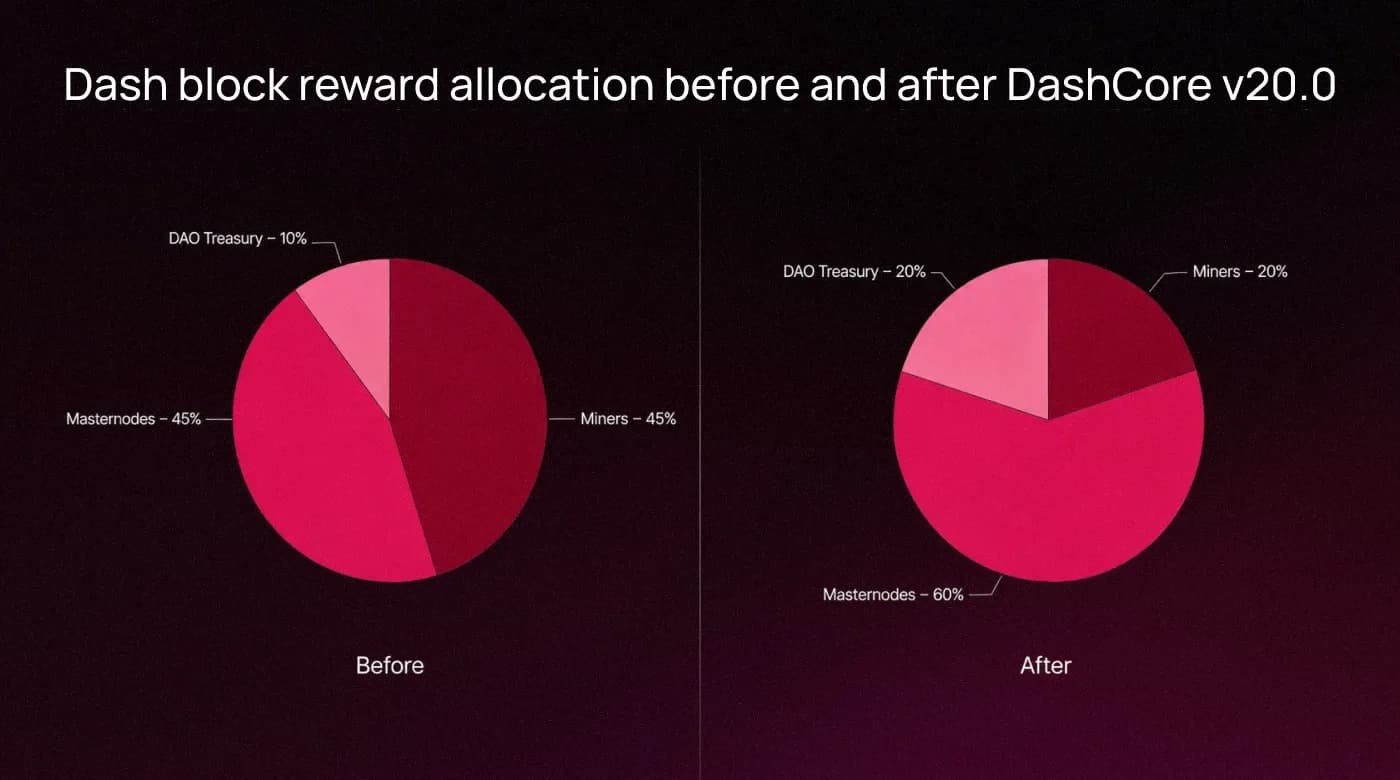
One of Dash's more distinctive features is its development is supported through an on-chain treasury, rather than relying on external investors, venture capital, or centralized funding sources. Since 2015, the Dash treasury has funded ecosystem development through a portion of block rewards, allowing participants to vote on proposals and allocate resources toward newly approved initiatives. This model was adjusted further with the DashCore v20.0 upgrade, which changed the block reward distribution.
Previously, the block reward was split as follows:
- 45% to miners
- 45% to masternodes
- 10% to the DAO treasury
Following the upgrade, the block reward was reallocated in these proportions:
- 60% to masternodes
- 20% to miners
- 20% to the DAO treasury
This reflected Dash's increasing emphasis on service infrastructure and on funding ongoing development through its treasury. Given how crucial EvoNodes is, it gets a larger allocation to the masternode network.
Governance utility
While governance alone is rarely sufficient to create coin demand, it contributes to the broader utility of holding DASH within the ecosystem.
Self-funding treasury
A large portion of block rewards is allocated to the DAO treasury now. Even though treasury funding does not itself create coin demand, it supports the continued development of the ecosystem. Furthermore, it bolsters the ecosystem's long-term health by addressing one of blockchain projects' biggest challenges — maintaining development momentum across market cycles. So even if less external capital is available, the project remains more stable.
Many crypto projects depend heavily on fundraising, revenue, and keeping their product actively used through incentives. Many of them often do not realize that their product isn't actually creating value, but instead people are just enticed by the incentives. Often, there are special points or additional coins that holders end up preferring a lot more, which replace demand for the token.
Comparison table
Key takeaways
- Utility is the foundation of sustainable demand. A token economy cannot rely indefinitely on speculation, incentives, and marketing campaigns.
- Not all adoption creates the same level of token demand. Merchant integrations, payment features, and exchange access improve distribution and reduce friction, but that doesn't mean users will hold onto a token long-term.
- Dash has continually come up with innovations facilitating infrastructure for payments, privacy, decentralized infrastructure, and data services.
- Dash's masternode and EvoNode systems create direct collateral-based demand. This links participation in network infrastructure to coin ownership. This storage-fee mechanism is one of its most significant economic features.
About 8Blocks
8Blocks is a Dubai-based token economy design firm working with Web3-native teams and Web2 businesses entering Web3, including projects launching across the UAE and the wider MENA region. Since 2017, the company has designed tokenized economic systems where the token functions as part of the business model rather than a standalone asset. 8Blocks delivers tokenomics design, strategic consulting, tokenomics audits, and launch strategy, connecting business modeling, token mechanics, and investor materials into one coherent model.
Disclaimer
This content is provided for informational and educational purposes only. It does not constitute investment, financial, legal, or tax advice, and is not a recommendation to buy, sell, or hold any token or digital asset. Token design does not guarantee any financial return, token price performance, or regulatory outcome. Crypto assets carry a high risk of loss. In the UAE, the legal classification and permitted marketing of a token depend on its specific structure and the applicable framework, such as VARA in Dubai, the ADGM, or the DFSA in the DIFC. Readers should conduct independent research and consult qualified legal and financial advisors licensed in the relevant jurisdiction.
The 5 Most Common Tokenomics Mistakes and How to Avoid Them
Very few people understand tokenomics. Even in specialized crypto forums, most of the real discussions happen between funds, market makers, and teams that have already launched a token and learned the hard way. This article is for those who are about to launch and want to avoid the usual mistakes.
Crypto Token Deflation: a Crash-and-Burn Strategy
Deflation is a common practice to bolster a crypto token’s value, which achieves the opposite effect. This short-sighted view restricts opportunities for benefits, acceleration, and problem-solving. Furthermore, tokens behave differently from money and are much less stable. Developers must pursue true utility and functionality before focusing on simpler tactics like scarcity and marketing.
Why Tokens Drop After TGE Even When Everything Goes to Plan
In this article, we'll break down why a token can start dropping right after TGE, where that price pressure comes from, and how the way you structure rounds before listing can change the outcome entirely.